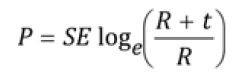
In Prime, log(x) alone stands for the decimal logarithm – unfortunately, because this does not comply with the standard and should actually be lg(x). Of course, you could also define the function yourself -> lg(x):=log(x) In other programs, log(x) often stands for the natural logarithm, which is no better, because it should be denoted by ln(x). Prime supports ln(x) but also logarithms to any base, because the log function can also be used with a second function argument, the logarithm base. So you could also write the natural logarithm as log(x,e), analogous to the general notation in your image. But why would you do that when you have the ln function ready to use?
But as an engineer in particular, you should be used to adhering strictly to standards, right?
Luc was faster to post the ISO 80000-2 standard dealing with logarithm. (actually I thought that "ld" would be defined as an alias for "lb" in the standards, but obviously that's not the case).
And if you are really used to log(x) denoting the 'common' logarithm with base 10, you will have to be very careful when using programs like MatLab and Maple as in both log(x) means the natural logarithm. 😈
Wolfram is arrogant enough to define his own “standards,” but even in Mathematica, Log[x] (note the upper case "L" and square brackets) stands for the natural logarithm.
None of these programs is adhering to the standards and I wonder why - shouldn't be that difficult.
Nor do pocket calculators adhere to the standard. Here "log" usually means the base-10-log and instead of "arcsin" etc. the key is labeled with sin-1 which is quite common use but also does not conform to the standard. Actually sin-1(x) should be interpreted as 1/sin(x), i.e., as a reciprocal value and not as an inverse function. Similar to sin² x = (sin(x))².
If so, please mark the appropriate reply as the Accepted Solution or please feel free to detail in a reply what has helped you and mark it as the Accepted Solution. It will help other members who may have the same question. Please note that industry experts also review the replies and may eventually accept one of them as solution on your behalf.
Of course, if you have more to share on your issue, please pursue the conversation.