

Mathcad Community Challenge May 2024 - Polyhedrons and Platonic Solids (Part 1)
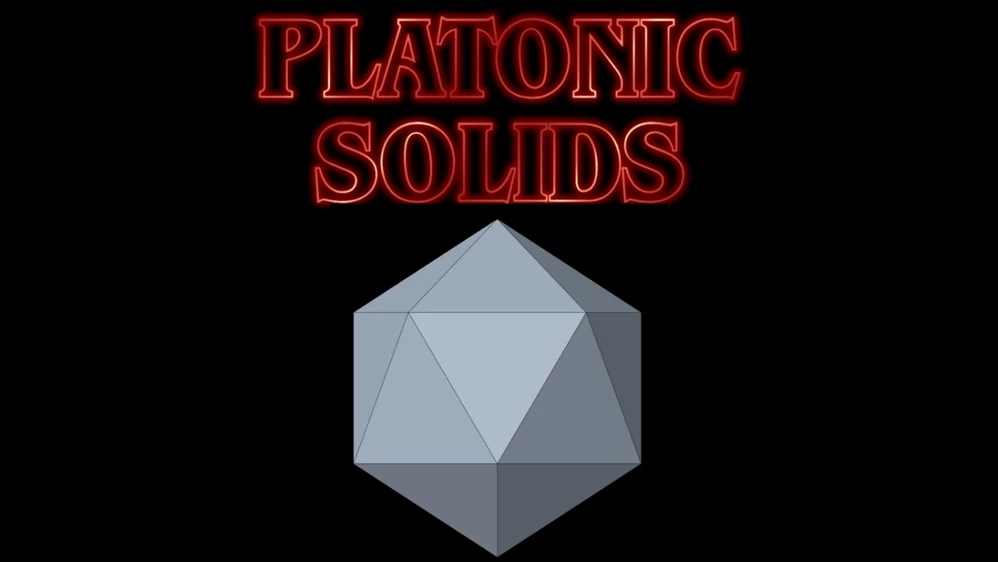
This month’s challenge is inspired by Dungeons and Dragons and Stranger Things. D&D involves spinning dice, which are regular convex polyhedrons. The most common dice used are d4 (tetrahedron), d6 (cube), d8 (octahedron), d10 (decahedron), d12 (dodecahedron), and d20 (icosahedron), where ‘d’ is for die and the number indicates the number of sides. In this challenge, we will focus on the Platonic solids, which are the regular polyhedrons made up of regular polygons (the lengths of each side and interior angles are equal). In other words, skip the 10-sided die.
Most references define regular polyhedrons as a function of the edge length of one of the polygonal faces. In this challenge, we are defining the regular polyhedrons by the radius of the circle that circumscribes a polygonal face.
Your challenge is as follows:
- Derive the surface area of the regular polyhedrons as a function of the radius of a circle that circumscribes a polygonal face.
- (Optional) Derive the formula for the volume of one or more of the regular polyhedrons as a function of the radius of the circle that circumscribes a polygonal face.
- Create a calculator where the user can select a regular polyhedron by its name or number of sides, and for a given radius of the circumscribed circle of the polygonal face, the surface area (optional: and volume) will be calculated.
- You can use a Combo Box input control for selecting the polyhedron. The ambitious can use one of the advanced input controls available in Mathcad Prime 10 (just released April 10th).
- After the user selects a polyhedron, the number of vertices, number of edges, and Euler characteristic for the polyhedron should be displayed on the worksheet. (Hint: you can’t calculate the number of vertices or edges, so you will have to store them in a Combo box, matrix, or table.)
- (Optional) Using the Chart Component, graph the surface area (optional: and volume) as a function of the number of faces. (Hint: add a 2nd Y-axis if including volume.) Assume a radius of 100.
As always, documentation is key! Someone should be able to read the worksheet and understand what problem you are trying to solve. Have fun!
Find the Mathcad Community Challenge Guidelines here!