10-Marble
July 1, 2025
Solved

Maximum Response of an Elasto-Plastic SDOF to Rectangular Load Pulses

  • July 1, 2025
  • 4 replies
  • 1198 views

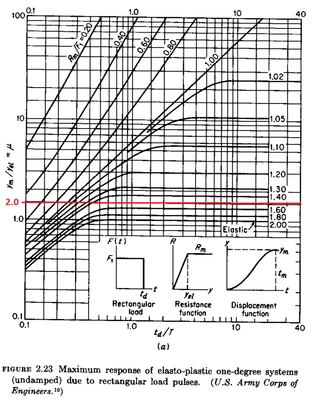
I have been working on a task in which we are to obtain the maximum response of an elasto-perfectly plastic SDOF.  The main reference is: Introduction to Structural Dynamics, by John M. Biggs, 1964. In the second chapter, they provide these tables with the maximum response of a SDOF to different types of load pulses (rectangular, triangular, etc Figs 2.23 to 2.26). See the figure for a rectangular load pulse:
CN_13593194_0-1751332410972.png

as you can see from the graph, the maximum response is represented by the ductility factor Mu, ratio of the maximum displacement to the elastic displacement of the system. Mu depends only on the ratio between the duration of the pulse (td) and the natural period (T) as well as the maximum spring force (Rm) and the maximum load (F1).

In my case, since we are conducting a sensitivity analysis, it is not very practical for us to be retrieving the results from these graphs for every analysis we do.

Therefore, I proceeded with writing my mathcad file that obtain the complete response of a SDOF system so i could obtain the maximum response analytically.

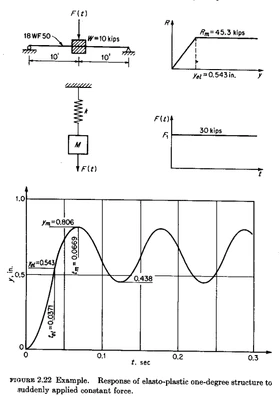
However, my problem is, in trying to compare my results with this graph, I observed that the results dont match. So I took a step back and compared the results of the graph with that of an example in the Book itself:
CN_13593194_1-1751331491202.png

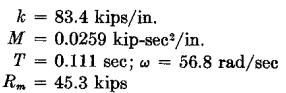
other input parameters are:

CN_13593194_2-1751331564808.png


This example is a constant force (it doesnt have a td like the graph/figure provided). I assume that for a large td/T, the results would be the same (if not, I would like to understand why).

In this case, I look at the table for the largest value of td/T and for Rm/F1 of 1.51, which should be somewhere close to 2.0 (marked in the first figure in this post).

However, the result in the book gives ym/yel as 0.806/0.543 = 1.48.

From 2 to 1.5 is a big difference, and using different values of td/T in my analytical solution of the complete response of an elasto-plastic SDOF problem under a constant pulse load, the results differ even more


My guess is that I am not using the right values either of displacement or something else when using these tables. Anyone have familiarity with this approach can explain why this difference in the results?

Best answer by BillWadsworth

Just noticed this item. This happens to be an example I used when I wrote this sheet in 2009. I have enlarged the displacement graph so, using trace, you can read off values for ym and yel which agree with the book example. 


4 replies

25-Diamond I
July 1, 2025

I definitely can't help with the interpretation of the books diagrams and comparison with your calculations as I have no experience in your field of work.

Just out of curiosity: Is this question somehow related to your unsolved thread here: Re: How to define a subroutine or an alternative... ?

netoprax10-MarbleAuthor
10-Marble
July 1, 2025

It's related yes, I forgot to accept the answer to that question, thanks for the reminder


and indeed, this forum might not be the best place to ask this question. I am just out of ideas/places to ask this question and discuss


I tried other forums but no luck yet. Apologies if the question is not suitable here.

25-Diamond I
July 1, 2025

I guess we have structural engineers here as well, so lets hope you have luck that somebody can shed light on this even though its not directly Mathcad or Prime related.

23-Emerald I
July 4, 2025

It took a while to get Express to work it's way thru the equations, then it produced a graph fairly close to your example.

Fred_Kohlhepp_0-1751601684301.png

I suspect that the difference has to do with the return, most material would show some hysteresis as you came out of plastic deformation..


Place to start--I'll keep hacking.

10-Marble
July 15, 2025

Just noticed this item. This happens to be an example I used when I wrote this sheet in 2009. I have enlarged the displacement graph so, using trace, you can read off values for ym and yel which agree with the book example. 


25-Diamond I
July 15, 2025

I still have no expertise in this field of work, but wouldn't the "max" function do a better job than using 'trace'?

Werner_E_0-1752587203570.png


But the OP seems to have lost interest anyway and we still don' know which version of Mathcad or Prime he is using.


10-Marble
July 16, 2025

Absolutely, Werner.  I suppose using the graph comes more naturally to the engineer's brain. It is easier to find the info already there in the diagram, rather than writing yet another formula, albeit a short one! 


netoprax10-MarbleAuthor
10-Marble
July 23, 2025

I was able to write a code that replicates the graph, in case anyone comes across this issue and need guidance, feel free to message me and I'll be glad to help.