
24-Ruby IV
June 26, 2020
Solved

Rouché–Capelli theorem

  • June 26, 2020
  • 2 replies
  • 4066 views

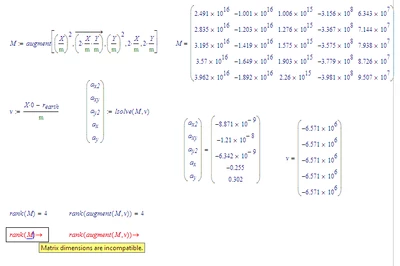
See please the attach - Prime 6.

Why in case 1 we have rank = 4

but in case 2 we have rank = 5?


Best answer by LucMeekes

The theorem syas:

"A system of linear equations with n variables has a solution if and only if the rank of its coefficient matrix A is equal to the rank of its augmented matrix [A|b].[1] If there are solutions, they form an affine subspace of


of dimension n − rank(A). In particular:

  • if n = rank(A), the solution is unique,
  • otherwise there are infinitely many solutions."

In your both your cases the rank of the matrix and the augmented matrix are the same. But in case1 that rank is 4, unequal to the number of equations, so there are infinitely many solutions.

In the second case you picked one solution,  so the rank equals the number of equations.

The discrepancy is probably caused by the larger difference in X and Y values for the second case 2. I guess in case 1 you loose precision due to the large numbers all close together.

The numeric rank function is limited by numeric precision. I get this from the symbolic processor:
LucMeekes_1-1593161029242.png

What does the symbolic processor in Prime say about the rank?


Success!
Luc

2 replies

LucMeekes23-Emerald IVAnswer
23-Emerald IV
June 26, 2020

The theorem syas:

"A system of linear equations with n variables has a solution if and only if the rank of its coefficient matrix A is equal to the rank of its augmented matrix [A|b].[1] If there are solutions, they form an affine subspace of


of dimension n − rank(A). In particular:

  • if n = rank(A), the solution is unique,
  • otherwise there are infinitely many solutions."

In your both your cases the rank of the matrix and the augmented matrix are the same. But in case1 that rank is 4, unequal to the number of equations, so there are infinitely many solutions.

In the second case you picked one solution,  so the rank equals the number of equations.

The discrepancy is probably caused by the larger difference in X and Y values for the second case 2. I guess in case 1 you loose precision due to the large numbers all close together.

The numeric rank function is limited by numeric precision. I get this from the symbolic processor:

LucMeekes_1-1593161029242.png

What does the symbolic processor in Prime say about the rank?


Success!
Luc

24-Ruby IV
June 26, 2020

Thanks, Luc!

I have forgot about symbolic solution!

rank.png


23-Emerald IV
June 26, 2020

I think this proves my guess:

LucMeekes_0-1593167118996.png


Luc

24-Ruby IV
June 27, 2020

SLAE with 5 unknowns and 7 equation - I have been waiting for an answer already half a day. Do I still have to wait? 

time.png

23-Emerald IV
June 27, 2020

I thought you know by now that Prime is slow.


Luc 

24-Ruby IV
June 27, 2020

Quickly Mathcad 15

rank-15.png