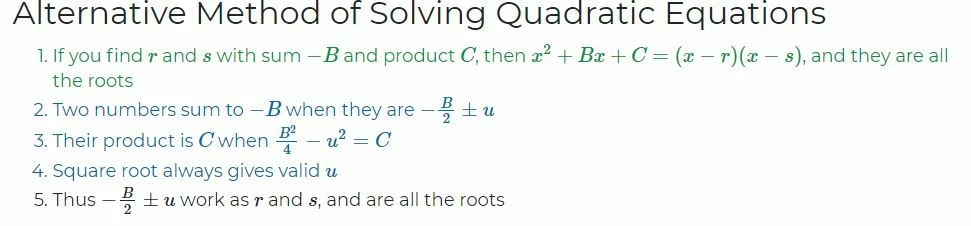
This is the famous quadratic root formula, but with A=1.
Well, duh! You didn't expect a different answer, did you? 😉
What I found noteworthy, that maybe didn't come across in my post, was the development of the solution in his paper, https://arxiv.org/abs/1910.06709, was the logic behind the derivation. (I like starting from basics and developing the solution rather than memorizing an equation. Probably because my memory is so poor.)
First off: I did not mean to be offensive in any way. Please accept my apologies if my reaction came across that way.
No, I did not expect a different answer.
Unfortunately the link you provide does not work (for me), but I was able to follow the gist of the 'derivation' by the 5 steps. I felt that the calculation to find the value of u should be explicit, rather than just hinted at in step 4. Hence my step 6; in hindsight this should be added to step 4.
Note that the method also works for Ax^2+Bx+C=0 as follows: Divide the entire quadratic by A, gives you x^2 + B'x+C'=0, with B'=B/A and C'=C/A.
Luc
Translate
Windchill Satisfaction Survey
Help shape the future of Windchill. Take our 5-minute survey and share your feedback.