

1-Visitor
April 8, 2017
Solved

Stability of Offshore Platform

  • April 8, 2017
  • 4 replies
  • 13458 views

Hello all,

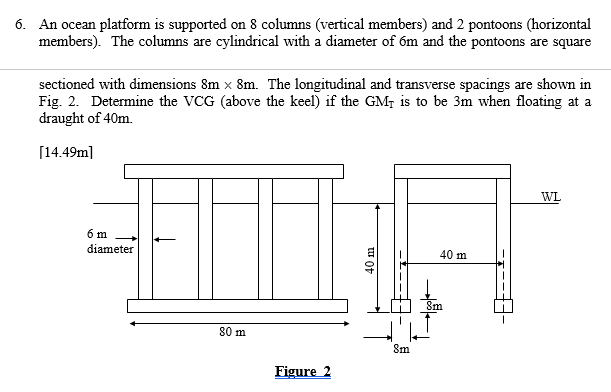
Tonight I am attempting the below problem:
Capture.PNG

The given correct answer is given as 14.49m for the centre of gravity from the keel of the platform i.e. KG=14.49m

I have so far approached this as follows:
Capture.PNG

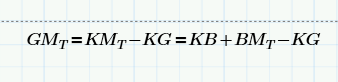
I.e. the transverse Gravity to the Metacentre is equal to the Keel to the centre of Buoyancy + Centre of Buoyancy to the transverse Metacentre - KG.

I.e. KG=KB+BMT-GMT

I have also worked on the assumption that:
Capture.PNG

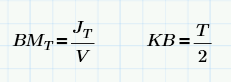
i.e. BMT is equal to the transverse second moment of the water plane divided by the underwater volume. I've also assumed that the KB is half the draft.

Further I have assumed that as the cylindrical columns are at the waterplane, the second moment of these areas will be about a circle and can be calculated as:
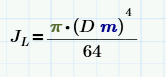
Capture.PNGi.e. Pi * diameter to the power of 4/64.

I have carried on as below.
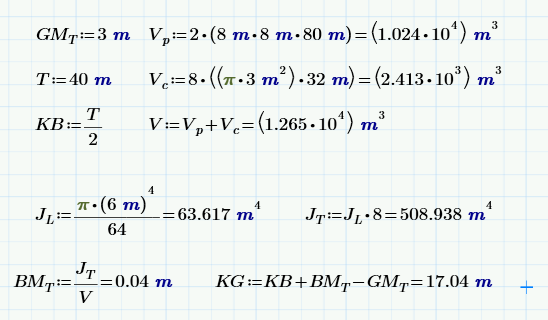
Capture.PNG

I think that I have calculated the underwater volume correctly and the second moment for one column correctly. I am not sure how to equate the total second moment for the total waterplane i.e. all 8 columns. I am sure it is not as simple as multiplying by 8 as I have done?

Further, I believe that if KB is actually T/2, then BMT would need to be a negative value which is unlikely for the metacentre to be beneath the centre of buoyancy as the metacentre is essentially the point at which the structure will rotate about when heeling either way. In fact the more I think about it the more I believe this must be impossible. So perhaps the KB value needs to be obtained another way than by assuming it is at half the draft?

Any help warmly welcomed.

Cheers,

Andy

Best answer by Fred_Kohlhepp

You need to find the metacenter.  This requires you to track the center of buoyancy as the platform tilts.

You owe me!!

4 replies

awibroe1-VisitorAuthor
1-Visitor
April 9, 2017

So Obviously I am still working through this.

So far I have managed to work a proper method of calculating KB using Morrish's formula:

Capture.PNG

This I can believe is more realistic as most of the underwater volume is at the base of the structure.

I also realised that I had an error in my units so now the area of the waterplane should be correct.

I have also looked at refining my approach to second moment of the waterplane as below but am not convinced this is correct.

Capture.PNG

So basically I am still stuck and open to help/ suggestions.

Cheers,

Andy.

1-Visitor
April 9, 2017

Can you spell out the names of all the terms? The math to solve this problem is easy, but I have no idea what most of the terms you are using mean.

What I am familiar with is that the center of gravity needs to be below the center of buoyancy in order to be generally stable and for the center of buoyancy to move in the direction of tilt to remain stable.

I have no idea what GMt is and no idea what KG is. They aren't labeled on the diagram, so it is harder to guess.

awibroe1-VisitorAuthor
1-Visitor
April 10, 2017

Hi,

The terms relate to:

KB = Distance from keel to centre of buoyancy

BMT = Centre of Buoyancy to transverse Metacentre

GMT = Centre of Gravity to transverse Metacentre

KG = Keel to Centre of Gravity

T = Draught

J = Generally used as second moment of area

V = under water volume

A = Area (of waterplane)

X = I generally use for distances

Think that is it.

24-Ruby IV
April 10, 2017

See please one article about this Subject and Mathcad:

http://twt.mpei.ac.ru/ochkov/Ship.pdf

awibroe1-VisitorAuthor
1-Visitor
April 10, 2017

It is not in English?

24-Ruby IV
April 10, 2017

Andy Wibroe написал(а):

It is not in English?

https://translate.google.com/

awibroe1-VisitorAuthor
1-Visitor
April 10, 2017

Just to add, I understand the basics of ship stability.

The math indeed should be easy by following the simple concept of KG (Centre of Gravity to Keel) being equal to (KB + BMT) - GMT.

I believe I have calculated a relatively accurate KB using Morrish's formula for KB as above.

The area I am struggling with is calculating BMT which I believe to be equal to Jt/V i.e. the transverse second moment of the waterplane divided by the underwater volume.

I believe I have calculated the underwater volume correctly, but I am struggling to calculate the transverse second moment of area for the waterplane. I believe that the transverse and longitudinal second moments for a circle are the same and I think I have calculated second moment for a single column at the waterplane i.e. a circle correctly. What I can't get my head round is calculating for all 8 columns at the waterplane. I think this is a form of parallel axis theorem, but am struggling as the areas are obviously not connected. As I say above, I looked at this by way of calculating two sets of 4 columns and calculating about the transverse centroid of the waterplane i.e. the middle of the two sets of 4 columns.

Originally I thought about calculating second moment for each set of 4 columns but the question does not give the longitudinal spacing of the columns so do not know the X value i.e. the distance between the centroid of each individual column?

A

1-Visitor
April 11, 2017

Hi Andy,

can you give me please some measurement (see attachement) ?

I found something interesting about Titanics stability here: http://titanic-model.com/articles/A_Matter_of_Stability_Trim/A%20Matter%20of%20Stability%20&%20Trim.pdf

best regards, Volker

awibroe1-VisitorAuthor
1-Visitor
April 11, 2017

‌those measurements are not given.

1-Visitor
April 11, 2017

Hi Andy,

When rotating a rod, in common we have to take into account the Steiner-moments.

For instance:

where "r" is the distance to the center of gravity of the rod.

awibroe1-VisitorAuthor
1-Visitor
April 11, 2017

‌nnot sure I understand the application of your diagram to this problem?

1-Visitor
April 11, 2017

is it a dynamic problem?

If it's a dynamic process, when the platform rotates around the longitudinal axis.

If you don't have all important measurements, how will you calculate it?