
24-Ruby IV
May 10, 2016
Question

The physical meaning of some units

  • May 10, 2016
  • 2 replies
  • 5915 views

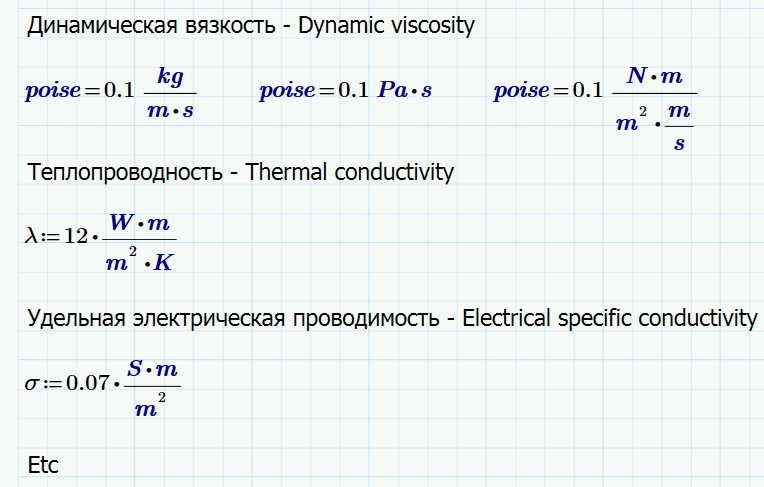
The physical meaning should be back in the unit of measurement of certain physical quantities.

The examples below. The most striking - a unit of dynamic viscosity. Do you know some others units?

2 replies

15-Moonstone
May 10, 2016
24-Ruby IV
May 10, 2016

Thanks, Denis (Денис?)

I understand that dynamic viscosity has unit poise or kg/m/s.

But I do not understand Pa*s. I see in  dynamic viscosity time but I do not see pressure!

I have wrote aboit it in the first chapter of the book Физико-математические этюды с Mathcad и Интернет - Let go to meanings in formulas and units!

17-Peridot
May 12, 2016

Hello Valery,

the definition for this comes from a simple experiment. when you have a (Newtonian) liquid between two parallel plates you can observe that some of the liquid is carried along when moving one plate. The relation of velocity and liquid "resistance" to that motion is expressed as the shearing angle. The resistance itself is measured in units of presssure (N/mm2). Although it is a force parallel to a given surface it has the same physical unit as a force perpendicular to it.

This is quite counter intuitive and I have a hard time explaining this to my collegues from the electrical department.

Raiko

P.S.

Another example might be: bending torque N*m and torsional torque, also in N*m.

23-Emerald IV
May 11, 2016

How about the unit of energy: Joule [J=N*m] and the unit of moment (of force) [N*m]?

Where the unit Newton itself is [kg*m/s^2], or maybe better [(kg*m/s)/s].

And to reverse you specific conductivity, specific resistivity is often given in units of [Ohm*mm^2/m].

Luc

24-Ruby IV
May 11, 2016

LucMeekes написал(а):

How about the unit of energy: Joule [J=N*m]