

Solved

Werner_EAnswer
25-Diamond I
April 23, 2023
"series" expands an expression into a Taylor series. If not otherwise stated at u=0, which in your case of course must fail because of the division by zero if u=0.
A Taylor series is a (most often inifinte) polynomial, a sum of powers of u (or of u-u0). The series you want to see sure is not a polynomial and so you can't expect "series" to give you that answer.
Furthermore "series" never returns an infinite sum but only finite ones (which usually means that you get just an approximation of the initial expression).
You could tell Prime to give you a Taylor series at a position different from u=0, maybe u=1

but thats not what you would like to see.
I see no way to let Prime expand the expression to that sum shown in your pic.
You could hope that a symbolic Math program may be able to do it the other way round, simplifying the series to the initial expression, but I guess that Primes symbolic is not capable enough to do so.

Wolfram Alpha e.g. is able to get rid of the sums and so succeeds in simplification, even though the result is not exactly the one you are starting with
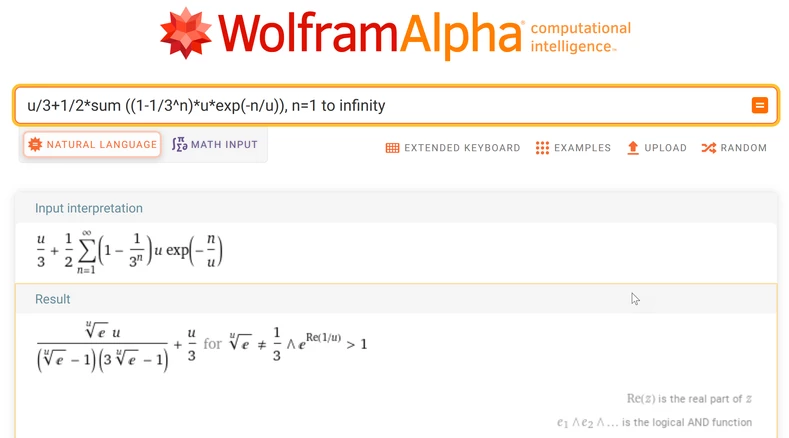
BTW, I don't think that the sum in the picture and your initial expression are equivalent for negative values of u.