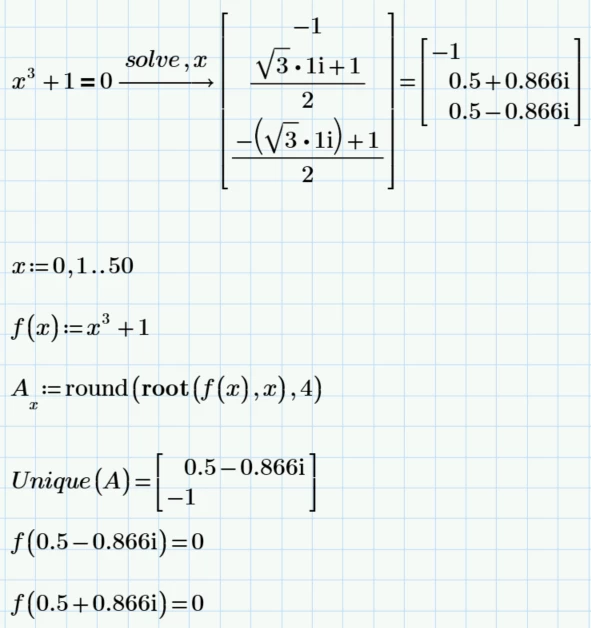
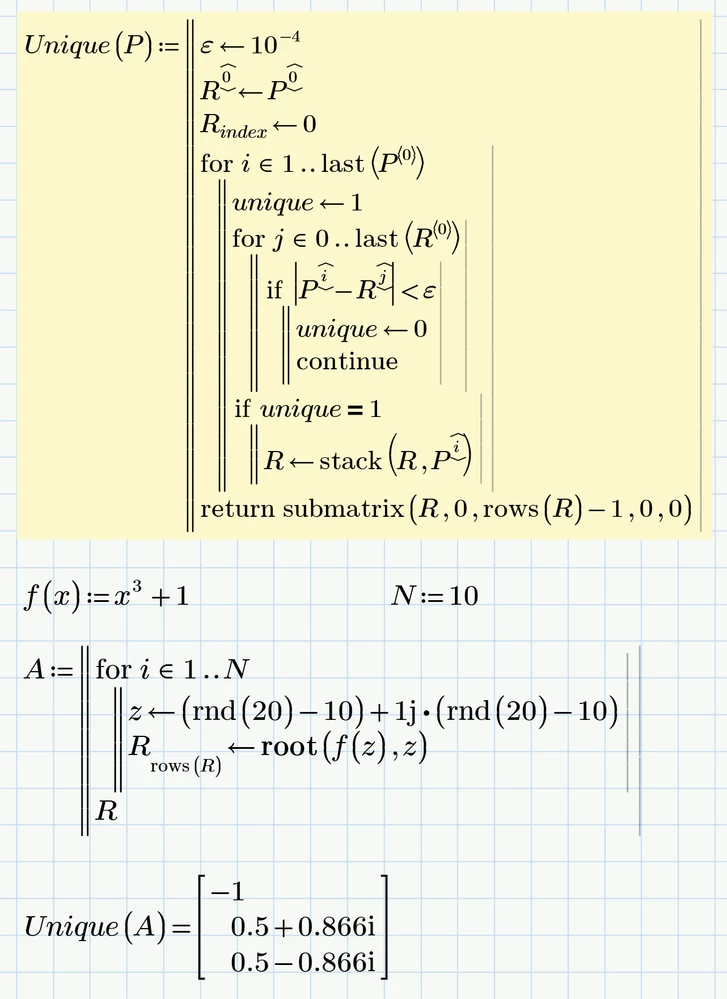
I understand. Also, I can use solve command and received all 3 solutions.
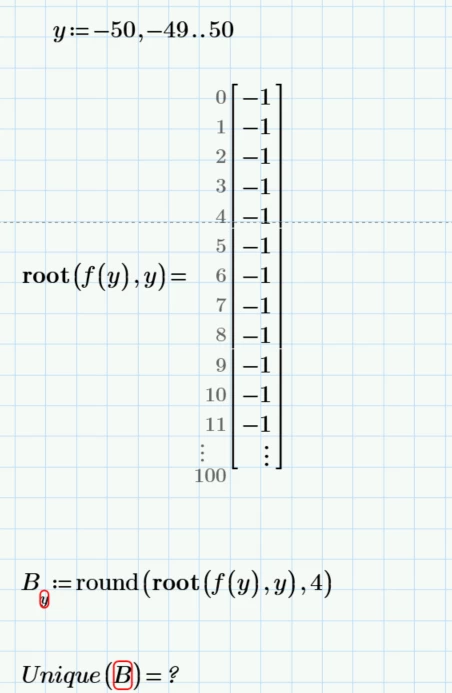
But I want to understand why in the way as I shown above (with x as a range, and with root function), this way does not find the second imaginary solution as I should be the case.
I enjoy conversations where messages cross each other—so much more fun than a strictly linear thread. 😊
You'd have to dig into the code to understand why Ridder's (or Brent's) algorithm returns one complex root and not the other. It would help if one could specify a complex range. Perhaps somebody could write a wrapper function around f(x) that allows root to stray further into the complex plane. Alternatively, somebody could write a new root function. I've got vague memories of rolling my own Levenberg–Marquardt solver to better understand what it did.
The root of a function is the value at which the function equals zero.
•polyroots(v)—Returns a vector containing the roots of the polynomial whose coefficients are inv.
•By default,polyrootsuses theLaGuerremethod which is iterative and searches for solutions in the complex plane. If you want to use theCompanion Matrixmethod instead, right-click on thepolyrootsfunction and select the method from the menu. TheCompanion Matrixmethod converts the equations into an eigenvalue problem. Learn more about choosing a solving algorithm for thepolyrootsfunctionhere.
•root(f(var1, var2, ...), var1, [a, b])—Returns the value ofvar1to make the functionfequal to zero. Ifaandbare specified,rootfindsvar1on the interval[a, b]. Otherwise,var1must be defined with a guess value beforerootis called. When a guess value is used,rootuses the secant or Mueller’s method; in the case where root bracketing is used,rootuses Ridder’s or Brent’s method.
Stuart
I have a strange feeling of deja vu, as if this subject has been discussed in the not too distant past.
Now that's interesting. When I tried that, Mathcad squawked like a parrot on a sugar high. "No, take that nasty complexity out right now! Honestly, some people. Pieces of Eight. Who's a pretty CAS. The horror, The horror ...".
The local definition I used above arose from such an attempt. However, with freshly typed expressions this time, the parrot was rather quiet.
Reducing the range over which root searched gave better (for values of "better") results.
I blame any typos, logical errors and programming mistakes on it being Oh Dark O'Clock and sleep deprivation taking its toll.