

Is there room for a new gear tooth standard?
I am posting this in the FIRST section only because I am proposing a simplification for FIRST teams to develop gears that are highly functional and super easy to define. By no means am I proposing to replace established gear manufacturing methods. I specifically propose this variation due to the advent of rapid prototyping technology where tooling and conventional manufacturing methods require no consideration.
There are few advantages to the proposed Round Tooth^tm method.
- The tooth is inherently stronger since they have no undercut requirements.
- Manual meshing of teeth is nearly foolproof.
- Common conventions can be used for defining tooth profiles.
- Parametric relations can generate any spur/ pinion/ring gear and spline pair with ease.
- Spline drives also have a great strength advantage.
- Internal tooth profiles are easily compensated.
- RoundTooth^tm can also be adapted for bevel gears.
...and I am sure I've overlooked several more.
The only downside I can see is that this there is some inherent backlash during the cycling of each tooth.
This is more prevalent with low tooth count pinions, similar to inherent undercut issues with small tooth count pinions in conventional gearing.
Another finding is that convention does not yield simple C-C distances as metric module systems does. However, with the inherent lack of accuracy in rapid prototyping systems, I have added a simple compensation factor to allow characterization of the RP tools available to the users and teams.
If a discussion of Round Tooth^tm gear development is of interest, I would be happy to continue posting findings, examples and solutions.
Considering I do not have rapid prototyping capabilities (as yet), I would really appreciate feedback from those who are will to try this system.
For your consideration...
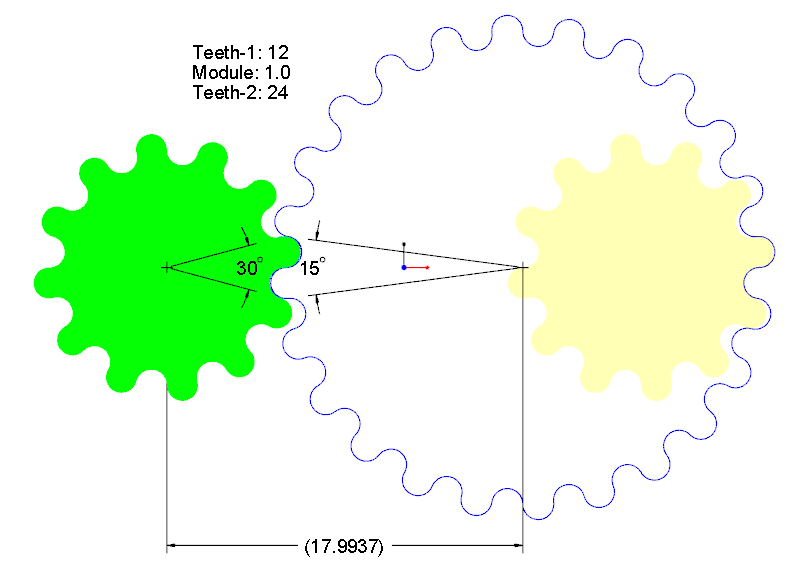
History: I am not one to simply download files and parts from the web. I need to test each system to know exactly what I am receiving. The technology for gears is well developed from a manufacturing perspective which is not easily translated back into CAD. This method has been under development for over a year. The pure simplicity to implement in CAD is just too attractive not to share.
Challenge: The engineering behind this proposal is not well developed although it could be if someone had the interest to share stress analysis and other empirical findings. The idea that this is a more robust design for use in rapid prototyping is that RP materials are inherently weaker than their molded or machined counterparts. My hope is to even the odds even if it is only marginal.
With this simplified RoundTooth^tm system, my hope is to let ideas flow more easily from your CAD development effort while providing workable solutions for your prototyping efforts.