1-Visitor
March 16, 2016
Solved

How tell Mathcad to simlify square roots?

  • March 16, 2016
  • 2 replies
  • 4623 views
I want to simplifying radicals in Mathcad. I have expression with product of radicals and want use this rule of transformation:
The product of the square roots of each factor is equal to the square root of a product
How I can do it?
For example,
  srqt(a)*srqt(b) as sqrt(ab); sqrt(a-1)*sqrt(a+1) as sqrt(a^2-1). 
Comment I have complex expression that can simplify by use last transformation, but Mathcad don't view how simplify it, how explain Mathcad use above rule?
Best answer by Werner_E

What Luc has shown was the way Mathcad 11 did it using Maple for symbolics.

In Mathcad 15 and in Prime the symbolics are done by muPad (Maple usually was far superior) and muPad handles some things differently. While Maple usually replaced roots by rational exponents, muPad uses roots in its results, too (which generally can, but must not be seen as improvement).

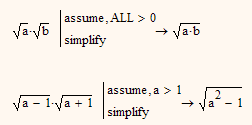
As Luc already said, the rule you mention only applies if the radicand is real and positive and thats exactly what we have to tell muPad using the "assume" command:
Nevertheless someone has to explain this:
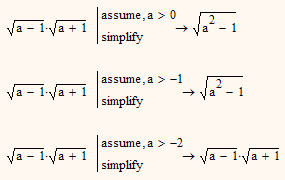
Not sure why the first two lines work, as we could have either an expression like sqrt(0.5-1) which is not defined (if we consider demain real) or we are in domain complex, where the simplification rule does not apply.

Obviously only the result is viewed where he radicand is positive as long as a is greater than or equal 1.

Mathcads symolics can be quite tricky and ever so often, especially given more complex expressions, we find no way to talk Mathcad/muPad to use the simplification we see with naked eye but mupad refuses to apply. Symbolics sure is not the strongest part of Mathcad.

Werner

EDIT: Concerning the simplification rule: One (and only one) of the roots involved can have a negative radicand and the rule still applies even in complex.

So in this example
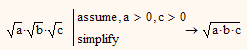
its not necessary that b is real and positive, too. Thats the reason the above examples which had confused me did worked OK.

2 replies

23-Emerald IV
March 16, 2016

Your statement:

The product of the square roots of each factor is equal to the square root of a product

is true when each factor is at or above 0.

That is one of the reasons why it is hard to force Mathcad to simplify as you want it.

Success!
Luc


is_011-VisitorAuthor
1-Visitor
March 16, 2016

Thanks! I have some progress, but substitute work only when I write original expression under root, it is not simple.

1. My decision make not readable, I have some different part this same transition in radicals . I's better to write as you:

                   "substitute, sqrt(a)*sqrt(b)=sqrt(a*b)"

2. What I can do when I don't view with naked eye this transition to  simplify expression?

Werner_E25-Diamond IAnswer
25-Diamond I
March 16, 2016

What Luc has shown was the way Mathcad 11 did it using Maple for symbolics.

In Mathcad 15 and in Prime the symbolics are done by muPad (Maple usually was far superior) and muPad handles some things differently. While Maple usually replaced roots by rational exponents, muPad uses roots in its results, too (which generally can, but must not be seen as improvement).

As Luc already said, the rule you mention only applies if the radicand is real and positive and thats exactly what we have to tell muPad using the "assume" command:

Nevertheless someone has to explain this:

Not sure why the first two lines work, as we could have either an expression like sqrt(0.5-1) which is not defined (if we consider demain real) or we are in domain complex, where the simplification rule does not apply.

Obviously only the result is viewed where he radicand is positive as long as a is greater than or equal 1.

Mathcads symolics can be quite tricky and ever so often, especially given more complex expressions, we find no way to talk Mathcad/muPad to use the simplification we see with naked eye but mupad refuses to apply. Symbolics sure is not the strongest part of Mathcad.

Werner

EDIT: Concerning the simplification rule: One (and only one) of the roots involved can have a negative radicand and the rule still applies even in complex.

So in this example

its not necessary that b is real and positive, too. Thats the reason the above examples which had confused me did worked OK.

is_011-VisitorAuthor
1-Visitor
March 16, 2016

Thanks!