
12-Amethyst
January 16, 2015
Solved

Solving an integral equation (with MathCAD)

  • January 16, 2015
  • 4 replies
  • 5633 views

Hi everyone,

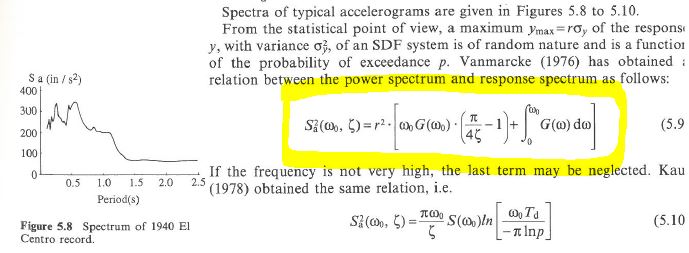
I would like to know if there is a way in MathCAD to solve such an equation:
Unbenannt.JPG

Where (unfortunately ) Sa(w,x) is known and G(w) is unknown. All other parameters can be considered known.

The equation comes from a book about Eartquake Engineeering, and gives a possible relationship between Response Spectrum and Power Spectrum, together with Fourier Spectrum (less common) they are the type of spectra commonly used in earthquake engineering.

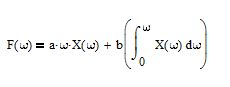
So the unknown function G (in my problem the power spectrum) would appear at the same time under integral and outside of it. Schematically it would be something like:
Unbenannt.JPG

with F(w) known (but not a simple analytical function, it would have to be a splined interpolation, see small example on the left in the first picture above) and X(w) unknown.

If, as I believe, there is no MathCAD way, I would be grateful for some hints to known numerical methods to solve the problem... my calculus lessons are a little dated

Thanks a lot in advance

Claudio

Best answer by Werner_E

Wouldn't it be possible to differentiate both sides of the equation and obtain a differential equation which Mathcad possibly could solve numerically?

4 replies

Werner_E25-Diamond IAnswer
25-Diamond I
January 16, 2015

Wouldn't it be possible to differentiate both sides of the equation and obtain a differential equation which Mathcad possibly could solve numerically?

19-Tanzanite
January 16, 2015

Differentiate with respect to w0 to obtain a differential equation in G(w0):

Integral to Differential.png

BTW, it's bad practice to use the same variable name for the variable of integration and the limits of the integral, because they are not the same variable

12-Amethyst
January 19, 2015

Well, thanks a lot to both of you, Werner and Richard. That was easy enough, I just didn't think of this. It should work, I will have to think a little about the initial conditions, but I will certainly give it a try.

19-Tanzanite
January 19, 2015

The initial condition is the lower limit of the integral, so substiute this into your equation 5.9:

Integral3.png

12-Amethyst
February 5, 2015

It took a little time because I was busy on something else.

I just wish to inform both of my helpers 🙂 that thanks to your suggestions the equation 5.9 could be solved (I used an odesolve block), and the complete solution is in good agreement with the simplified solution provided by 5.10, for my special case. I do not post the complete solution because it is very specialized to my problem, but it worked perfectly.

Just out of curiosity, what's than the matter with integral equations? I was under the impression that they are much much difficult than "normal" differential equations. Possibly I am misunderstanding the real meaning of "integral equation".

Anyway thanks a lot. This forum is one where I always get immediate and competent answers, which is not always the case on the internet 🙂

Have a nice day

Best regards

Claudio

Unbenannt.JPG

25-Diamond I
February 5, 2015

Glad you found your solution. I guess the trickiest part was finding the initial condition.

Just out of curiosity, what's than the matter with integral equations? I was under the impression that they are much much difficult than "normal" differential equations. Possibly I am misunderstanding the real meaning of "integral equation".

Integral equations sure are much more difficult to deal with compared to differential equation. But there are very simple differential equations which can simply be solved by a single integration and so we also have easier integral equations which can be turned into a DE by differentiation.

The lucky part in your equation is that the variable (omega0) does not appear in the intgeral but as the upper integral limit.