1-Visitor
February 10, 2013
Solved

Symbolic Derivative Problem

  • February 10, 2013
  • 1 reply
  • 4072 views

Hello,

Please see the attached worksheet.

I need the actual derivative of vf(lambda,alpha) function. MathCad says it is too long to be shown.

Is there any way to overcome this issue?

Thank you so much.

Anousheh

Best answer by Werner_E

Anousheh Rouzbehani schrieb:

Hello,

Please see the attached worksheet.

I need the actual derivative of vf(lambda,alpha) function. MathCad says it is too long to be shown.

Where? I couldn't find that problem in you worksheet. Obviously I'm missing the point. Always better to post a stripped down worksheets which just shows the error or, as in your case, the undesired behaviour.

As you have defined Alpha at the top I assume you are interested in the derivative wrt lamda. I move the range variable for lamda down a bit.
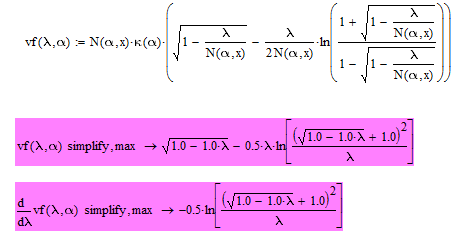
cohesive2.png

One way to look at an expression which Mathcad 15 says being to long is to convert the worksheet in Prime format and load it in Prime 2, if you have the possibility to do so. Prime would let you scroll - no, unfortunately not, but you are allowed to enlarge the expression region to the right.

1 reply

Werner_E25-Diamond IAnswer
25-Diamond I
February 10, 2013

Anousheh Rouzbehani schrieb:

Hello,

Please see the attached worksheet.

I need the actual derivative of vf(lambda,alpha) function. MathCad says it is too long to be shown.

Where? I couldn't find that problem in you worksheet. Obviously I'm missing the point. Always better to post a stripped down worksheets which just shows the error or, as in your case, the undesired behaviour.

As you have defined Alpha at the top I assume you are interested in the derivative wrt lamda. I move the range variable for lamda down a bit.

cohesive2.png

One way to look at an expression which Mathcad 15 says being to long is to convert the worksheet in Prime format and load it in Prime 2, if you have the possibility to do so. Prime would let you scroll - no, unfortunately not, but you are allowed to enlarge the expression region to the right.

12-Amethyst
February 10, 2013

Werner,

I was working on this at the same time. I was able to get the derivative when alpha = .5 as was assumed in the worksheet, but the evaluation doesn't complete in a long time when other values for alpha are used. The same happens with your suggestion for the modifiers. When alpa is treated as a variable without a value, then the long result occurs.

Anousheh showed plots with other values of alpha, so I assume there will be an interest in a more general result. Any ideas?

Harvey

25-Diamond I
February 10, 2013

So, if I am not mistaking, the derivative I can see on the worksheet is for one specific value of alpha, i.e. 0.5

correct?

Yes, we are speaking of the first (only slightly altered) sheet I posted. Its all for the value assigned at the top of the sheet.

Then, to produce the curves, I can input other values for alpha, right?

At the top, yes. I think the way you did it in the graphs is wrong (I made the same mistake in the second (simplified) worksheet I posted. There is no failure as long as you let x=10, but you get wrong results if you decide to change x. If you do not intend to do so, I wonder why you use y(x) and not simply 1.

Your function vf() depends upon y(x), y is derived from a solve block which is using the fixed value of alpha assigned at the top of the sheet. y(x) is used in ß(), which is used in N1(), which is used in N() which is used in vf(). You didn't make it easy for us, didn't you? 🙂

So no matter what the second parameter of nf() is, y(x) will be the value which could (if x is not 10) be dependable of alpha. To overcome this you would have to turn the solve block in a function.

See attached sheet. In developing it it came to my mind that you cannot use numerically derived "functions" (like your y(x)) in symbolics - at least they do not evaluate.