24-Ruby IV
April 15, 2013
Solved

One Rocket

  • April 15, 2013
  • 3 replies
  • 5640 views

I can not solve this task in Prime (with units) Help me please!

In Mathcad 15 - no problem (see the attach). We can add air resistance, g=f(h) etc

PSrocket2.png
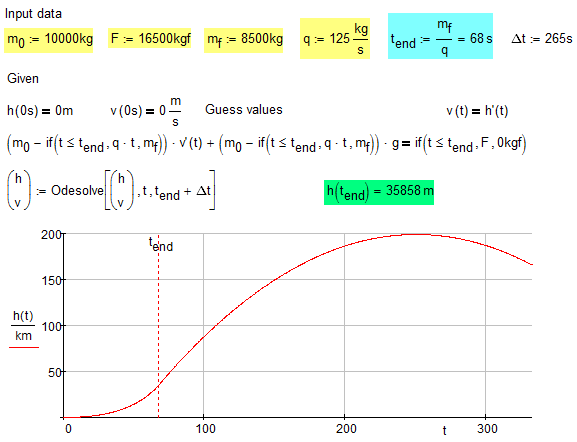
One North Korean rocket

rocket1.png

Best answer by ValeryOchkov

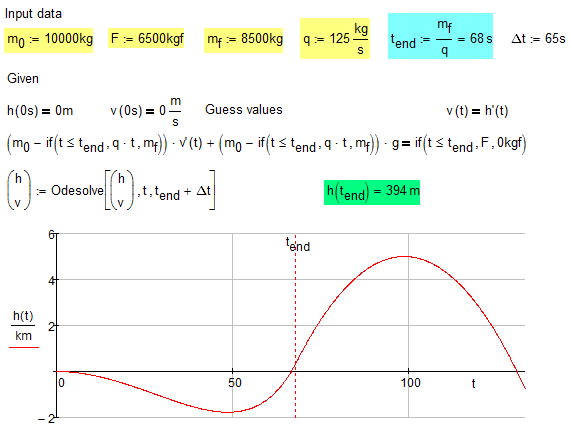
This is similar to the use of alcohol - first bad, then good, then bad again:

http://communities.ptc.com/servlet/JiveServlet/downloadImage/2-202255-48605/450-338/rocket1.png

3 replies

19-Tanzanite
April 15, 2013

It seems starightforward enough in Prime 2 - see attached. Perhaps I'm missing something?

Alan

24-Ruby IV
April 15, 2013

Thanks, Alan!

I have done it too by help the Mathcad 15 Mathcad Prime convertor.

But I cannot do it direct.

Questions (2 old and 2 new) on the picture:

rocket3.png

19-Tanzanite
April 15, 2013

Valery Ochkov wrote:

Thanks, Alan!

I have done it too by help the Mathcad 15 Mathcad Prime convertor.

But I cannot do it direct.

I didn't use the converter (I still only use M15 F000, so the converter doesn't work), I did it direct without any problems. In answer to your red questions: I also get the mess of words on the side of the solve block; and the blue h of the h(t) in odesolve; and the messy looking marker label. By increasing the number of -plotting points it is easy enough to get rid of the velocity glitch near tend:

rocket2.PNG

Alan

ValeryOchkov24-Ruby IVAuthorAnswer
24-Ruby IV
April 15, 2013

This is similar to the use of alcohol - first bad, then good, then bad again:

http://communities.ptc.com/servlet/JiveServlet/downloadImage/2-202255-48605/450-338/rocket1.png

19-Tanzanite
April 15, 2013

I'm somewhat lost as to where you are going with this Valery! Does this mean you are now able to program this problem succesfully in Prime (something you didn't manage earlier)?

Alan

24-Ruby IV
April 15, 2013

AlanStevens wrote:

I'm somewhat lost as to where you are going with this Valery!

I also

But one interesting problem...

For animation and for this group

http://communities.ptc.com/groups/dynamic-models-in-mathcad

too...

24-Ruby IV
April 16, 2013

One North Korean rocket

rocket1.png

The first part of the rocket flight - is a virtual flight (h=0). The rocket is on the start platform and burns fuel (m.f) as long as its weight (m*g) becomes (10 9 8 7 6 5 4 3 2 1 Zero) equal its engine thrust (F)

rocket.png

19-Tanzanite
April 16, 2013

Valery Ochkov wrote:

O

The first part of the rocket flight - is a virtual flight (h=0). The rocket is on the start platform and burns fuel (m.f) as long as its weight (m*g) becomes (10 9 8 7 6 5 4 3 2 1 Zero) equal its engine thrust (F)

I don't think the calculation shows this. At the end of the calculated "virtual" flight there is a significant upward velocity! If the rocket stayed on the platform just burning fuel it would have a zero upward velocity at the point of take-off.

Alan

24-Ruby IV
April 16, 2013

Yes - no limit to improve calculation

Add h=g(h) and air resistance - with cloud functions!

http://twt.mpei.ac.ru/ochkov/T-2012/rocket.png