
1-Visitor
July 3, 2013
Solved

rate constants determination: from ODEs solving v.s. numerical integration

  • July 3, 2013
  • 3 replies
  • 2935 views

Again in the book "chemical kinetics with maple and mathcad", chapter 4 introduces different ways for rate constants determination.

Take figure 4.8 as an example (corresponding attached file is "Fig_4_08_PineneIsomerization_InvTask_MC14" ), numerical integration method is used searching rate constants:
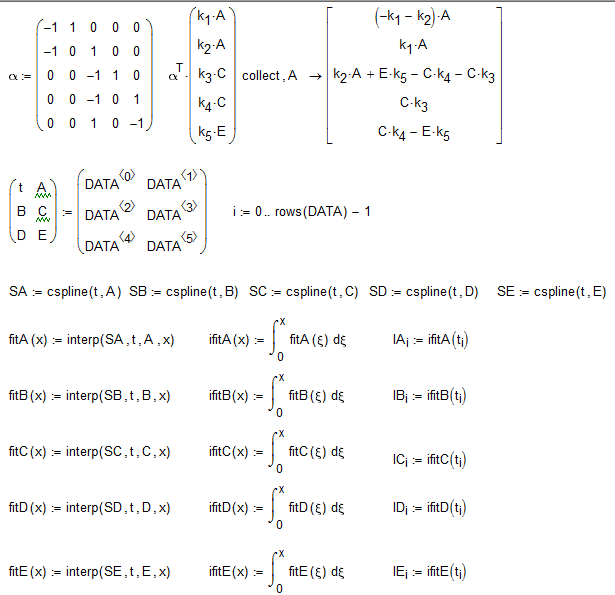
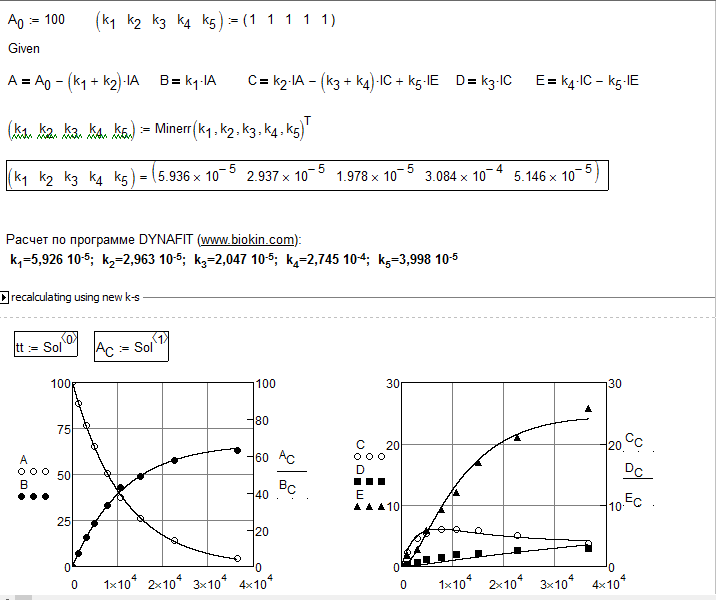
integ+method+1.PNG

integ+method+2.PNG

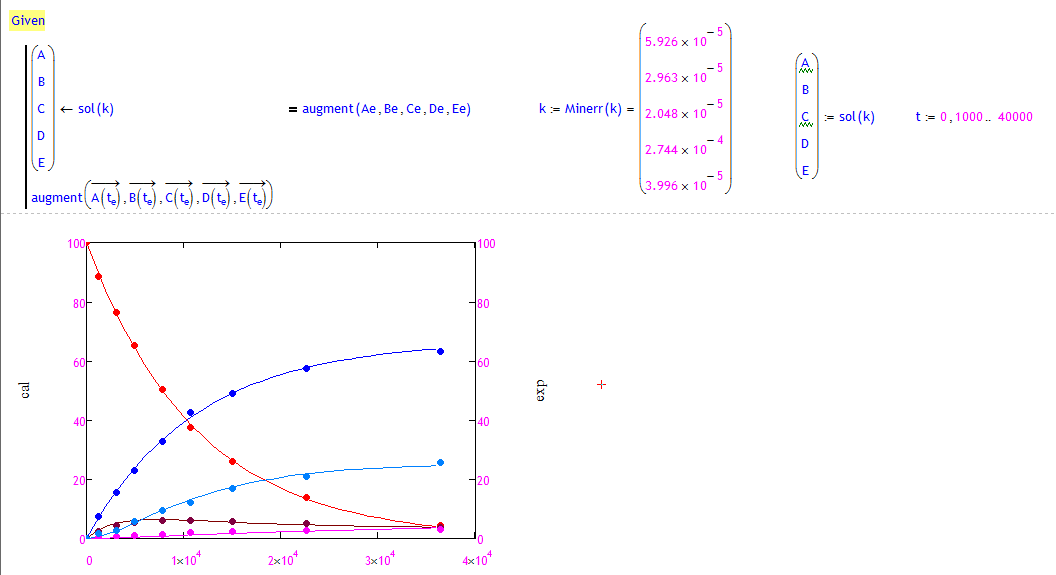
but i think that solving ODEs is more direct and general than integration method, so I solve the problem with ODEsolve method:
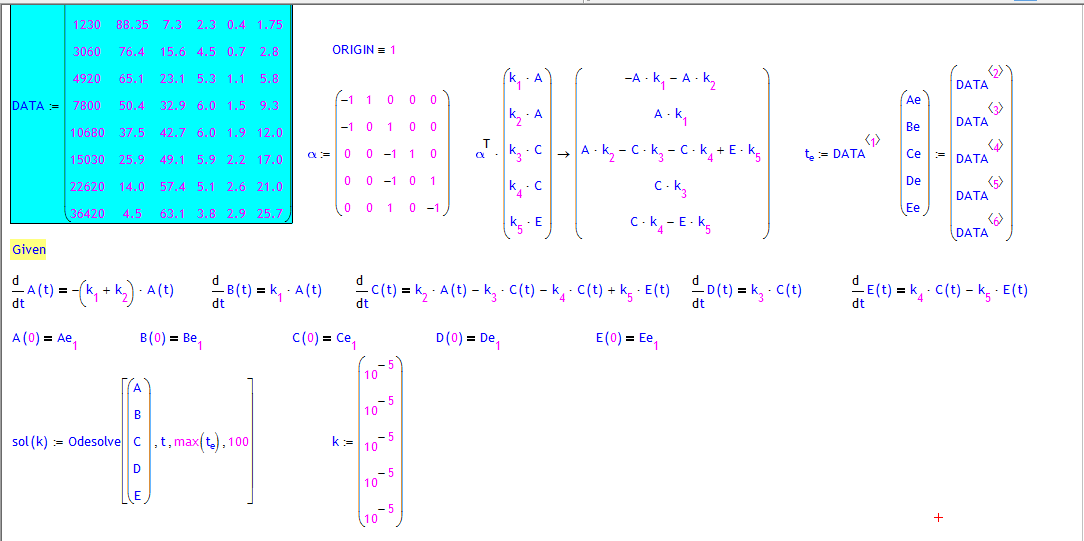
diff+method+1.PNG

diff+method+2.PNG

Both methods looks good enough, but differential method results are closer to that of DYANFIT than for integral method.

But differential method seems much more initial-condition sensitive than integral method, e.g. if guess values of k1--k4 are all set to 1, the calculation will be very time-consuming. and I dont know how to improve this situation.

Does anybody give any suggestions on "lowering/ reducing" the initial - condition sensitivity of differential method?

Best answer by AlanStevens

Try basing your initial guesses on the information available to you from the basic data and, where possible, the form of the equations. See attached.

Alan

Improved file attached

3 replies

12-Amethyst
July 3, 2013

For parameter estimation, all parameters should be scaled to the same order of magnitude and then you try guesses for two orders of magnitude surrounding the expected values.

19-Tanzanite
July 3, 2013

Try basing your initial guesses on the information available to you from the basic data and, where possible, the form of the equations. See attached.

Alan

Improved file attached

FanCG1-VisitorAuthor
1-Visitor
July 4, 2013

Thanks. Alan

your method is very interesting, time-saving and skillful than mine. I appreciate very much. Now I got three ways of solving the problem, lol.

by the way, I think your answer is more educational than practical, coz the reaction orders are all integers, and this is not very often in engineering practice.

thanks a lot again for your very detailed answer to my question

24-Ruby IV
July 3, 2013

Thanks to all for the interesting to the book http://twt.mpei.ac.ru/TTHB/New-Chem-Kin/En-Ru-book.html

Now we try to solve book's problems in Prime with units - mole, L, sec etc.

This discussion is very usefull for the second edition of the book.