
6-Contributor
Nov 11, 2026 3:47 PM UTC
Question

Creo X: a user's concept to let engineers focus on engineering

Note: I'm currently working independently, so my account isn't linked to a maintenance contract and I can't access the Ideas boards. I'm sharing these ideas here in agreement with the Community team, who will forward them to Product Management.

THE PROBLEM
I've been a Creo user since 2018 and I believe it has one of the most rigorous parametric foundations in the industry. But in many companies I've seen engineers spend days managing files, revisions and release procedures instead of designing. And for styling surfaces, the common advice is still "use another CAD".
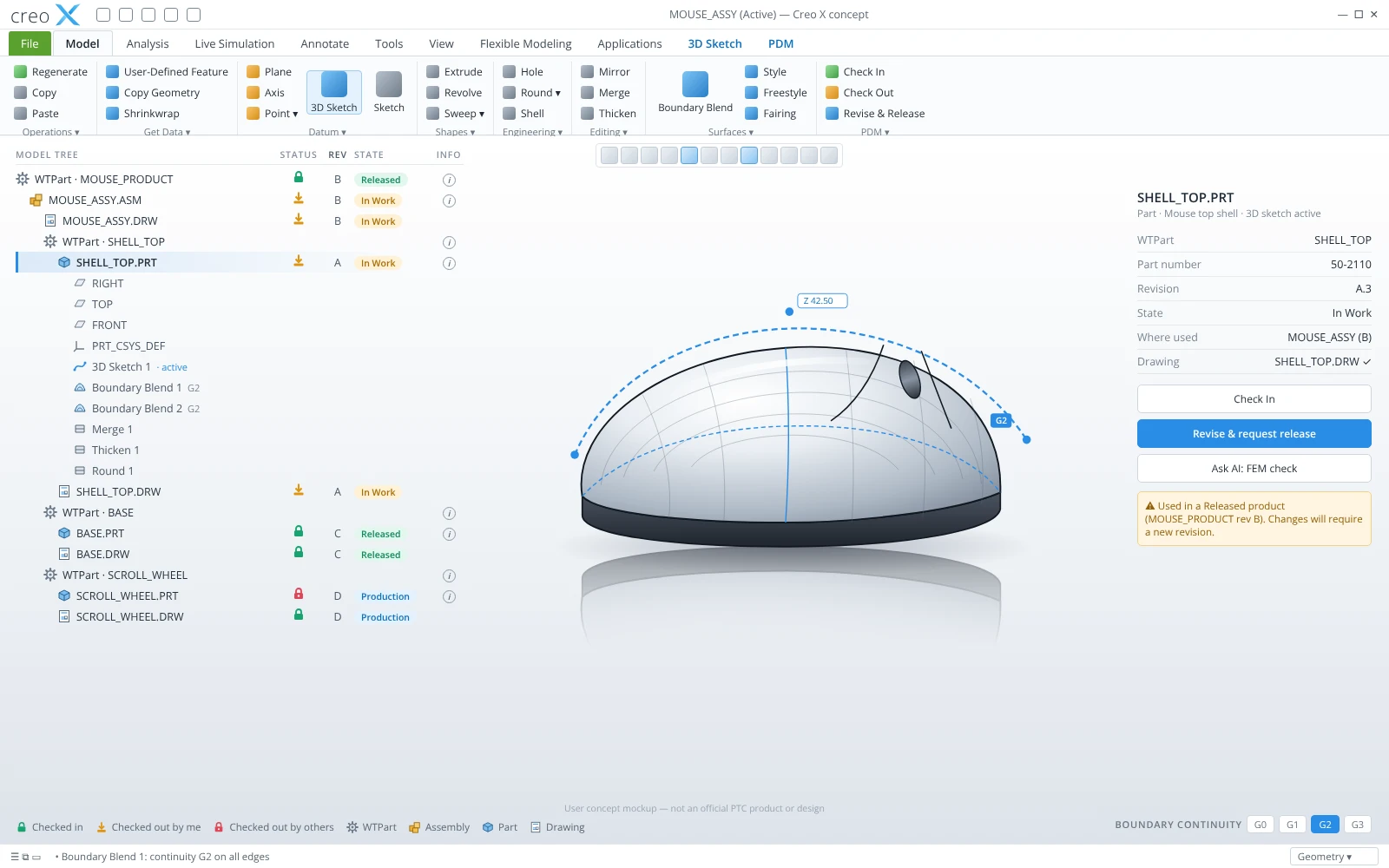
"Creo X" is my concept of how Creo could solve this. The attached image shows the main ideas.
1. INTEGRATED PDM MODEL TREE
The whole product structure in the model tree: WTParts as containers, each part with its own drawing, the feature tree of the open part, and a status icon to check in / check out directly from Creo, plus revision, lifecycle state and an info panel. One guided action ("Revise & request release") instead of 10-15 steps across Creo and Windchill, with automatic warnings when a part is used in a released product.

2. FLUID STYLING INSIDE CREO
Building on my 3D Sketch and surface fairing ideas (linked below), I propose:

parametric freeform (Freestyle cages driven by sketches and dimensions), continuity markers G0-G3 on every surface edge, and a realistic view with sharp edges by default.

3. PLATFORM AND HARDWARE
Native support for ARM processors (Apple Silicon, Windows on ARM, new ARM workstations) and more use of GPU and multi-core, while keeping a strong local/offline option for companies that can't move projects covered by patents and NDAs to the cloud.

4. OFFICIAL AI INTERFACE
An official PTC AI interface (for example an MCP server for AI assistants) to run FEM/CFD checks on request and generate a first skeleton or reference surfaces from hand sketches, which the designer then refines with precise features.

Let engineers engineer.
Comments and opinions from other users are very welcome!

3 replies

6-Contributor
Nov 11, 2026 3:53 PM UTC

Full detailed version of the Creo X proposal:

WHY I'M WRITING THIS
I've been a Creo user since 2018, starting my career as an engine designer. I chose Creo because I believe it's one of the most rigorous parametric CAD systems ever built: Pro/ENGINEER introduced feature-based parametric modeling in 1987, and its model tree and sketcher logic are still a benchmark for the whole industry.

But today I see three problems:
- In job postings for automotive, motorcycle, aerospace and marine engineering, Creo is rarely mentioned. For styling surfaces, the common advice is always "use CATIA, NX or Alias".
- Engineers spend days managing files, revisions and release procedures instead of designing.
- The hardware world is moving fast (ARM processors, powerful GPUs, AI), and Creo risks being seen as "legacy software".

None of this is about the core engine: Creo's foundation is excellent. It's about what surrounds it. Here is a proposal organized in three pillars.

==================================================
PILLAR 1 — DESIGN FREEDOM
Creo should be the place where any object can be designed, from an engine head to a car body, a lamp or a sculpture, with parametric rigor.
==================================================

1.1 Interactive Parametric 3D Sketch (in standard part mode)
Today, controlled 3D curves require datum points from coordinate tables, projections, intersections, or ISDX, which is a separate paid extension just to create a 3D curve. I propose a 3D Sketch that works like the normal Sketcher, but in space: on-the-fly plane switching, weak/strong dimensions in space, snapping to all existing geometry, G0-G3 end conditions, live curvature and zebra analysis. This is a long-standing request: the official idea "3D sketch in part mode" already exists, and other users have discussed with Product Management the possibility of reusing ISDX technology in part mode for this.
Detailed proposal (together with 1.3):

1.2 Fluid, parametric freeform ("parametric SubD")
Freestyle and ISDX exist, but they are perceived as hard to control. I propose Freestyle cages that can snap to sketches and datum geometry and be driven by dimensions, and Boundary Blend networks with simple continuity markers (G0/G1/G2/G3) on every edge. This would open Creo to product, furniture, lighting, interior, toy and art designers, who today choose Blender, Plasticity or Rhino.

1.3 "Virtual Clear Coat" surface fairing
Automatic fairing that improves continuity up to G3/G4 within a user-defined maximum deviation, like a coating thickness, with zebra and deviation maps before/after. Similar tools exist in dedicated Class-A software: having it inside Creo, integrated with the parametric model, would be a strong differentiator.

1.4 A modern visual experience by default
Enhanced Realism already exists. Make it the default: real-time shadows and reflections with sharp edges on top (like RealView), "white room" / "dark studio" gradient environments, and a modern UI with a floating, semi-transparent model tree. First impressions decide which software students and young engineers choose.

==================================================
PILLAR 2 — ZERO-FRICTION DATA MANAGEMENT
Engineers should design, not manage files.
==================================================

2.1 Integrated PDM Model Tree
Product structure, linked drawings, part number, revision, lifecycle state (In Work / Released / Production) and check-in/check-out status visible and manageable directly in the Creo model tree: WTParts shown as containers with their part and drawing, clear icons for assemblies, parts, weldments and drawings, a check-in/check-out status icon and an editable info panel (part number easy to copy from there). In many companies, users even create mapkeys just to copy a part number: that alone says a lot.

2.2 One guided action instead of 10-15 steps
Today, revising and releasing a single component can require 10-15 steps across Creo and Windchill: finding the WTPart, creating a new revision, editing notes from the workspace, creating a promotion request, attaching every affected object while manually checking revision numbers, filling reason and phase fields, notifying production by e-mail, then starting a separate release procedure. Adding a family table instance means copying a similar drawing and replacing the model by hand.
Proposal: right-click a part > "Revise and request release". Creo collects all affected objects automatically, checks revision numbering, shows one guided panel and runs the approval workflow in the background. Part numbers are generated automatically by item type. New family table instances get their drawing automatically from the most similar instance.

2.3 A recommended standard out of the box
Today every company invents its own structure and rules, and engineers must relearn data management with every new job. A ready-to-use best-practice structure, customizable only when needed, would make engineers productive from day one in any company using Creo.

2.4 Promote what already exists: Model-Based Definition
MBD (GD&T directly on the 3D model) is available, but many companies still re-create everything in 2D drawings. Better promotion, templates and training would save time and showcase a real competitive advantage.

==================================================
PILLAR 3 — PLATFORM, HARDWARE AND AI
Creo should run where engineers work, and use the hardware they have.
==================================================

3.1 Beyond x86: ARM and Apple Silicon
Creo runs on Windows x86. But the market is moving: Apple Silicon Macs, Windows on ARM laptops, ARM-based workstations from NVIDIA, and in the future RISC-V. Many engineers and designers today simply can't use Creo on their main computer.
Onshape already runs everywhere, but many professionals need a desktop CAD with Creo's depth.
The challenge is not rewriting the Granite kernel from scratch: the code can be recompiled for new architectures. The real challenge is validating that every result stays identical across decades of models and huge assemblies. This is exactly where AI-assisted porting and large-scale automated regression testing could make a difference.
A possible path:
- Step 1: officially test and support Creo on Windows on ARM through x64 emulation.
- Step 2: native Windows on ARM build, validated with automated regression testing.
- Step 3: native macOS.
The first major parametric CAD to run natively and officially on ARM could attract a whole new generation of users.

3.2 Local, secure, offline
Cloud and SaaS (Creo+) are useful, but many companies will never move projects covered by patents and NDAs online. A strong local/offline offering must remain a priority.

3.3 More use of GPU and multi-core
Creo Simulation Live already uses NVIDIA GPUs very effectively. Feature regeneration is sequential in every parametric CAD, but graphics, large assemblies, analysis and rendering can use modern hardware much more. Users with powerful workstation or gaming PCs would see Creo as modern, not legacy.

3.4 An official AI interface
PTC has introduced a Creo AI Assistant, and community projects already connect Creo to AI assistants through MCP. An official PTC AI interface could:
- run and explain FEM/CFD checks on request;
- generate a first skeleton, reference surfaces or a "pre-model tree" from hand sketches and images, which the designer then refines with precise features;
- automate the repetitive data management steps of Pillar 2.
The designer stays in control; the repetitive work disappears.

3.5 Parametric interoperability
STEP AP242 and Unite technology already help. Exchanging the parametric history between CAD systems is still unsolved. Leading this effort would let designers choose their tool, and many would choose Creo.

==================================================
WHERE TO INVEST: A SUGGESTED PRIORITY
==================================================
HIGH IMPACT: 3D Sketch in part mode / Parametric freeform / Integrated PDM Model Tree / ARM roadmap
QUICK WINS: Visual experience by default / PDM status in the tree / MBD promotion / GPU and multi-core
STRATEGIC BETS: Official AI interface / Parametric interoperability / Virtual Clear Coat fairing

Recent releases have added important capabilities in generative design, composites, CAM and cloud services. My suggestion is to balance the roadmap toward these gaps: they decide which CAD companies choose for automotive, aerospace and design, which CAD the next generation of engineers learns first, and how much of an engineer's day is spent on engineering.

Let engineers engineer.

Translate
StephenW
23-Emerald III
Nov 11, 2026 4:25 PM UTC

Generally broad improvement requests are not reviewed or only get a cursory look by PTC project managers. This specific request crosses multiple product managers making it virtually impossible to categorize.  It has been a long-standing policy within the ideas board to ask that these sort of request be broken down in to separate ideas.  You can continue writing novels if you want, it is your time and if it makes you feel good, there is value in that.  I’m not trying to discourage you, but sometimes, ideas will get attention from PTC product managers, but only if they are clear and concise and not broad and rambling.

Translate
6-Contributor
Nov 11, 2026 4:32 PM UTC

Thank you Stephen, that's fair feedback and I appreciate it.

This post is meant as an overview: the Community team is helping me route the different parts to the relevant Product Managers. When I'm able to post on the Ideas board, I'll split them into separate, short and concise ideas, as you suggest.

I wrote all this simply because I want Creo to win the CAD race: with AI changing the way we design so quickly, I believe now is the right time to address these gaps.

Translate