1-Visitor
February 21, 2019
Solved

creo simulation ; how can i set constarint in nonlinear analysis

  • February 21, 2019
  • 3 replies
  • 3203 views

it very simple


 i want to know stress of twisted part on 1dgree.


could you let me konw how set "prescribed rotation" in constraint


thanks. 

Best answer by gfraulini

Hi,
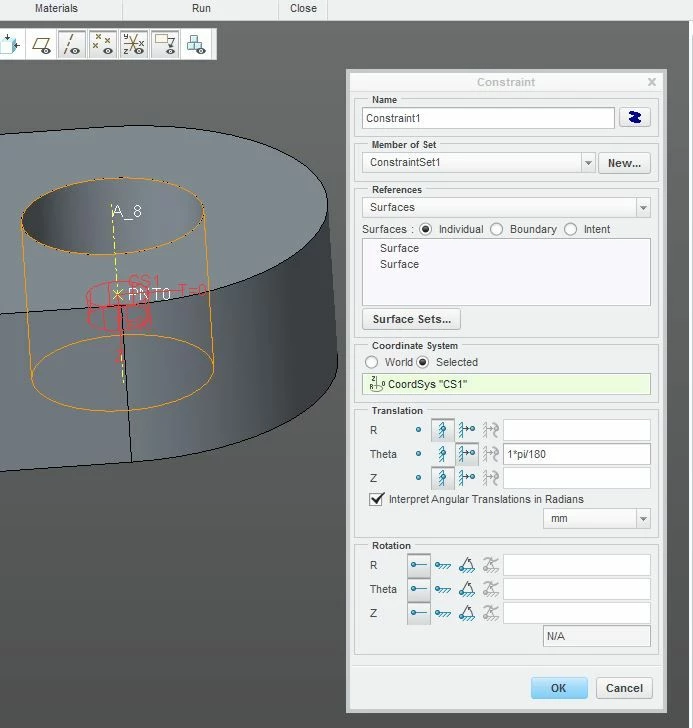
you have to set a cylindrical coordinate system and refer the translation to its theta.
Remember to flag the interpretation like radians.

Nuova immagine.jpg

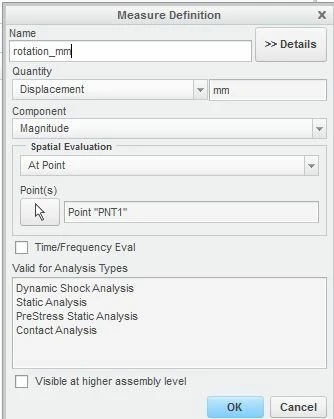
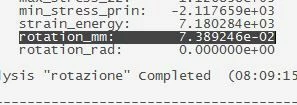
You can check out the result by making a displacement measure; it's being in mm, so it's measuring the arc of displacement.
You can't measure directly the angle; the measure "rotation" serves for beams or shels nodes that have also rotation degrees. The solid one doesen't have rotation degrees.

Nuova immagine (1).jpgNuova immagine (2).jpg

This thing can be make both in linear and non-linear analyses.
Bye

3 replies

gfraulini17-PeridotAnswer
17-Peridot
February 21, 2019

Hi,
you have to set a cylindrical coordinate system and refer the translation to its theta.
Remember to flag the interpretation like radians.

Nuova immagine.jpg

You can check out the result by making a displacement measure; it's being in mm, so it's measuring the arc of displacement.
You can't measure directly the angle; the measure "rotation" serves for beams or shels nodes that have also rotation degrees. The solid one doesen't have rotation degrees.

Nuova immagine (1).jpgNuova immagine (2).jpg

This thing can be make both in linear and non-linear analyses.
Bye

17-Peridot
February 22, 2019

Cylindrical coordinate system - watch this limitation for twist situation.  


Interpret Angular Translations in Radians  - Beware that this cannot be used for Large Displacement.

1-Visitor
February 22, 2019
Hi,
What about to constraint displacement of one end of the part and apply weighted/rigid link between the other end and a point, say on the axis of rotation, and then apply a prescribed rotational constraint to the point with respect to the appropriate direction.
skunks
19-Tanzanite
February 24, 2019

I like the rigid link,

example att.

17-Peridot
February 25, 2019

yes, and if you need accurate stresses at either the constraint end or the rigid end then you need to model the fixture or component that does the constraining/loading.  Skunks model assumes rigid glue to a rigid apparatus.