
12-Amethyst
April 4, 2023
Solved

Dynamic Mechanism Analys - decrease the dynamic effects

  • April 4, 2023
  • 3 replies
  • 2344 views

Hello.

I'm running a similar analysis, and currently, I'm facing problems to decrease the dynamic effects.

@ptc-4639841, about this Dynamic Analysis that you've mentioned, have you compared the values with the Static condition?


In my model, if I run a Dynamic Analysis, the pin "X" of my 4-bar system will get ~18000 N, but if I use Force Balance, this same pin (in the same equipment position) results in only ~14800 N.

I have run the analysis with 0,1 mm/s using relative tolerance of 1E-5, and friction is turned off.

The accelerations at the fastest point of my mechanism are small. 

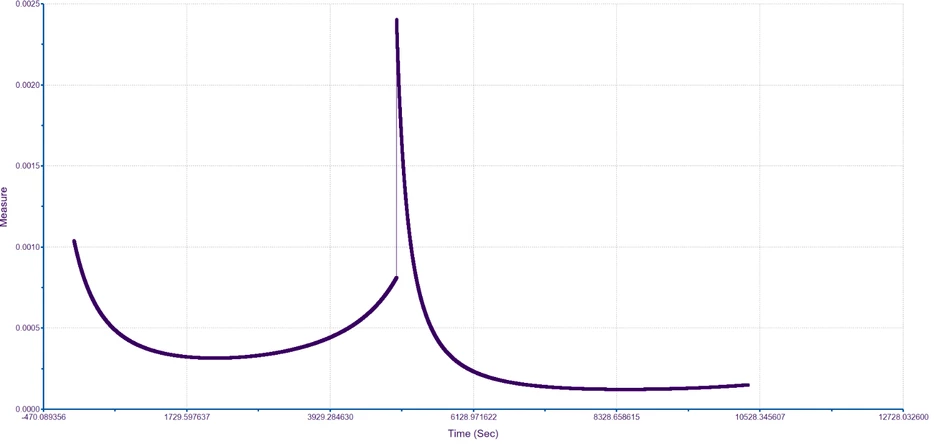
Magnitude and mm/s². The peak in the graph occurs when one cylinder stops and the second starts. At the position mentioned before, the graph gives me 0,00075 mm/s².
VR_9713318_0-1680605839628.png

Sadly, I don't have the BMX license to try James' solution using Multi Objective.


Do you have any idea why, even with these small velocity and accelerations, the difference between dynamic and static is so big?


Thanks!


----

This post was originally posted as a reply on this topic.

Best answer by achirila

The accepted solution on this post can be found here.

3 replies

8-Gravel
April 4, 2023

It has been a while, I don't think I was ever able to get the dynamic analysis to work the way I wanted and had to use Multi Objective, which did work quite well. 


Do you have a simplified model you'd want to share? 

12-Amethyst
April 4, 2023

Got it. It really does not look easy and reliable to use dynamics for this.

Sadly, I can't share the model. 

I'll keep running some tests in the future, but for now, I'll use the Force Balance and a lot of position servos to get the variations... It's safer do it like this.

I hope PTC can make some improvements in the future, to provide a straightforward way to vary the positions inside MDO.

I'll keep you posted. Thanks!

16-Pearl
April 4, 2023

How large are your masses? Most often, I find users miss assigning a material property (density) to one, or a handful, of the components in the system...yes, even the ground part, as you may have this take-on motion at some point as well. Just a thought, but is most often this is the reason you would see these differences.


Good Luck

12-Amethyst
April 4, 2023

Hello, Chris.

We are talking about ~750 kg of product and 150 kg of load.

All the masses and loads are correctly assigned, and used for both, Dynamic and Force Balance Analysis.

We are refining the analysis with another model, just to check if this behavior is replicated. We may have something else interfering.

Let's see.

17-Peridot
April 5, 2023

My 2 cents... I would want to understand why there is that discontinuity/jump at the peak. It could be some impact event like a joint at its end of travel. Force balance of course would not include the impact. Make sure there are no result changes if you reduce all the mass values to say 1/100 of original Double check all units. Check that friction is truly off. Try with friction very low rather than off. There will be a similar discontinuity with a change in the sign/direction of friction. You probably don't have dampers but they create force by velocity. I have seen issues with very low coefficients of restitution.(below 0.1) The statement about one thing stopping and another starting is hard for me to conceptualize as a 4-bar system.

achirila5-Regular MemberAnswer
5-Regular Member
April 10, 2023

The accepted solution on this post can be found here.