5-Regular Member
February 5, 2026
Solved

Mesh problem in assembly

  • February 5, 2026
  • 2 replies
  • 277 views
I am using Creo Parametric Release 12.4 and Datecode12.4.2.0

Meshing problem. I have 2 assembles. Each are messing fine. But when I combine them it fails.

Here are the errors that I faced
Could not complete creating elements on all the seleted entities.
    Best answer by SweetPeasHub

    I think the main issue was a corrupt top level assembly on the simulate side. Even making "New Simulate Model" on all parts and top level did not fix this.

    I made a new top level assembly.

    Don't ignore red text showing in model tree.
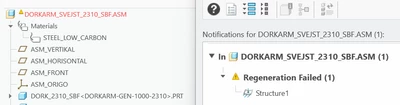
    SweetPeasHub_2-1770654896616.png


    I also fixed errors with using the old format for Materials (assigned from "STEEL LOW CARBON" in CREO included library.

    And there were some problems in the generics where thin solid properties were getting suppressed.

    When I made a new assembly, and meshed with default = free the entire assembly was all thin solids.

    When I made default = bonded, every bond interface was changed to regular solid elements but it still meshed as shown.

    I have a config settings that helps with thin solid meshing. I should have set to 3mm but it worked.

    sim_agem_model_thickness = 1.0


    Finally, the welds in the model are only necessary for shell element models where the collapse to midplane requires extending the surfaces to touch.

    I actually would have preferred to model the entire assembly as shell pairs rather than solids and thin solids. In that case end welding is likely needed.

    Not only is meshing more robust for shell models but the results should be faster and usually more accurate. Of course you may need solids to enable non-linear analysis.
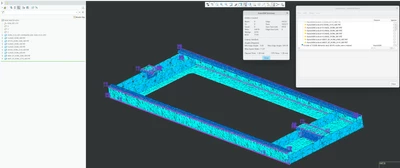



    SweetPeasHub_0-1770654573083.png


    2 replies

    16-Pearl
    February 5, 2026

    Only in case you provide geometry community will be able to help you.

    Shots to the air. Check connection interface between models if there are any tangent edges/sufraces, check model tolerances. 
    If creo doesn't show any error try changing geometry tolerance settings use absolute/relative and play with that untill creo shows you at least some edges.

    ilyachaban_0-1770304797962.png


    5-Regular Member
    February 9, 2026
    17-Peridot
    February 9, 2026

    I think the main issue was a corrupt top level assembly on the simulate side. Even making "New Simulate Model" on all parts and top level did not fix this.

    I made a new top level assembly.

    Don't ignore red text showing in model tree.

    SweetPeasHub_2-1770654896616.png


    I also fixed errors with using the old format for Materials (assigned from "STEEL LOW CARBON" in CREO included library.

    And there were some problems in the generics where thin solid properties were getting suppressed.

    When I made a new assembly, and meshed with default = free the entire assembly was all thin solids.

    When I made default = bonded, every bond interface was changed to regular solid elements but it still meshed as shown.

    I have a config settings that helps with thin solid meshing. I should have set to 3mm but it worked.

    sim_agem_model_thickness = 1.0


    Finally, the welds in the model are only necessary for shell element models where the collapse to midplane requires extending the surfaces to touch.

    I actually would have preferred to model the entire assembly as shell pairs rather than solids and thin solids. In that case end welding is likely needed.

    Not only is meshing more robust for shell models but the results should be faster and usually more accurate. Of course you may need solids to enable non-linear analysis.


    SweetPeasHub_0-1770654573083.png


    17-Peridot
    February 5, 2026

    This is pretty vague. This problem is not unusual that combining fails meshing when individually works.

    Here are some tips, but for sure I do not have time to explain in full details, because there are many.

    -->It is usually related to geometry quality and mesh quality and settings.

    There should be more feedback in the diagnosis when meshing than just this error.

    Check tools - geometry checks to see if bad geometry

    Check for geometry interferences and remove them.

    Make sure model accuracy is absolute and consistent for all components.

    Make mesh global tolerance setting absolute instead of relative.

    Gradually assemble component by component to find the trouble component.

    Make sure global simulation settings like default interface are not different between sessions that work and don't work.

    If some geometry is imported and not native Creo those are first to check.

    Check for short edges, sliver surfaces and fix them.

    last resort - simplify geometry... start with removing most of the small rounds to make sharp corners. (unless in critical area)


    Conventional meshing = loose approximation to supplied geometry = more forgiving mesh step and results more dependent on meshing.

    Creo Simulate meshing = tight capture of supplied geometry = more difficult when geometry has bad conditions. but results less dependent on meshing.


    21-Topaz I
    February 5, 2026

    @SweetPeasHub 's suggestions are great. I would add: Manually creating the FEM from scratch rather than allowing the FEM to be created as part of the study sometimes fixes the issue. Its an easy thing to try. It it meshes outside of the study you can save it and then run the study.