
1-Visitor
Apr 24, 2013 6:32 AM UTC
Solved

A calculation of steam fluid flow pressure loss

Attached is a steam flow pressure loss calculation.

I broke it down into three file. Please make sure your mathcad has internet access because

Thermodynamic Properties of steam flow is based on IAPWS-97 mathcad server . I really appreciate the authors effort

You probably has to rework the file reference in the "steam head loss PartIII " to point to the other file

the reference of viscousity calculation can be found in the mathcad file

The fanning friction factor is simply a find(f) of the colebrook-white equation thanks to the power of mathcad, dont we all love that?.

I would like the community effort to check the validity of the calculation (I only check a few result and it seems to be matching table/graph value of steam pressure loss)

You can go to "steam head loss Part III" to change the pressure, temperature and piping data. Feedbacks are most welcomed!

The file only works in (and hopefully it works):

0<T<800C, P<100MPa and 800<T<2000C, P<50MPa because that's the range of IAPWS-97

Thanks

BTW, I am struggling with my career and if anyone is interested in hearing me whining please send me a private message.
24-Ruby IV
Apr 24, 2013 12:56 PM UTC

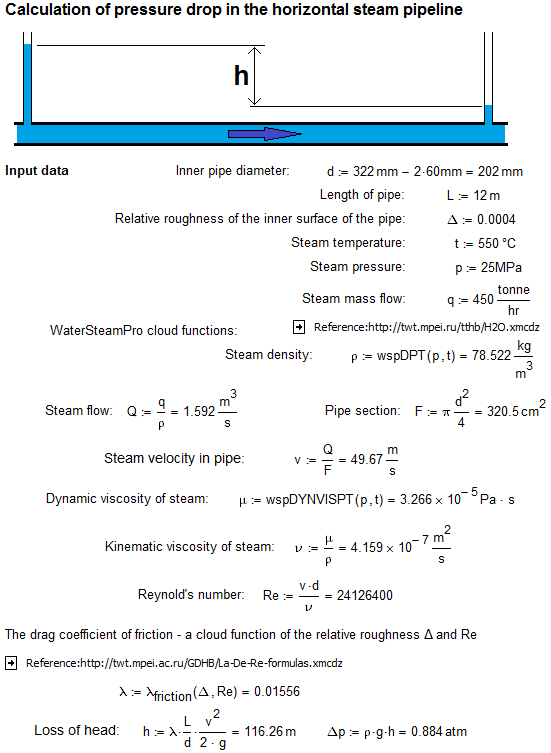
See please my calculation:

Loss-h-steam-eng.png

15 replies

24-Ruby IV
Apr 24, 2013 6:44 AM UTC

See here please http://www.iapws.org/relguide/viscosity.htm

Matcad on-line calcularion

Translate
24-Ruby IV
Apr 24, 2013 7:40 AM UTC

Special for You I add the wspDYNVISPT function in my WaterSteamPro cloud function set:

Visc.png

Translate
24-Ruby IV
Apr 24, 2013 12:56 PM UTC

See please my calculation:

Loss-h-steam-eng.png

Translate
24-Ruby IV
Apr 26, 2013 1:18 PM UTC

Solution with templates of Mathcad Prime 3.0. See the discription in attach.

loss-p.png

Translate
24-Ruby IV
Apr 26, 2013 6:36 PM UTC

There is a lot of formulas for this function...

But what is it delta!? How can we messure it!?

Template-Lambda.png

Translate
1-Visitor
Apr 26, 2013 11:35 PM UTC

Actually I do not know ! There are tabulated value of absolute roughness of different piping material of NEW pipe...as the pipe ages/corrode/get deposite etc. ...then of course its roughness changes

I think you can do experiment to re-measure the roughness. But since we can only measure pressure drop as far as I know....it is like collecting pressure drop data and fitting a "rougness" parameter for what ever function you use to model pressure drop.

But maybe there are special way to actually measure "roughness"? Hope some industry professional can address your question. Besides, how much attention does the industry pay to the absolute roughness of aging pipe? Or they just pay attention to the pressure drop since this is the ultimate properties that impact $$$$$$?

Translate
24-Ruby IV
Apr 27, 2013 4:57 PM UTC

Nikuradze spoons:

Nikuradze-s-spoons.png

Translate