23-Emerald I
Jan 16, 2021 1:29 PM UTC
Solved

A water flow problem

Okay, here's the challenge:  measure the flow rate of a stream. 

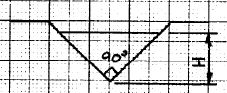
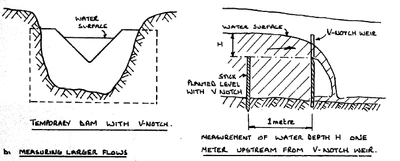
  • Build a weir with a V-notch as shown below,
  • measure the water depth as shown.

What is the flow rate (liters/min) for a given height H?  A derivation and formula, please!
Fred_Kohlhepp_0-1610803649388.png

Fred_Kohlhepp_1-1610803694180.png


19-Tanzanite
Jan 18, 2021 3:36 PM UTC

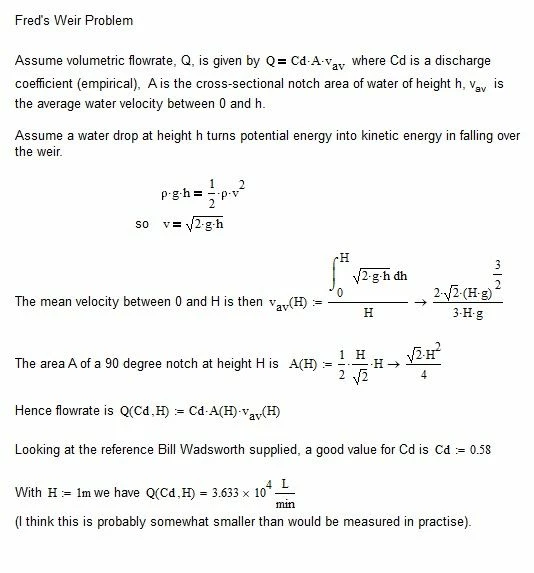
Here's my contribution

FredsWeir.jpg

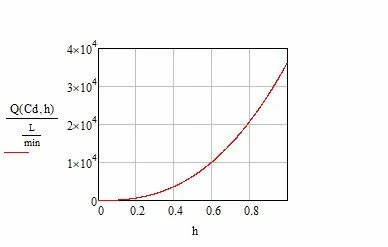
Thought I should add a graph:

FredsWeir2.jpg

Alan

6 replies

24-Ruby IV
Jan 17, 2021 10:47 AM UTC

I know very good handbook on this field of science. But in Russin.

Translate
10-Marble
Jan 18, 2021 10:30 AM UTC

Have a look at Ken Edward's stuff at LMNOeng.com  He seems to have solved this problem quite well.

Translate
19-Tanzanite
Jan 18, 2021 3:36 PM UTC

Here's my contribution

FredsWeir.jpg

Thought I should add a graph:

FredsWeir2.jpg

Alan

Translate
23-Emerald I
Jan 19, 2021 1:50 PM UTC

This is an interesting illustration of engineering adapting physics.


Both Alan's solution (kudos, BTW) and the one attached below properly derive the physics of the problem from basic concepts: the gravity head creates a flow over the weir, and that times the area gives the flow rate.  But when the actual flow rate was measured it fell significantly short of what was calculated. 


The old engineers, well used to having theory only approximate reality (because of the assumptions made to achieve a solution) merely created a "coefficient," to adjust theory to reality.  It would be interesting to see what ANSYS would do with this problem.

Translate
19-Tanzanite
Jan 19, 2021 2:10 PM UTC

"The old engineers, well used to having theory only approximate reality (because of the assumptions made to achieve a solution) merely created a "coefficient," to adjust theory to reality.  "


Engineers regularly do this, of course.  They have discharge coefficients, friction factors, loss coefficients etc.  The nuclear reactor physicists I knew would never stoop to such common or garden terms.  When their theoretical rod positions didn’t quite match the measured ones, they modified their theory by an eigenvalue bias (a rose by any other name…!)


Alan

Translate