14-Alexandrite
August 21, 2025
Solved

Another (simple) problem with SOLVEBLOCK

  • August 21, 2025
  • 3 replies
  • 2333 views

Hi

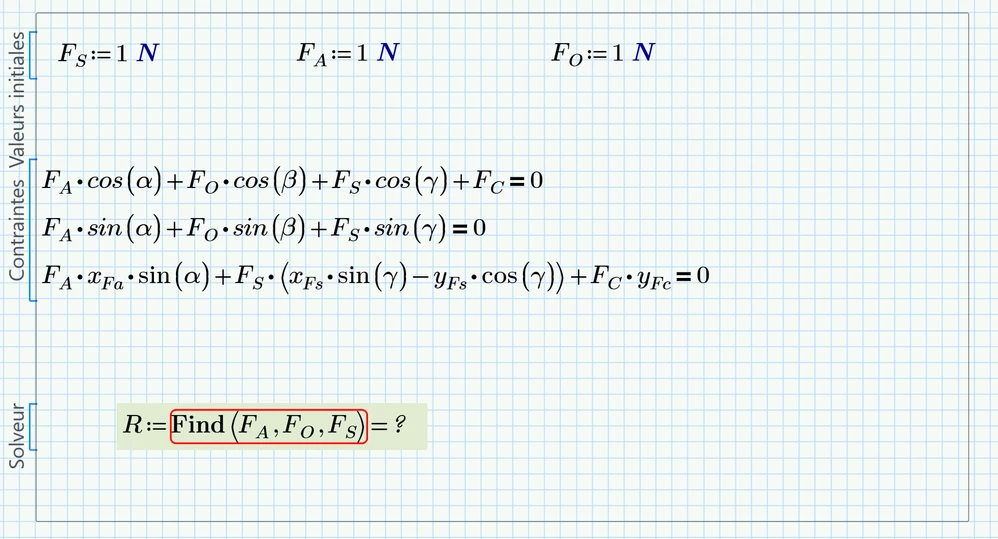
I make a very simple sheat (mechanical problem), i don't understand why blocksolve  fail ?

I can to solve it with my hand and paper.  For example , i find with my hand:

FA = -8978613,01
FS = -1038187,81
FO = -9333161,37

Can someone help me ?img.png

Best answer by Werner_E

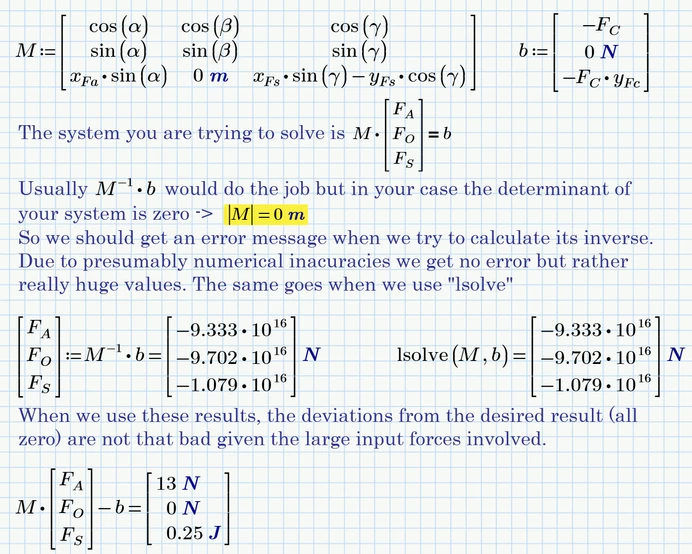
Your system is inconsistent! Its coefficient determinant is zero. That's the reason you get no solution from the solve block with "find".
Werner_E_0-1755783815438.png


Also I wonder why you are using positive guesses when you expect negative results.

And why guesses of a magnitude of 1 N when you expect results in the range of a few MN ?

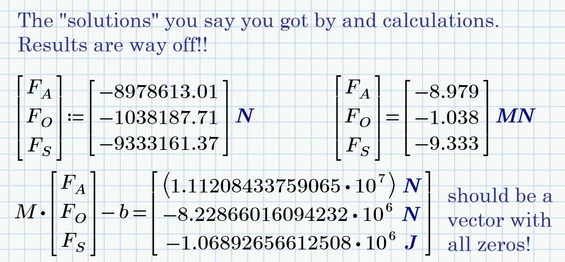
It looks to me that you did not check the results you got by manual calculation against the given three equations, right?

The results are far off!
Werner_E_1-1755783987554.png


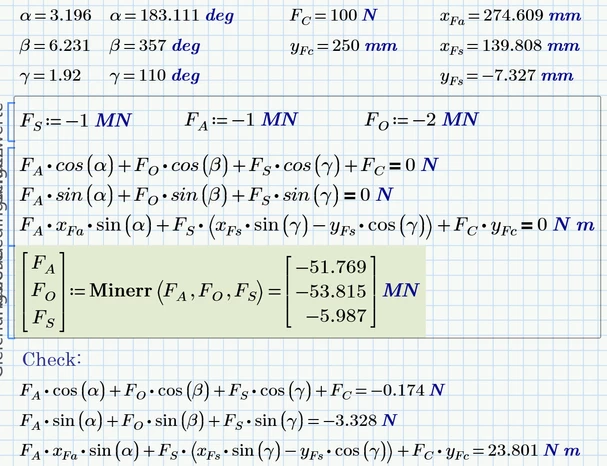
I guess that there may be an error somewhere in the derivation of your equations,, but if you really want to use the equations as given, you could use "minerr" instead of "find" to get a solution with overall minimized deviations. 
Werner_E_2-1755784166602.png

But you have to be aware that even slight changes in the guesses may result in huge differences in the results!

Just changing the guess of F.O from -2 MN to -1 MN turn all results into positive values. Nonetheless the check shows similar results.
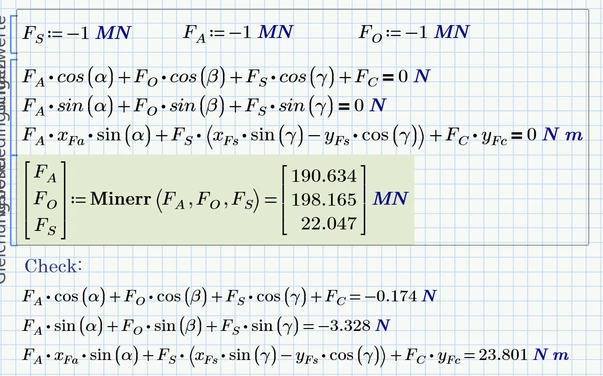
Werner_E_3-1755784331208.png


Prime 11 sheet attached

3 replies

12-Amethyst
August 21, 2025

In Mathcad 15 it is like this.

Screenshot_1.png

XDN14-AlexandriteAuthor
14-Alexandrite
August 21, 2025

yes it's the same order of magnitude as my manual calculation (I make approximations) but I don't have the real mathcad unfortunately. I don't understand what's wrong? the goal is to find a geometry that minimizes FS... I'll have to do everything in iterative mode with excel if this continues...

12-Amethyst
August 21, 2025

Remove the dimension.

Screenshot_2.png

Werner_E25-Diamond IAnswer
25-Diamond I
August 21, 2025

Your system is inconsistent! Its coefficient determinant is zero. That's the reason you get no solution from the solve block with "find".

Werner_E_0-1755783815438.png


Also I wonder why you are using positive guesses when you expect negative results.

And why guesses of a magnitude of 1 N when you expect results in the range of a few MN ?

It looks to me that you did not check the results you got by manual calculation against the given three equations, right?

The results are far off!

Werner_E_1-1755783987554.png


I guess that there may be an error somewhere in the derivation of your equations,, but if you really want to use the equations as given, you could use "minerr" instead of "find" to get a solution with overall minimized deviations. 

Werner_E_2-1755784166602.png

But you have to be aware that even slight changes in the guesses may result in huge differences in the results!

Just changing the guess of F.O from -2 MN to -1 MN turn all results into positive values. Nonetheless the check shows similar results.

Werner_E_3-1755784331208.png


Prime 11 sheet attached

XDN14-AlexandriteAuthor
14-Alexandrite
August 21, 2025

Thank you, Werner. As always, you're brilliant, but my math skills aren't as good as yours, and it takes me time to understand your explanations. But it helps me make a lot of progress.
For my immediate problem, I've simplified the modeling a lot. I can easily calculate this with prime and trigonometry using three calculations... sometimes it's better to spend time simplifying things! Thanks again.

25-Diamond I
August 21, 2025

It seemed to me that your system is inconsistent and has no solution at all because it looked like the coefficient determinant is zero with the values given.

I tried to evaluate it using symbolic calculation and it looks like its not zero but very close to. 

We even get a similar (but slightly different) result with numeric calculation as well if we let display the result in mm

Werner_E_2-1755789712215.png


So even when we use the symbolic engine to solve we don't get an absolutely correct result and I guess forces with a magnitude of 10^17 newton are of no value to you:

Werner_E_1-1755789625735.png


BTW, in case you want to experiment with the symbolic engine yourself, you have to define the unit "deg" in front of the sheet

Werner_E_3-1755789781472.png

because the symbolics does not know anything about units and you have to enable the option shown in the pic below to ensure that units stay labelled as units in calculation results.

Werner_E_4-1755789913950.png


You may solve the whole system symbolically. Simply clear the input variables for symbolic use

Werner_E_5-1755790089024.png

and either use symbolic evaluation with "solve" or your solve block (no guesses necessary) to get a symbolic solution:

Werner_E_6-1755790106813.png

As you can see I turned the solution into a function of the input variables which can be evaluated numerically using the specific input variables you calculated (they were only cleared for symbolic use but still kept their values for numeric calculations).

Werner_E_8-1755790371938.png

You can check using the symbolic result and the numeric values provided that the denominator of the solutions (all the same for all three result and its the determinant of the coefficient matrix) is incredibly small, hence the huge result values.

Werner_E_9-1755790541217.png

I would therefore say that, although the system is solvable from a mathematical point of view, in practice it must be considered unsolvable and too unstable.


14-Alexandrite
August 22, 2025

Hi @XDN,


It's hard from your sketch to determine what the constraints are.  It seem like the red rectangle is constrained to the x-axis and constrained from rotating, as I see no other members to hold it from translating in the y-direction and from rotating.  And I assume O is a pinned joint and the other end of the piston is also a pinned joint (can't fully tell with the image cut off).


If that were the case then Fc is simply acting at A, and you can calculate Fb2 directly.  Fb2 is then applied at S and you now you have a "two variables and two unknowns" system, in order to determine the force in the piston and Fb1. 


I cannot see the reason to do a balance of moments, âˆ‘M=0. That's if I am reading things right. 😉 

Now, ignoring your sketch, your system of three equations 'looks' like you are modeling a structure of three pinned lingages all connected to a rigid body.  I do the same style of equations when I am analyzing barges or analyzing 3D rigging arrangements.  However, a system of three linkages to a point or a rigid body is already indeterminant.  You actually have two valid equations âˆ‘Fx=0 and âˆ‘Fy=0 and three 'unknowns':  FA, FS and FO.  If you add the âˆ‘M=0 equation, then you have a missing an additional 'unknown', which is a moment reaction.  That is, if you don't have a reaction to keep your rigid body from rotating, then you don't have a statics calculation, you have a dynamic calculation and you need to allow the body to rotate and deflect until it comes to a minimum energy state.