
Density and an Immersed Block
So today's challenge...
So I have a problem to which I am given the answer. The real issue is that I need to understand how the answer is derived.
I have attached a word document which gives the problem and the solution. I understand the first steps taken in that the resultant forces have to be at equilibrium as the block immersed (and floating) in the 2 liquids is at rest.
i.e 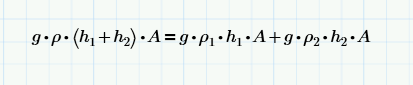
Then by factoring g and A out of the RHS and dividing both sides by gA I am left with:

Then as the question calls for the ratio h1/h2, I believe that I multiply out the LHS then divide both terms on both sides by h2 to get:
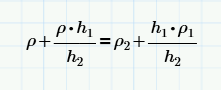
I know that the example in the question factors the LHS but I don't believe this is necessary. The problem I am then having is that the question's given answer in the attached document seems to suggest the ultimate answer is:
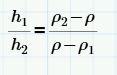
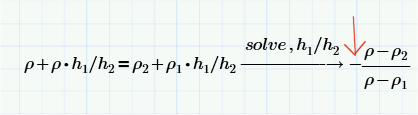
however, from everything I have tried algebraically by hand, the likes of Cymath / wolfgram Alpha and Mathcad itself the answer is suggested to be:
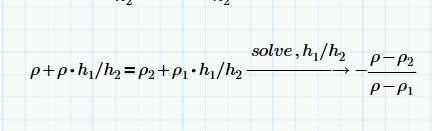
Am I going mad somewhere or am I going to need to be brave enough to question the professor who issued the model answer?
Thanks to anyone that can put me out of my misery!
Andy