

1-Visitor
January 27, 2017
Solved

Energy Calculation (heating a decreasing mass)

  • January 27, 2017
  • 5 replies
  • 3637 views

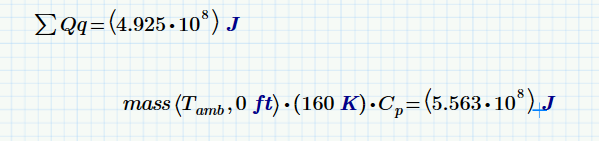
There is a good chance I am just being less than intelligent about this but I'm having some trouble calculating the energy required to heat a container of air (a hot air balloon).

In this scenario, the pressure is remaining constant and air just leaves the container as temperature increases and air expands (in other words mass is decreasing).

Since Q=m*ΔT*Cp it should take less energy to heat the decreasing mass then it would to the system if the mass was constant however my calculations are saying otherwise.

I know I'm doing something wrong but I'm just not sure what.

Thanks
Best answer by Fred_Kohlhepp

I thick you're getting wrapped around the temperature scale axle!  There are degrees Kelvin, and degree Centigrade (which is 273 degrees higher.)  Then there are delta degrees Centigrade.  One delta C is one delta K, but one deg centigrade is 274 degrees K.

Work in absolute temperature (Which is what Cp wants to see.)

5 replies

23-Emerald I
January 27, 2017

You've got

then

In my Prime 3.0:

I get an "units don't match" error.

Try this:

1-Visitor
January 27, 2017

Haha, thanks, Fred. I actually had that just in the hidden region I felt it was just less "pretty" forcing units into the equation like that. I probably should have shown that in the pdf though sorry about that.

23-Emerald I
January 27, 2017

I thick you're getting wrapped around the temperature scale axle!  There are degrees Kelvin, and degree Centigrade (which is 273 degrees higher.)  Then there are delta degrees Centigrade.  One delta C is one delta K, but one deg centigrade is 274 degrees K.

Work in absolute temperature (Which is what Cp wants to see.)