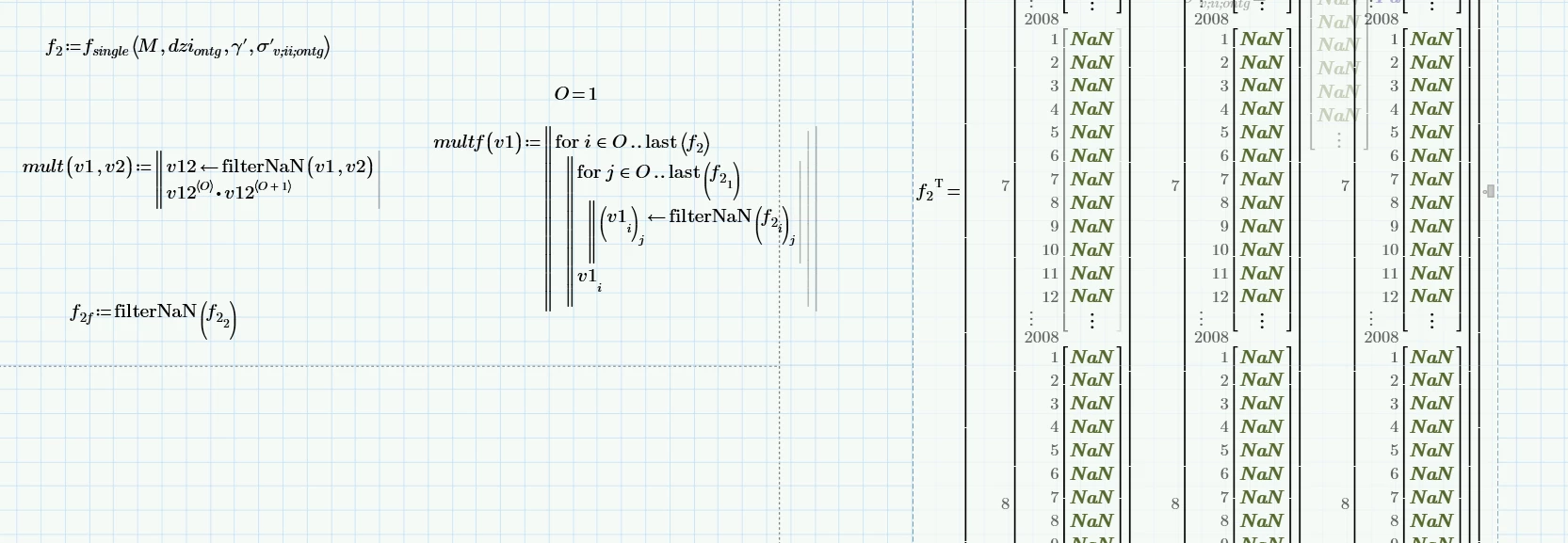
I want to use this function ( filterNAN) , but I’m not sure how it works . I have a nested array f2 . I tried three different approaches but non is working , in f2 I’m using M and sigma they also have NaN in their values , but not all the values are NaN.
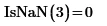
First off there is IsNaN(x), which tells you if x is a NaN (or not):
Realise that IsNaN is the only way to test if an item is a NaN. You cannot use comparative expressions to test for NaNs, as shown here:
Defines n to be a NaNBut the comparison of n with NaN results in 0 (False). That is to say, n does not equal NaN, even though it is defined NaN.
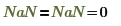
Even more clear:
NaN is unequal to NaN. Again: you cannot compare with NaNs.
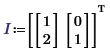
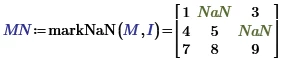
Then there is markNaN(M,I), wich takes a Matrix and a vector of row/column pairs and marks the items in M indicated by pairs in I as a NaN:
If
and
then
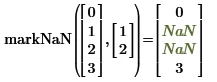
(You can also do this with a vector:
Set the two items of the (first) vector with the indexes of the second vector to NaN.
)
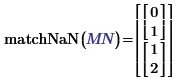
You can find I back from MN with matchNaN(x), which finds the r/c pairs in x that contain a NaN:
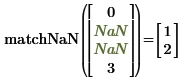
(On the vector:
)
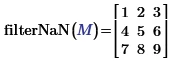
Finally there's filterNaN(x), that filters out all rows of x that contain a NaN. So with no NaNs it gives:
But on the modified matrix that contains NaNs it gives:
just the last row of MN, as the first two rows each contain a NaN.
Now note that for an item to be a NaN, it must be a scalar (single value).
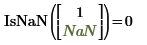
Tells you that the vector [1 NaN] is NOT a NaN (because it is not a scalar)
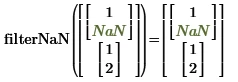
And so:
filterNaN returns the full vector (of vectors) because it contains no NaN scalars
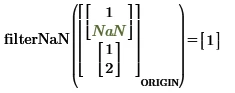
but
Has filterNaN working with only the first element of the nested vector, that element is a vector and contains a NaN in the second row. Hence it returns a vector with just the first element of it.
First off there is IsNaN(x), which tells you if x is a NaN (or not):
Realise that IsNaN is the only way to test if an item is a NaN. You cannot use comparative expressions to test for NaNs, as shown here:
Defines n to be a NaNBut the comparison of n with NaN results in 0 (False). That is to say, n does not equal NaN, even though it is defined NaN.
Even more clear:
NaN is unequal to NaN. Again: you cannot compare with NaNs.
Then there is markNaN(M,I), wich takes a Matrix and a vector of row/column pairs and marks the items in M indicated by pairs in I as a NaN:
If
and
then
(You can also do this with a vector:
Set the two items of the (first) vector with the indexes of the second vector to NaN.
)
You can find I back from MN with matchNaN(x), which finds the r/c pairs in x that contain a NaN:
(On the vector:
)
Finally there's filterNaN(x), that filters out all rows of x that contain a NaN. So with no NaNs it gives:
But on the modified matrix that contains NaNs it gives:
just the last row of MN, as the first two rows each contain a NaN.
Now note that for an item to be a NaN, it must be a scalar (single value).
Tells you that the vector [1 NaN] is NOT a NaN (because it is not a scalar)
And so:
filterNaN returns the full vector (of vectors) because it contains no NaN scalars
but
Has filterNaN working with only the first element of the nested vector, that element is a vector and contains a NaN in the second row. Hence it returns a vector with just the first element of it.