
24-Ruby IV
December 14, 2017
Question

Formulas in reference books and in Mathcad, Maple etc

  • December 14, 2017
  • 2 replies
  • 5727 views

There is no Polls now in this community,

but I ask you

what we must do now

1. Change formulas in references books

2. Change tools in Mathcad, Maple etc

3. Nothimg

4. Others

See the picture please
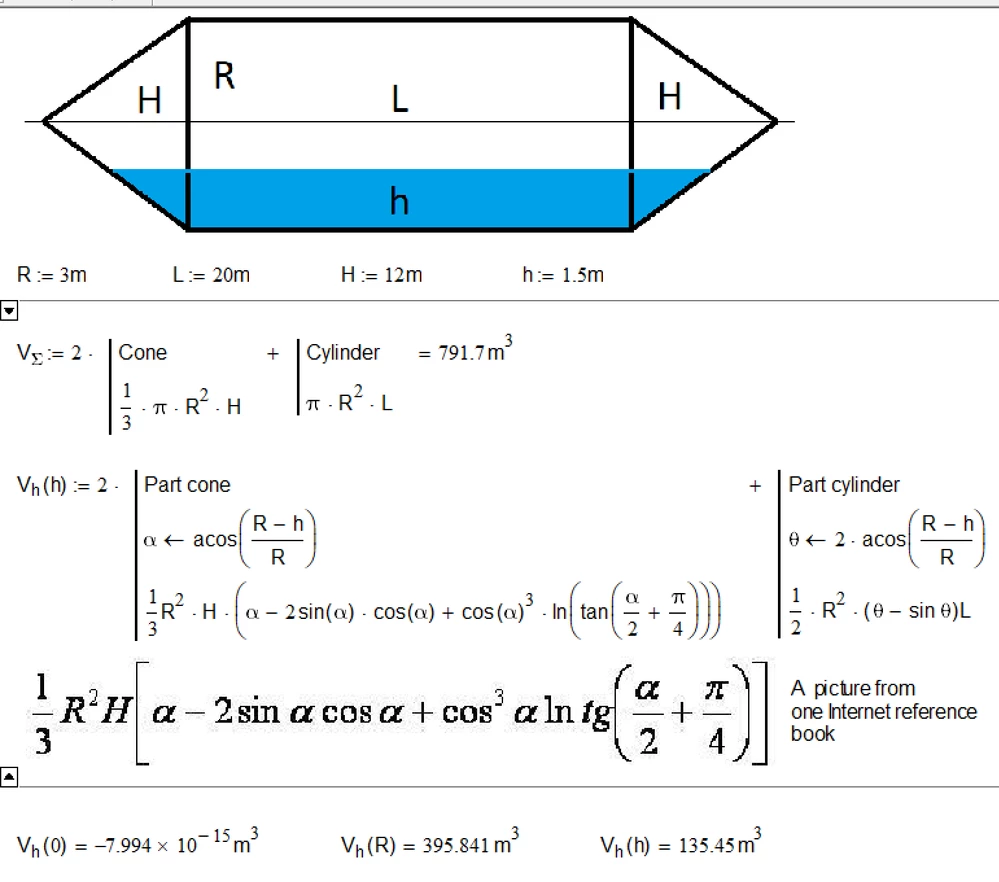
Cone-Formulas.png

2 replies

24-Ruby IV
December 14, 2017

Part of solution

sin.png

1-Visitor
December 14, 2017

Use Alt+0179

cos.png

24-Ruby IV
December 14, 2017


Yes, it is for us - for elite of Mathcad user!

sin-2.png

23-Emerald IV
December 14, 2017

I suggest a reference to ISO 80000 "Quantities and units" , mainly parts

1 (ISO 80000-1 "General" https://www.evs.ee/preview/iso-80000-1-2009-en.pdf), and

2 (ISO 80000-2 "Mathematical signs and symbols to be used in natural sciences and technology" https://www.evs.ee/preview/iso-80000-2-2009-en.pdf).


In part 1 you will find that symbols for quantities are to be written in sloping (italic) font, and units are to be presented as upright (not italic) symbols, separated from the preceding value by a space.

Example: borderlength = 15 m.


In part 2 you will find that:

Variables (x, y etc.) and running numbers (i, j etc.), parameters (a, b etc.) which may be considered constants in a particular context and functions in general (f, g etc.) are all printed in sloping (italic) font; while numbers are printed in upright (not italic) font

Example: f(x) = a·x + 123·g(b)

the symbols for well explicitly defined functions (sin, ln etc.), operators (d/dt, div etc.) and constants (e, π etc.)  are to be written in upright (not italic) font.

Example: sinewave(t) = -d cos(2·π·t)/ dt

The argument to a function is written in parentheses after the symbol for the function, without an intervening space. If the symbol for the function is 2 or more letters AND the argument contains no operation symbol (+, - etc.) THEN the parentheses may be omitted, and a thin space is to be inserted between the function and the argument. Example: arcosh 2a

If there is any risk of confusion, parentheses must be used. Hence write:  cos(a) + b, not:  cos a + b.

There are no rules set for the use of font types (Times, Arial etc.), nor for colour usage.


Further:

The symbol for:

- the tangent is tan    ( tg should NOT be used)

- the inverse trig functions are arcsin, arccos and arctan   (so not asin etc.)

- the inverse hyperbolic functions are arsinh, arcosh and artanh   (so not arcsinh etc.)

- natural, decimal, binary and a-based logarithmic functions are ln, lg, lb and log(with a in the subscript).

- the exponential function is ex  (with x in the exponent) or exp(x).


In a future release of Mathcad this should be implemented.


Luc

24-Ruby IV
December 14, 2017

OK!

And what about

sin^2x or sin(x)^2

and {[(a+b)*c)/c]*}

23-Emerald IV
December 14, 2017

That took a longer search through the standard (which is about 30 pages...).


The standard addresses powers, and states that x² is x squared and x³ is x cubed.
It briefly addresses powers of functions, stating that e.g. (sin x)² is often written as sin² x;
it does not say (sin(x))² = sin²(x).

You have parentheses (), square brackets [], braces {} and angle brackets <>.
The standard advises to use only parentheses for grouping, because the other items (braces and brackets) may have specific meanings in specific fields of application; the parentheses can be nested without causing misunderstanding.

The symbol for multiplication is a half-height dot · (ALT-0183) or a cross × (ALT-0215). Note that when a and b are vectors, then a·b is the scalar product of a and b, and  a×b is the vector product of a and b.
The symbol for division is a horizontal bar with numerator above it and denominator underneath, or the /.

The  :  may be used for ratios. Use of the symbol ÷ for division or ratio should be avoided.


Success!
Luc