24-Ruby IV
November 27, 2014
Question

Fuuzzy logic in Mathcad

  • November 27, 2014
  • 24 replies
  • 7149 views

Fuzzy logic ln Mathcad

(see please the begin of discussion - http://communities.ptc.com/message/264608)

Not fuzzy logic
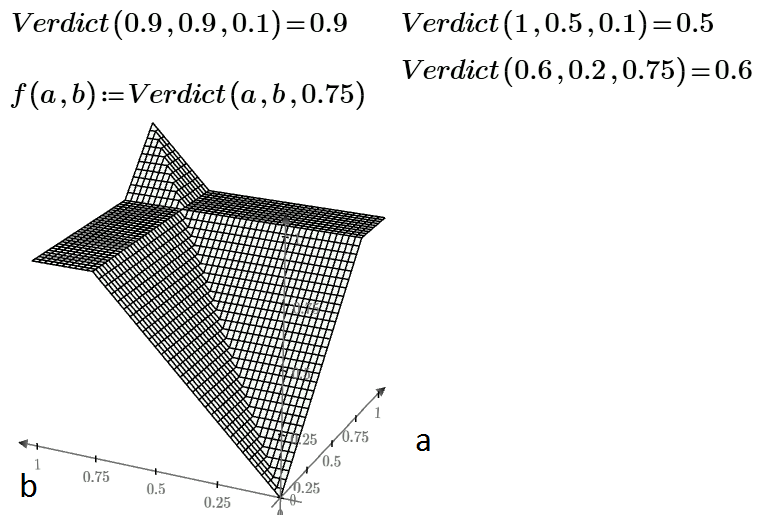
verdict1.png

Fuzzy logic

verdict2.png

One question. What is the function Verdict not fot 3 but for n (12 for example) jorors?

24 replies

1-Visitor
November 27, 2014

If I understand properly you want to make your inputs "vote".

Here is an example of verdict function for 12 voters, with votes in a vector. I don't like it very much, because you have to re-write the function when you change the number of voters (can someone adapt it to make a version that will make it work with any number of voters in a single function ?), but I think it should be reasonably straightforward to adapt.

Werner_E
25-Diamond I
November 27, 2014

Adrien Thurin wrote:

If I understand properly you want to make your inputs "vote".

Here is an example of verdict function for 12 voters, with votes in a vector. I don't like it very much, because you have to re-write the function when you change the number of voters (can someone adapt it to make a version that will make it work with any number of voters in a single function ?), but I think it should be reasonably straightforward to adapt.

I haven't spent much time on it, but wouldn't the following to the job as well?

1.png

1-Visitor
November 27, 2014

Awesome ! I don't think it is possible to make any simpler that that !

Except that it doesn't look for the right value when there is an even number of voters, so I woulddrop the "-1" in the index.

24-Ruby IV
November 27, 2014

I would like to now opinion on my lecture from my students

(here is my students - see, please http://communities.ptc.com/videos/3543)

  • very good -1
  • good 0.8
  • more good than bed 0.7
  • fifty-fifty 0.5
  • more bed than good 0.3
  • bed 0.2
  • very bed 0

The result is mean (V)

Or?

Werner_E
25-Diamond I
November 27, 2014

Looks like you forgot which question you asked at the very beginning of this thread 😉

24-Ruby IV
November 27, 2014

Werner Exinger wrote:

Looks like you forgot which question you asked at the very beginning of this thread 😉

I cannot remember all my questions

But the question was

One question. What is the function Verdict not fot 3 but for n (48 students for example)?

24-Ruby IV
November 28, 2014

The question is!

I am writing the article "Boolean cubics or origami".

One picture from it:

bc.png

1. Are Xor and Eqv (=) cubics correct for fuzzy logic?

2. Can we plot others fuzzy logic cubics (create origami) using this table?

tab2.png

Werner_E
25-Diamond I
November 28, 2014

1. Are Xor and Eqv (=) cubics correct for fuzzy logic?

Equivalance seems to be wrong. Equivalence (XNOR) is the neagtion of antivalence (XOR).

2. Can we plot others fuzzy logic cubics (create origami) using this table?

Why not? You can create all with combinations of AND, OR and NOT.

1.png

24-Ruby IV
November 28, 2014

Thanks!

But sorry - XOR is Not(Equal), and Equal(0.5, 0.5)=1, not 0.5. Equal(a, b):= 1-| a-b|.

And second.

We can create all (17!) function by using only one, not three.

24-Ruby IV
November 29, 2014

One more question.

Can we solve this reverse problem?

RevTask.png

24-Ruby IV
December 3, 2014

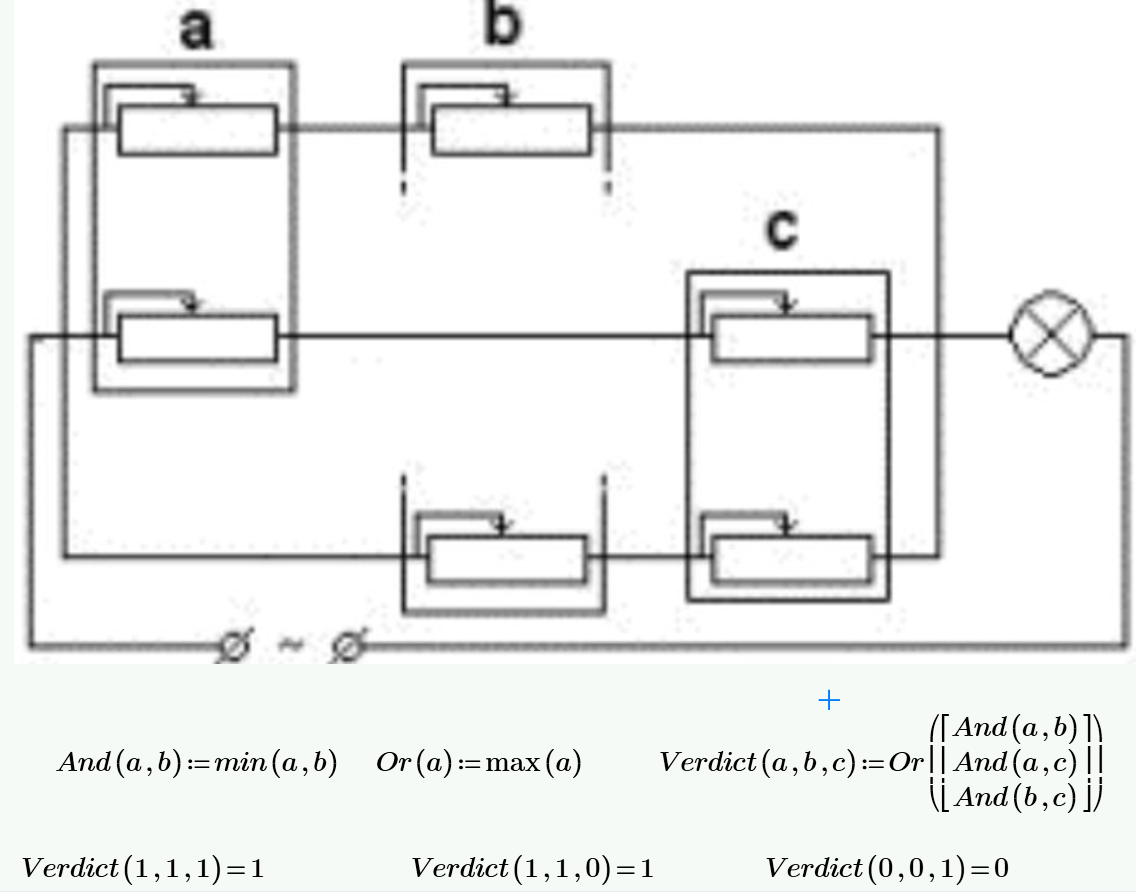
It is said that in the US the electric chair brought into lethal effect several people. In this case, the present switch is operated by only one person. Other participants include the execution of this fake breakers. And no one knows where the fake, and where the real switch. This procedure is somewhat hypocritical allows each such executioner think that not he but someone else was the cause of death. If all of these circuit breakers replaced by rheostats (See below. Fig. 14), a smoothly varying voltage, death can be replaced by non-lethal punishment: sentenced offender will receive an electric shock (strong or weak), but remain alive.

Is it true?

Or more correct question:

It is true - 1

It is more truethan false - 0.75

50-50

It is more false than true - 0.25

It is false - 0