Mathcad enables you to work with units. That is, you have full control over the values and units associated with quantities that you input. And you can change, for each numeric evaluation, the unit used for displaying the result.
If you assign a variable e.g. MyMass:=5 lb, MatCad internally calculates the physical quantity over in its internal unit system, SI, so the value gets stored as 2.268 with the units of mass. If you define another mass e.g. YourMass:=5 kg, the same thing happens. the value is internally stored as 5 with the units of mass.
Now you can add these two masses together, TotalMass:=MyMass+Yourmass, and evaluation results in TotalMass=7.268 kg.
Working with units can help prevent errors, e.g. mathcad does not allow you to add 5 ft to MyMass, for obvious reasons.
But it does allow you to calculate the pressure that TotalMass would exert on a footplate of 1 ft by 0.5 m:
TotalPressure:=TotalMass/(1 ft*0.5 m)
Since units of different unit systems are usable/used, how would Mathcad know what units to use in displaying a result, other than its internal (SI) units.
So the evaluation of TotalPressure results in 47.69 kg/m^2.
If you want that presented in other units, go ahead and insert your units on the placeholder of the result. And yes, you have to do that for every evaluation.
It might be nice if it were possible to define 'preferred units' for physical quantities, but then other problems pop up. Like how would MathCad determine to use use N*m ( for torque) or J (for energy) in the case where a result of 1 kg*m^2/s^2 is obtained?
And last but not least, the symbolic processor (that is involved with the 'explicit' keyword) doesn't know about units at all. It just treats them as undefined variables.
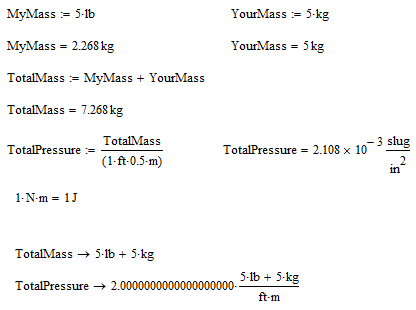
Knowing that units are undefined variables to the symbolic processor, you could:

Or even:

Until:
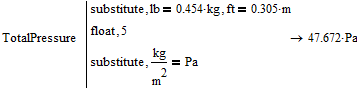
Sucess!
Luc

