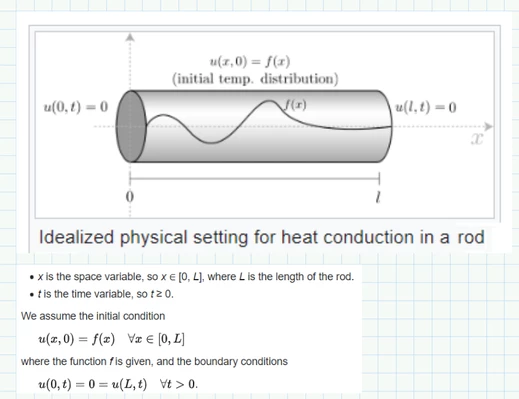
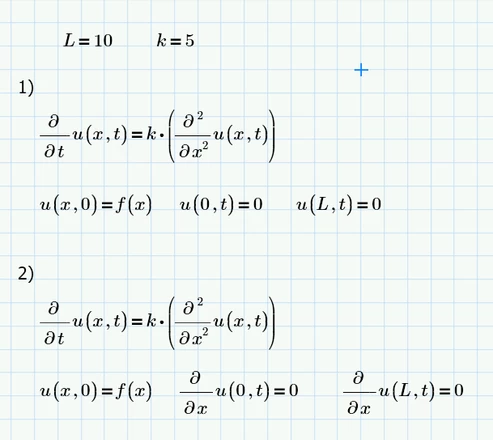
Perhaps this may be a help. I dusted off some very old notes and slogged through a solution to your posed problem using only the standard/usual Prime 8 functions.
Then I used the numol() function found in Prime 8. Much easier! But, of course, numol() returns a matrix of time-spatial data points rather than an u(x,t) function.
f(x) is missing. The system has cylindrical symmetry. The equation is partial differential. You have to apply Pdesolve(). But you should first and at the very least study the examples provided in the help. Without PRIME 9, being the problem an initial values one, you have to discretize all the linear operators, replace them in the starting equation, simplify, and first of all you have to see if it converges and is stable, otherwise you have to change the approximations with more suitable ones.
Perhaps this may be a help. I dusted off some very old notes and slogged through a solution to your posed problem using only the standard/usual Prime 8 functions.
Then I used the numol() function found in Prime 8. Much easier! But, of course, numol() returns a matrix of time-spatial data points rather than an u(x,t) function.