


PlanetPTC Virtual - Mathcad Challenge
Thursday, April 14, 2011 @ 1PM EST is the PlanetPTC Virtual - Mathcad event. Registration is open >>
During this virtual event:
- Get a sneak peek of Mathcad Prime 2.0
- Learn the Mathcad product strategy and Prime 2.0 product development goals
- See the power of Mathcad Prime 1.0 in a Tips & Tricks demo
- Hear a customer-use case. PlanetPTC Community's own Roger Mansfield, Principal Engineer of Astronomical Data Service, shares how he uses Mathcad in his work as an aerospace engineer.
- Enter for a chance to Win a $100 AMEX Giftcard by solving the Mathcad Challenge - 5 winners will be selected!
At the conclusion of each of the three conference sessions, the presenter will provide a clue to the audience. Collect all three clues, answer the problem statement below using Mathcad Prime 1.0, and email your worksheet to -.
The winners will be chosen based on the accuracy of solution; Mathcad Prime 1.0 must be used to calculate the solution. Out of all correct answers, 5 winners will be selected at random. The deadline for submission is Monday, April 18 at 11:59PM EDT.
The Challenge Problem Statement
A train leaves New York at 9:45am EDT, heading for San Francisco...
The train system consists of a straight-line tunnel connecting the two cities. The train uses a MAGLEV (magnetic levitation) system consisting of permanent magnets in the tracks and superconductive electromagnets in the train. To accelerate it uses a combination of electromagnetic force and gravitational pull of the Earth. The deceleration comes also from the gravitational pull of the Earth, as well as aerodynamic drag of the train.
Problem: Compute the arrival time in San Francisco assuming constant propulsion force.
Simplifying assumptions:
- We are ignoring the cost, or the feasibility, of building such a system
- We are assuming that the gravitational pull of the Earth is constant throughout the tunnel
- We are assuming the air in the tunnel is at standard atmospheric conditions (see simplified formula on next page)
- We assume that the resistance of the tracks is zero, so that all of the energy loss comes from the aerodynamic drag
- Use the constants provided on the next page to solve the problem
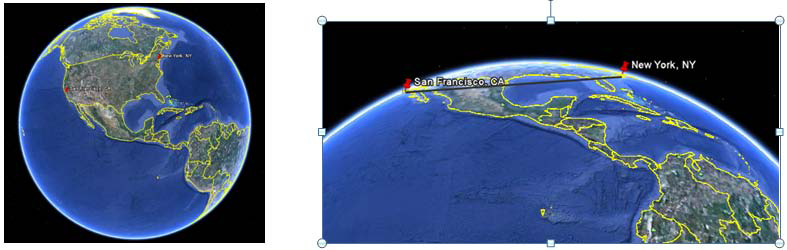
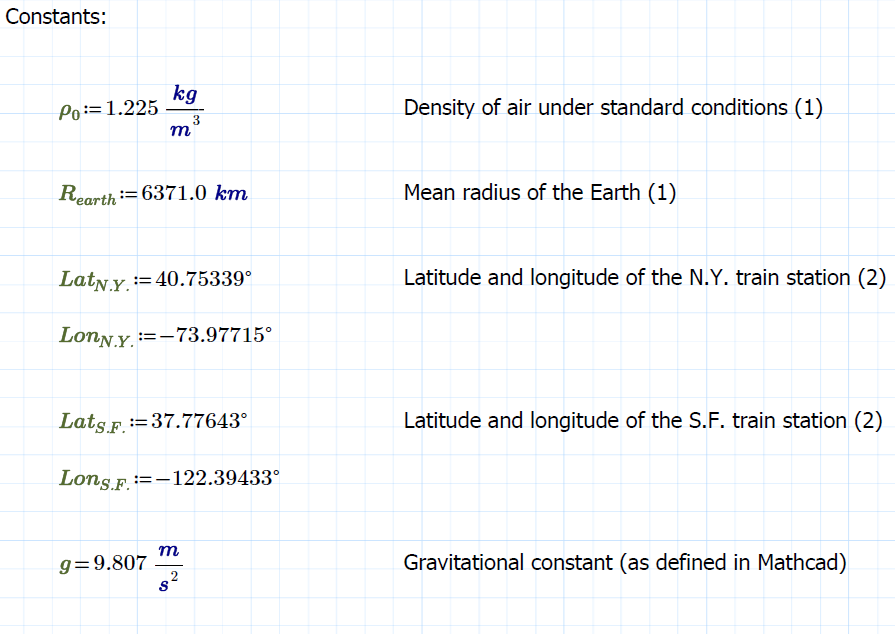

References: (1) Wikipedia (2) Google Maps
The 3 Input parameters will be revealed as “clues.” One clue will be revealed after each conference session.
- Mass of the train (mtrain) =X metric tons
- Effective drag coefficient of the train (Cd) =X
- Effective frontal area of the train (Atrain) is =Xm2
Email your worksheet to - Official Sweepstakes Rules
It will be quite difficult to win if you don't attend. Register for this free event >>