20-Turquoise
Solved

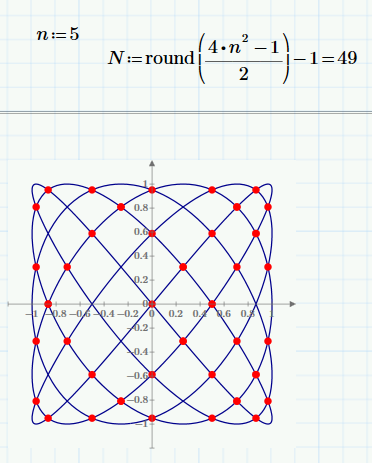
Plotting the points of intersection on the graph ?

  Hello Everyone.

  From :
(1).PNG

  To the question : Plotting the points of intersection on the graph ?

         Thanks in advance for your time and help.   

23-Emerald I

Emperically:

8 replies

23-Emerald V

The points where the curve intersects with itself are plotted on the graph.... along with a lot of other points.

If you want the coordinates of the intersection points plotted in readable text next to them, you need to define a few more curves to get them in.

Refer to the great work "Creating amazing images with mathcad" by Byrge Birkeland for ideas on how to do that.

Success!
Luc

Translate
Werner_E
25-Diamond I

Translate
lvl10720-TurquoiseAuthor
20-Turquoise

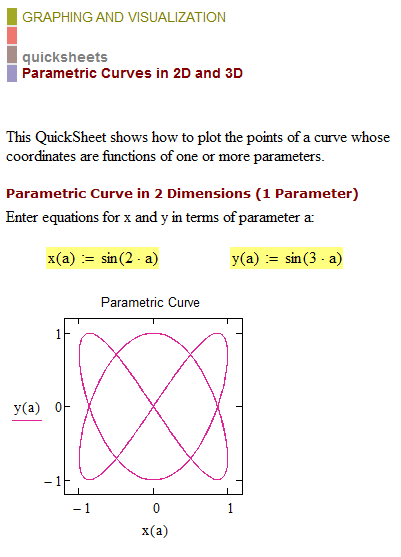
(2).PNG

   How many points of intersection on the graph ?

Translate
23-Emerald V

Sorry, I misunderstood your original question.

To solve the problem at hand, I would mathematically create the lissajous-shape in 3D, then make a projection of it on a (2D) surface and find the intersecting points of it.

Why the detour? because now you only have two expressions, and a single running variable. I see no path where that brings you to more than 2 solutions.

Success!
Luc

Translate
lvl10720-TurquoiseAuthor
20-Turquoise

    I greatly appreciate all of your time and help. Werner, Luc, and Fred.       . I'm very, very happy. And I think I still need help with the two of question, the above, on cos(  ) function :

(3).PNG

              Thanks in advance.
                    Best Regards.

                           Loi

Translate
lvl10720-TurquoiseAuthor
20-Turquoise

  From :

(4).PNG

  So I have a query : How to rotate a graph (pi/2) clockwise and (pi/2) counter-clockwise ?

        Best Regards.

              Loi 

Translate
Werner_E
25-Diamond I

> How to rotate a graph (pi/2) clockwise and (pi/2) counter-clockwise ?

clockwise: replace the x(t) on the abscissa by y(t) and the y(t) on the ordinate by -x(t)

counter clockwise: replace the x(t) on the abscissa by -y(t) and the y(t) on the ordinate by x(t)

Translate