1-Visitor
January 16, 2019
Solved

Problem solving second order ODE because of too many initial conditions

  • January 16, 2019
  • 8 replies
  • 4464 views

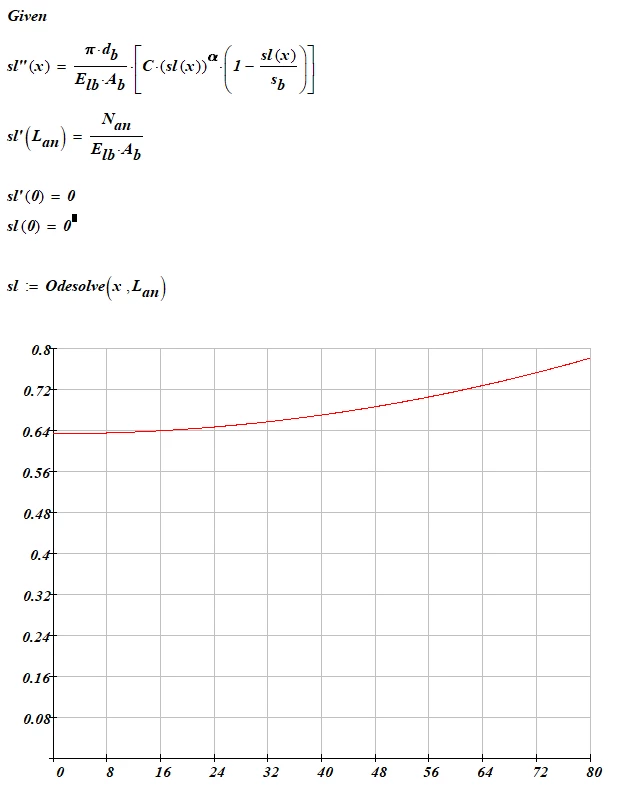
I am having issues solving a second order ODE because i need to force 3 boundary conditions, 2 for the starting point and one for the last one. I am forced to do this because otherwise the solution is incorrect so i can just obtain a solution with the correct derivative in 0 or the function with the correct value in 0. Of course if i enable all the three conditions mathcad says to me i have too many initial conditions but the problem is they are equally fundamental to obtain the correct solution. I will attach a picture also. Do you know how can i force a third condition solving a second order ODE? Or in general how to force much more conditions than the ODE order? thanks in advance.ode.png
Best answer by Sdruman

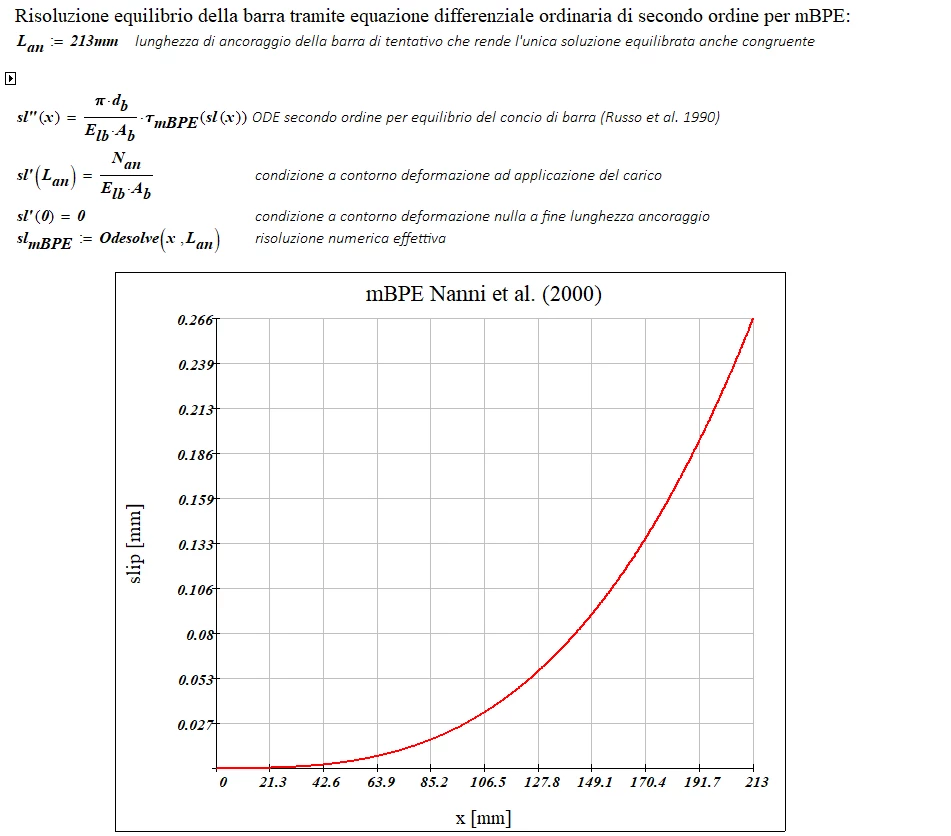
I solved the problem by myself.

I got the correct solution changing how large the interval is.

So basically changing it you obtain the only solution that is both balanced and with correct slips (it is a static problem). Basically i am changing the embedment length of the bar till i have the correct solution. You can do the same also changing the axial load at the beginning while length is fixed.

So basically if you have issues like these in future just try to change the boundary value or the length of the interval and look what it happens, you will see that odesolve solution change and you can find the one tha satisfy you. I would love to find a way to automatize this process using programming but seems like i am not able to put given and odesolve inside it. I will try maybe in future. Thanks everyone.

Immagine.png

8 replies

23-Emerald IV
January 16, 2019

Please attach the worksheet, not just a picture.

(For my convenience, save it as Mathcad 11 .mcd format; don't mind the warnings.)


Luc

Sdruman1-VisitorAuthor
1-Visitor
January 16, 2019
23-Emerald IV
January 16, 2019

I got this far:

LM_20190116_DEsolve.png

Success!

Luc

Sdruman1-VisitorAuthorAnswer
1-Visitor
January 21, 2019

I solved the problem by myself.

I got the correct solution changing how large the interval is.

So basically changing it you obtain the only solution that is both balanced and with correct slips (it is a static problem). Basically i am changing the embedment length of the bar till i have the correct solution. You can do the same also changing the axial load at the beginning while length is fixed.

So basically if you have issues like these in future just try to change the boundary value or the length of the interval and look what it happens, you will see that odesolve solution change and you can find the one tha satisfy you. I would love to find a way to automatize this process using programming but seems like i am not able to put given and odesolve inside it. I will try maybe in future. Thanks everyone.

Immagine.png

25-Diamond I
January 21, 2019

Being able to change the interval length of course changes the rules of the game and gives you one additional degree of freedom and so a solution exists.

Here is a way to let Mathcad find the optimal value for L.an. You have to turn the odesolve-block into a function of L.an and later use a normal solve block to find the value of L so, that sl(0)=0 (the condition not considered by odesolve.


B.png

Sdruman1-VisitorAuthor
1-Visitor
January 21, 2019

Thanks my friend you saved my life 😄