ttokoro
21-Topaz I
Solved

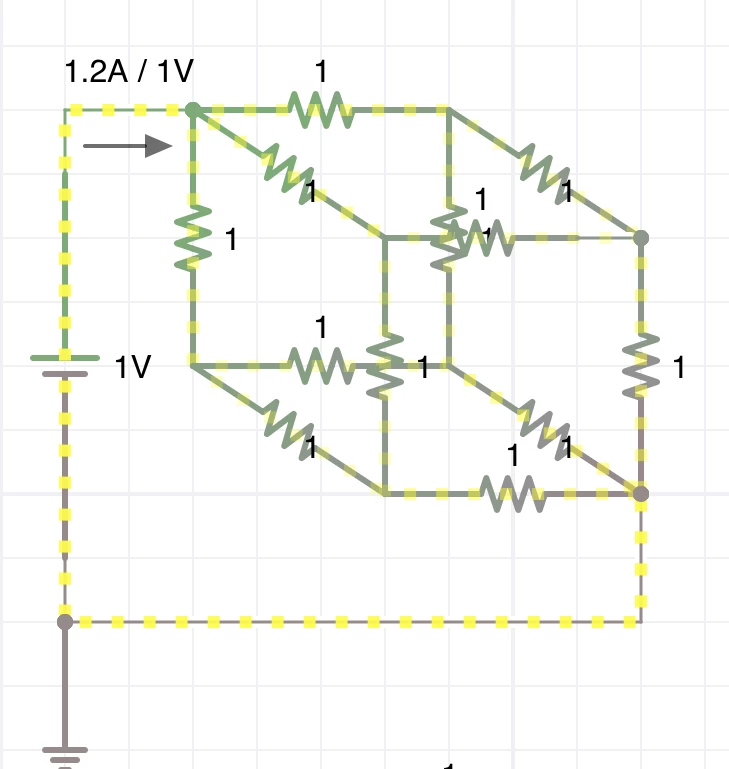
Solve diagonal resistance of resistor 3D mesh.
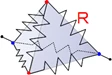
image.pngimage.png

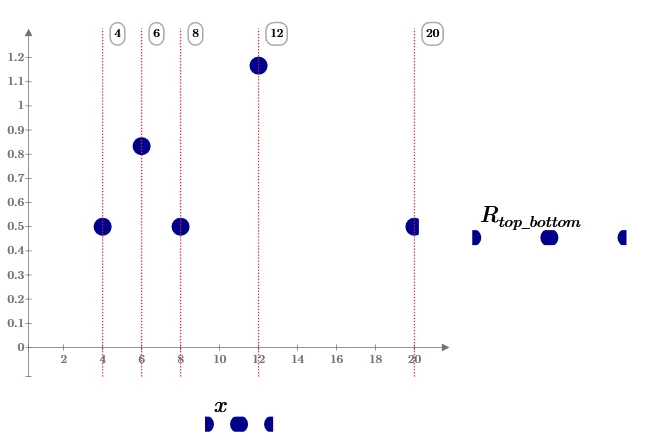
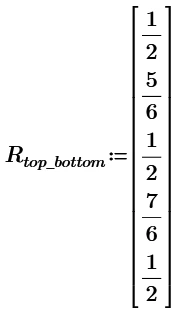
Diagonal resistance of regular polyhedron. R(4)=1/2, R(6)=5/6. How about R(8), R(12) and R(20)?

ttokoro
ttokoroAnswer
21-Topaz I

image.pngimage.png

t.t.

60 replies

24-Ruby IV

Cube.png

Translate
-MFra-
21-Topaz II

Hi,

A simplification of the network topology allows you to easily apply Thevenin's theorem:

rete composta 2.jpg

Translate
ttokoro
ttokoro21-Topaz IAuthorAnswer
21-Topaz I

image.pngimage.png

Translate
t.t.
ttokoro
ttokoro21-Topaz IAuthor
21-Topaz I

image.pngThe diagonal resistance of resistor 3D mesh is 5/6 ohm.

How about 1*2 3D Mesh?

image.png

Each branch resister is 1 ohm. 

Translate
t.t.
ttokoro
ttokoro21-Topaz IAuthor
21-Topaz I

image.png

image.png

Translate
t.t.
ttokoro
ttokoro21-Topaz IAuthor
21-Topaz I

image.pngimage.png

i=2:    1*1*1

i=3:    1*1*2

i=4:    1*1*3....

Translate
t.t.
ttokoro
ttokoro21-Topaz IAuthor
21-Topaz I

image.png

Translate
t.t.
ttokoro
ttokoro21-Topaz IAuthor
21-Topaz I

image.pngimage.png

Translate
t.t.
18-Opal

I don't know why every body went to town on this. You already gave the V and I  so R = 5/6 ohms.


But as an academic exercise - as others have given but more colourful pictures are here:


https://www.rfcafe.com/miscellany/factoids/resistor-cube-equivalent-resistance-kirts-cogitations-256.htm


Translate
ttokoro
ttokoro21-Topaz IAuthor
21-Topaz I

This is not solving 3D 1*1*1 grid resistor mesh only. Using Mathcad or other mathematical programs we can calculate more interesting resistor grid problems.

1/3+1/6+1/3 can not use if the grid is 1*1*2. I post many unique resistor grid problems here.  This time 60 node soccer ball resistor grid result is shown. Please try to solve it because I can not find any answer in WWW sites. Without using Math software, we can not solve such as R1-2 of resistor ball. 


image.pngimage.pngimage.png

1*1*2                                                                                        1*1*1

Translate
t.t.
-MFra-
21-Topaz II

What do you think of my solution?  Maybe I took the wrong node as a reference point?

2RBridges 0.jpg2RBridges 1.jpg2RBridges 2.jpg2RBridges 3.jpg2RBridges 4.jpg2RBridges 5.jpg2RBridges 6.jpg2RBridges 7.jpg2RBridges 5.jpg2RBridges 9.jpg2RBridges 10.jpg

Translate
ttokoro
ttokoro21-Topaz IAuthor
21-Topaz I

I will check your circuit. Please upload your Mathcad worksheet. I use Prime 9 to solve it.

I view your post and I understand this is 3D cube circuit with 12 one ohms to find the equivalent resistance of diagonal nodes. Node method is used to solve the circuit. I think this is the best method to solve the resistance.

image.pngimage.pngimage.pngimage.png

Translate
t.t.
-MFra-
21-Topaz II

Hi,
Undoubtedly, I made some mistakes. As for the theory, I was inspired by some texts including: "Linesr and non linear circuits" by L. O. Chua, C. A. Desoer, E. S. Kuh, for the construction of the TABLEAU matrix. You can find my worksheet attached.
Greetings

Translate
ttokoro
ttokoro21-Topaz IAuthor
21-Topaz I

3.4.5 ohms cube.

Pyta-345.jpeg

1 ohm circuit by 1 ohms. Each 1 ohm has different current when apply 1A for 1 and 13 nodes. 

1ohmby1ohms_3D.jpeg

Translate
t.t.
ttokoro
ttokoro21-Topaz IAuthor
21-Topaz I

image.png

Diagonal resistances of n-D cubes. AI only knows 3D and 4D ones. 

Translate
t.t.
ttokoro
ttokoro21-Topaz IAuthor
21-Topaz I

image.pngimage.pngimage.png

Translate
t.t.
ttokoro
ttokoro21-Topaz IAuthor
21-Topaz I

Source and Image Credits: Ellenberg, J., Libedinsky, N., Plaza, D., Simental, J., & Williamson, G. (2026). Bruhat intervals that are large hypercubes.


New hyper cube circuit 2026.

HyperCube20262.jpgHyperCube2026-2.jpg

Translate
t.t.
ttokoro
ttokoro21-Topaz IAuthor
21-Topaz I

12-5x6.jpg

ttokoro_0-1769594411535.png


Translate
t.t.
ttokoro
ttokoro21-Topaz IAuthor
21-Topaz I

Diagonal resistance of Galileo's 12-20 cube cauldron at the Milan Olympics.

image.pngimage.pngimage.png

Translate
t.t.