Werner_E
Werner_EAnswer
25-Diamond I
Oct 5, 2022 4:43 PM UTC

While cleaning up I noticed that I forgot to post the solution using Euklids algorithm. So before the file is deleted, I post it here.

Here we have no problem with numbers too high, as it seems.


10 replies

Werner_E
25-Diamond I
Sep 26, 2022 2:20 PM UTC

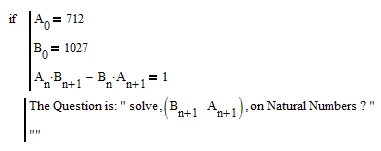
Your definition seems not define series of numbers.

Its NOT defined what the NEXT pair (a1; b1) would be.

Is it (165; 238) or should it be (877; 1265) or would you rather like it to be (1589; 2292) ?

The general solution is a.1=165+k*712 and b.1=238+k*1027 with k being any integer.


If you settle for the smallest positive numbers, a first hack could be

Werner_E_1-1664211429627.png


Not much error checking or whatsoever and the 'math' method used is not Euklid or congruences but simple pure brute force 😉


Translate
lvl10720-TurquoiseAuthor
20-Turquoise
Sep 27, 2022 1:31 AM UTC

@Werner_E wrote:

Not much error checking or whatsoever and the 'math' method used is not Euklid or congruences but simple pure brute force 😉

  With big numbers then:

Iterative Equation (2).PNG

(Attach ***.xmcd please)

Best Regards.

Loi.


Translate
Werner_E
25-Diamond I
Sep 27, 2022 3:39 AM UTC

Interesting error message. No idea what it should mean and why it pops up.

Solution: Don't use too high numbers 🙂

Translate
Werner_E
Werner_E25-Diamond IAnswer
25-Diamond I
Oct 5, 2022 4:43 PM UTC

While cleaning up I noticed that I forgot to post the solution using Euklids algorithm. So before the file is deleted, I post it here.

Here we have no problem with numbers too high, as it seems.


Translate