20-Turquoise
March 11, 2017
Solved

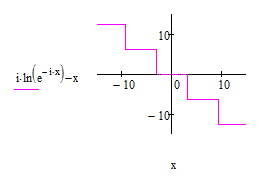
Step function 1i*ln(e^[-1i*x]) - x and plotting the intersection points ?

  • March 11, 2017
  • 23 replies
  • 6165 views

   Hello Everyone.

   From :

(1).PNG

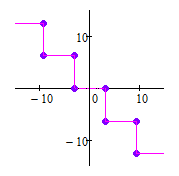
   Need help plotting the intersection points.
(2).PNG

          Thanks in advance for your time and help.

                Best Regards.

Best answer by -MFra-

coordinates of the intersection poins.jpg

23 replies

21-Topaz II
March 11, 2017

Hi Loi Le,

maybe you meant the discontinuity points? or what? the intersections with the axes?

Regards

FM

lvl10720-TurquoiseAuthor
20-Turquoise
March 11, 2017

   Hi F.M.

   On my side, any of them. (the purple points, the above)

       Best Regards.

            Loi

21-Topaz II
March 12, 2017

Hi Loi Le,

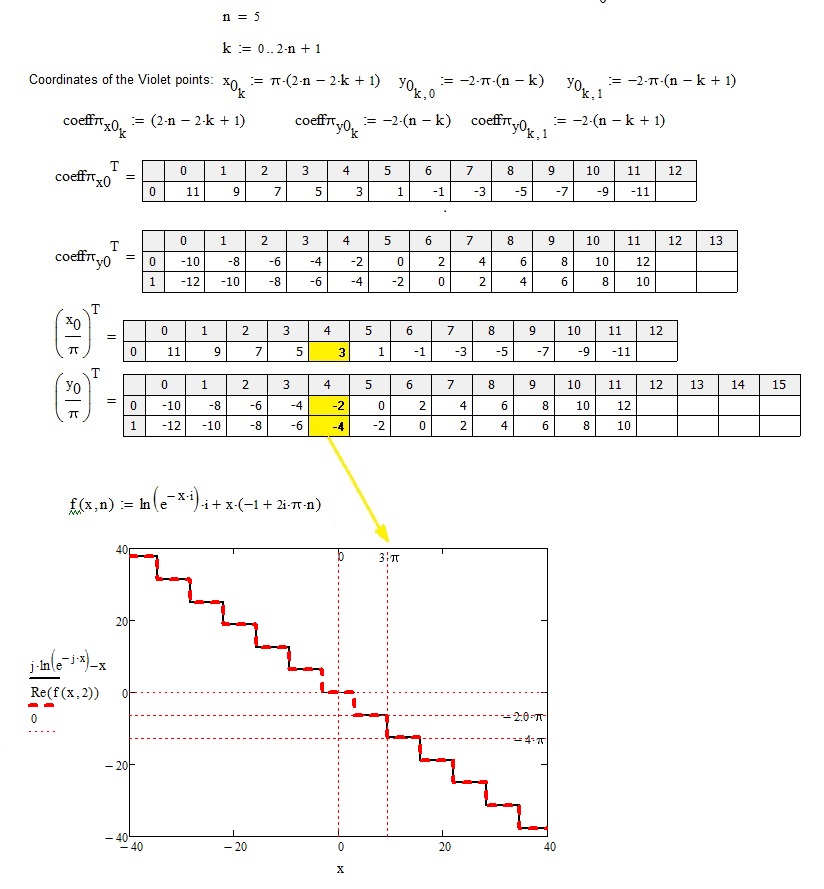
the coordinates of the violet points are:

coordinates of the intersection poins.jpg

Greetings

FM

25-Diamond I
March 12, 2017

Loi Le wrote:

   Need help plotting the intersection points.

Obviously thats not true! Looking at your plot we see that you found those points yourself and you just want to tease us! Why???

As so many times in the past once again you ignored that fact, that those expressions are not unique and that Mathcad can not correctly deal with it.

So the true graphs of the relations (they are not functions) are

and

Asking for "points of intersection" or "discontinuity points" therefore is rather senseless.

Its Mathcad choosing "arbitrary" (of course there is a logic behind) parts of those plots to make it a unique function:

Maybe one day you will explain what your real goal is and what you would like to achieve with all your similar questions where you continuously ignore what you were already told so many times.

lvl10720-TurquoiseAuthor
20-Turquoise
March 12, 2017

   Hi, Werner.

   Many thanks for your hint.   

" Obviously thats not true! "

- Because I don't undrstand the problem so I ask with my question for my self-educate. To me, "Obviously" isn't much help. Say :

(b).PNG

  " Looking at your plot we see that you found those points yourself and you just want to tease us! Why??? ". - Without going to school, so I just wish learning from the forum and nothing else. (once again, too).

  " So the true graphs of the relations (they are not functions) " - Because I don't understand and I'm so sorry calling that - is function. Please help me, I really don't know that expression is called  what is :

(a).PNG

" Maybe one day you will explain what your real goal is and what you would like to achieve with all your similar questions where you continuously ignore what you were already told so many times. " - Just still not understanding and just wish learning.


         Best, Best Regards.

                Loi

25-Diamond I
March 12, 2017

The point of my reply was that you asked how to plot those violet points and as we could see you already plotted them.

So asked for how to do something you already did.

Furthermore its often hard to guess what the real problem is you are experiencing. I think it would definitely help if you would be a little bit more detailed about what you really want to know and what the core problem is you experience or which detail you don't understand. In the example above your problem sure was not how to plot the points.

I understand that there is a language barrier but maybe with the help of google translate ...

> Because I don't understand and I'm so sorry calling that - is function.

Yes, what you see in Mathcad IS the graph of a function because Mathcad assign a unique value to each and every value of x. But the expression itself IS not unique.

Its similar to the inverse of the cosine function. The inverse is NOT a function. cos(x)=1/2 has a lot of solutions (x=+- pi/6 + k*2 pi). But in the real domain the FUNCTION arcsin is defined in a way so that its unique and this definition is internationally agreed on.

Same for the square root of a positive number n in real domain. Its defined as being only the positive solution of x^2=n. Thats true in R, but not in C.

So sometimes in mathematics we restrict results to a unique one by definition.

But usually we don't do this when we deal with complex numbers and so there is no agreed on definition for "uniqueness" with the expressions you post all the time - they are not unique and Mathcad chooses a single value by its own definition (and not even the symbolic and numeric engine agree on the same value in all cases - see example below).

> Just still not understanding and just wish learning.

Main problem now seems to be that you fully trust Mathcad and take its results at face value.

But whom would you trust more? Who is right - numeric or symbolics?

What would you say?

The answer is that both are right, but both neglect an infinite number of other possible results which are equally valid.

Not sure, but didn't we already talk about exactly that ambiguousness once or twice in the past?

21-Topaz II
March 12, 2017

Hi Loi Le,

It follows my reworking of the problem:

coordinates of the intersection poins.jpg

....and what would be, in your opinion, the analytical expression of the function, here below, represented?

bipolar staircase.jpg

lvl10720-TurquoiseAuthor
20-Turquoise
March 12, 2017

   Hello FM,

   I greatly appreciate your time and hint, FM.  It seems that I'm starting and interested in those hints ...   .

        Best Regards.

            Loi 

lvl10720-TurquoiseAuthor
20-Turquoise
March 14, 2017

I'm sorry. My original question should be :

(I).PNG

   Plotting Start-Points and End-Points ?


             Regards.

                   Loi

25-Diamond I
March 14, 2017

Loi Le wrote:

I'm sorry. My original question should be :

(I).PNG

   Plotting Start-Points and End-Points ?

             Regards.

                   Loi

The point(!) is that what you SHOULD see (but Mathcad is not showing) is not a step function but a number of horizontal lines as shown in my first answer in this thread. So there are no start- or endpoints!

Its simply Mathcad (and also other programs) which jump from one of those lines to the other at odd integer  multiples of pi.

lvl10720-TurquoiseAuthor
20-Turquoise
March 15, 2017

   I need help with : Is there a way to solve " which jump from one of those lines to the other at odd integer  multiples of pi." with symbolic solve ? ( at odd integer  multiples of pi ).

         Best Regards.

               Loi