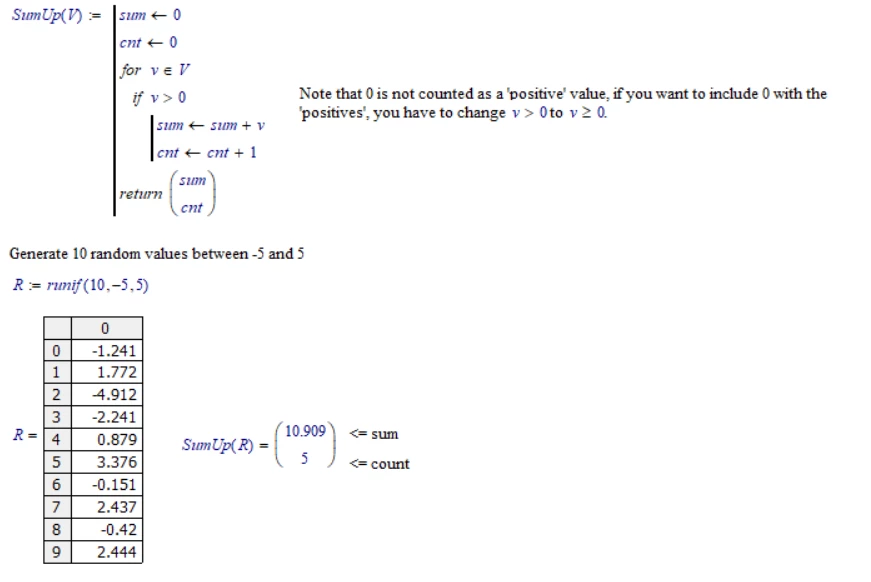
I managed to get the results I wanted for a larger matrix (see attached) with the help from both of you and it is greatly appreciated.
What i still don't understand is the functions you used for sum and count. For count you used the 'vector sum' function, for sum it's some sort of product. No wonder with the vector sum i couldn't get anywhere when i started this exercise. Why?
The result of (V>0) is a vector with the same size as V, where all elements are either 0 or 1. That is: 1 when the corresponding element in V is larger than 0, and 0 when it isn't. The vector sum of (V>0) is the sum of all 1's, that's the count of all your positive elements in vector V. If you multiply two vectors, like V*(V>0), the result is the total sum of all multiplications of all corresponding elements. So all positive elements of V get multiplied by 1, the other elements get multiplied by 0. The total sum of all those products is then the sum of all positive elements in V.
Success! Luc
Translate
Windchill Satisfaction Survey
Help shape the future of Windchill. Take our 5-minute survey and share your feedback.