

1-Visitor
February 25, 2017
Solved

System of Differential Equations - How to solve? - 2nd Edition

  • February 25, 2017
  • 39 replies
  • 19440 views

Hello,

I have the same problems to solve a system of differential-equations with the solve-block like in tried in my thread: System of Differential Equations - How to solve?

See attachement please, I'm working with Prime 3.1.

Thank you for your efforts.

best regards, Volker
Best answer by vlehner

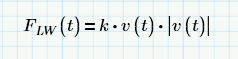
Setting the Air-resistance to a function below, allows a damped character of the curvation.

Now it's possible, that the force can take a correct effect into two directions.

39 replies

23-Emerald IV
February 25, 2017

Volker,

die erste Gleichung hat, laut .PDF,  x(t)'' anstatt x''(t)...

Viel Erfolg!
Luc

vlehner1-VisitorAuthor
1-Visitor
February 25, 2017
25-Diamond I
February 25, 2017

Can't read P31 files but how about replacing every lambda by y'/(2xx') ?

vlehner1-VisitorAuthor
1-Visitor
February 25, 2017

Werner,

I changed lambda, but no sucess.

anyway thanks

Volker

25-Diamond I
February 25, 2017

Schade! Allerdings kann die numerische Lösung mit einem unbekannten lambda meines Erachtens nicht funktionieren. Denn da nicht nach lambda gesucht wird, wird es auch nie neu berechnet oder variiert und ist vermutlich leider nur einer der Gründe, warum der solver einen Fehler produziert. Ich denke also, dass lambda auf jeden Fall elimiert werden muss, oder aber durch eine Funktion lambda(abhängig von ...?) ersetzt gehört. Denn was soll ein numerisches Verfahren mit einer unbekannten Konstanten anfangen?

P.S.: Mir fällt gerade auf, dass du überhaupt keine der Konstanten (k, mk, mu) mit einem Wert belegt hast. Mathcad kann DGLen nicht symbolisch lösen und für eine numeriosche Lösung, benötigt es auch konkrete Werte!

P.P.S.: Auch die Definition von te ist nicht erkennbar, aber trotzdem produziert die Definition der Bereichsvariablen fürs Plotten keinen Fehler. Ich nehme daher an, dass du die Konstanten in einem Bereich rechts definierst, der in der PDF-Datei nicht sichtbar ist.

21-Topaz II
February 25, 2017

Hi Volker,

my solution:

solve bloc VOlker 2.jpg

Ich denke eigentlich, dass die Lösung nicht so gut geht .... Ich denke, dass nicht die Lösung der Bewegung einer Parabelbahn ist ....

vielleicht die Unsicherheit ist abhängig von der Tatsache, dass die Berechnung auf den Bereich beschränkt ist 0s <t <= te

vlehner1-VisitorAuthor
1-Visitor
February 26, 2017

Hi FM,

your equations looks in comparison to mine very strange. How did you got it?

Lambda is a constant in this system.

To all: Thanks for your efforts again! Good hints- I have to check many things...

regards, Volker

21-Topaz II
February 26, 2017

Hi Volker,

for the constants it seems that it is better to choose the automatic label.

Greetings

FM

1-Visitor
March 3, 2017

Hi,

I only saw the pdf-file, perhaps I miss something, but I see 2 ode`s second order. You need 4 boundary conditions (bc`s) to solve them.  But I see 5 bc`s.

Best wishes

Stephan

vlehner1-VisitorAuthor
1-Visitor
March 6, 2017

Hi Stephan,

I have two differential Equations second order with four BC's.

regards, Volker

1-Visitor
March 6, 2017

Ok, I put some time in the worksheet.

I changed some points and got a solution:

First: I delete every units. (normally it should work with units, it seems there is a mistake in the formulas)

Second: I changed the term x(t)'' in x''(t), see picture below (first arrow).

Third: I changed ("*") into ("+") (second arrow in both ODEs). This is perhaps physically wrong, but there seems to be something wrong in your formula as well, otherwise it should work.

You can see my full changes below. Especially Point 1 und Point 3 are signs for a mistake in the formula, but i am too far away from that topic to see what's wrong.

I hope that will help.

vlehner1-VisitorAuthor
1-Visitor
March 6, 2017

Hi Stephan,

could you please post the File where you made your changes ?

What graphs did you get and can you imagine that the graphs should be a damped vibration because of friction and air-resistance?

you should take the latest sheets-not the one of the beginning of the threat.

THX, Volker

1-Visitor
March 6, 2017

Hallo Volker,

ich habs gerade nochmal versucht, stehe aber im Moment etwas auf dem Schlauch.

Ich darf ja ruhig auf Deutsch schreiben, weil ich gesehen habe, dass du das verstehst. Ich habe für meine Änderung die ursprüngliche Datei genommen. Ich würde aber sagen, dass an den Formeln etwas nicht in Ordnung war. Nicht nur am Syntax, sondern auch physikalisch. Eine Vermutung von mir ist auch, dass du gar kein gekoppeltes System von 2 DGLs benötigst, weil die Bewegung in x-Richtung und in y-Richtung durch die Beziehung der Parabelgleichung bereits miteinander gekoppelt ist.

Etwas ähnliches hast du ja auch bei der Pendelgleichung (siehe Wikipedia) nur auf einer Kreisbahn und ohne Reibung. Die Bewegung x(t) und y(t) sind da über die Kreisgleichung gekoppelt (ohne ein DGL-System und nur mit einer Differentialgleichung).

Weiter habe ich gelesen, dass du die Zentrifugalkraft mit berücksichtigt haben möchtest. Brauchst du das bei einer punktförmigen Masse? Ich glaube wenn die Masse nicht mehr punktförmig ist, und u.U. auch abrollen kann, bekommst du noch mehrere Probleme: Trägheitsmomente + Winkelbeschleunigung. Flüssigkeitsreibung am Umfang + Winkelgeschwindigkeit,... Eine punktförmige Masse heißt ja, dass die Masse in einem Punkt konzentriert ist, damit hat der Körper auch keinen Radius und damit auch keine Zentrifugalkraft, die wirken kann. Übrigens selbst bei einer Problemstellung mit einem nicht punktförmigen Körper, brauchst du, glaube ich, kein System aus DGLs. Eine reicht, die aber auch nicht unbedingt einfacher zu handhaben ist.

Der Ansatz von F.M. sieht aber generell nicht ganz verkehrt aus (für punktförmige Masse).

vlehner1-VisitorAuthorAnswer
1-Visitor
May 2, 2017

Setting the Air-resistance to a function below, allows a damped character of the curvation.

Now it's possible, that the force can take a correct effect into two directions.

24-Ruby IV
May 2, 2017

k*v(t)*|v(t)|

Or

k*v(t)^2*sign(v(t))

What is more quickly in calculation?

vlehner1-VisitorAuthor
1-Visitor
May 3, 2017

both variants do need the same time. (elapsed time: 0'52.07'')

The expression k*v(t)*|v(t)| is easier to write and looks pretty cool.

Dunno like to much functions in terms of math.