1-Visitor
August 16, 2019
Solved

Use case enquiry

  • August 16, 2019
  • 11 replies
  • 4591 views

Good day


Any advice on the following use case would be appreciated.

I'm designing 2 non round variable pitch cams.

Most of the calculations I've done in Excel but have gotten stuck on finding the angle of rotation of the second cam so that a vector of the cam passes through a point.

I can do a Matrix translation and rotation on the vector but need to find that angle.

There is a measured geometrical solution in CAD that works, but it takes very long to make changes so would like another solution.

Math can be found here, above my pay grade, but I though Mathcad might be easier.

https://math.stackexchange.com/questions/2278357/rotate-a-line-around-origin-to-pass-through-a-given-point-how-to-find-the-rotat

Express if possible, I do not have Mathcad, but this is a once-off so can do trial if required.


Thanks

Trenton

Best answer by Werner_E

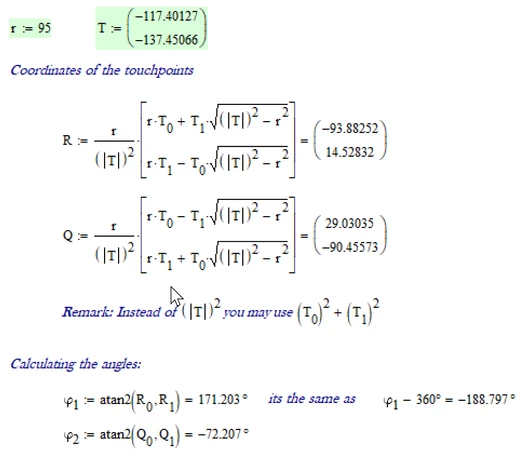
From your last post it looks like you are finally interested in the coordinates of the points Q and R, not necessarily in the angles.

You could calculate the coordinated directly like this and of course you could use the point coordinates to calculate the angles:

B.png

Again those calculations could be done in Excel as well.


11 replies

25-Diamond I
August 16, 2019

So the input values are A,B,C, h and k and the value you are looking for is the angle beta (one of the two solutions possible) as given in the in the first answer of the stackexchange thread you point to?

Sure it would be easy to do in Mathcad or Prime,

B1.png

but it should be as easy to do in Excel. Excel offers ARCCOS() or ACOS(), ARCTAN() or ATAN() and the square root SQRT. What else would you need more?


If you are looking for a free calculation program you may want to explore GeoGebra (Classic 6 or 5) -> https://www.geogebra.org/download

B2.png


BTW, I also wonder if A,B and C really are the most natural input values for your real world problem.

I also wonder if the formula given in the stackexchange thread is fully correct. It sure misses the absolute value of C and it only returns one value while the task has two solutions.

Trenton1-VisitorAuthor
1-Visitor
August 16, 2019

Oh, I think I see it now, (3) is the solution for the angle. I thought I had to sub (3) into (1) but that is for the line that I don't really need.

I don't need to use A,B or C as I have R as another vector perpendicular to the one that has to pass through the point.


Thanks.

25-Diamond I
August 16, 2019

I am not really sure if I understand but I guess it means that you realized that you can quite easy do it in Excel, too?

BTW, I added something to my answer above


R is not a vector but a length and I guess that your input simply are the cartesian (x,y) coordinates of two points. One of them should rotate around the origin. Or is the input values the polar coordinates (r,theta) of one or even both points? In case you haven't found out yourself how to do it you sure should provide a concrete example with all the numerics - preferably one where you already know the two solution angles.


Or maybe your input values really are just the fixed point and the radius and you are just looking for the information where to position the rotatable cam. This would mean three input values and two outputs.