21-Topaz II
Mar 28, 2023 2:37 PM UTC
Solved

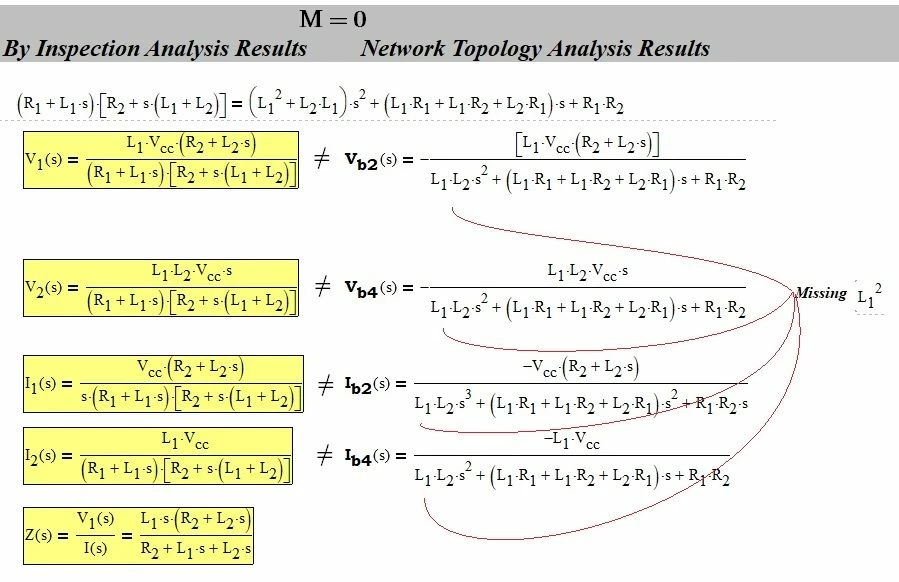
Why L1^2 is missing?

Hello everyone!
I have been looking into the transient in this passive circuit for some time. However, I see that the theoretical results do not coincide with those using the TABLEAU matrix. As you can see at the end of the worksheet, the denominators are slightly different i.e. L1^2 is missing. Why. Whoever finds the source of the problem is really good.
Thanks to anyone who can answer.
Greetings.Why L12 is missing.....jpg
 

ttokoro
ttokoroAnswer
21-Topaz I
Mar 29, 2023 4:51 AM UTC

image.pngimage.png

image.pngimage.png

image.png

image.pngimage.pngimage.png

t.t.

5 replies

23-Emerald V
Mar 28, 2023 5:58 PM UTC

Buongiorno,


I think you are not missing an L1^2*s^2 term where you indicate it, on Vb2(s) side, but you have one too many on the other side , for V.1(s).


Here's my quick analysis of the circuit:

LucMeekes_0-1680026272477.png

Success!

Luc


Translate
-MFra-21-Topaz IIAuthor
21-Topaz II
Mar 28, 2023 7:49 PM UTC

Thanks, but the following solution seems more correct to me:L. M. answer.jpg

Translate
23-Emerald V
Mar 28, 2023 9:40 PM UTC

I think that ( whether I assume that Vcc, like V2 and V3, is a function of s, or you state that Vcc is a constant, so its Laplace transform is Vcc/s ) may be a matter of taste.

But we (now) both agree that there should be no L.1^2 term in the denominator. Hence Vb2(s) is not missing a term, but V.1(s) has one too many.


Success!
Luc

Translate
ttokoro
ttokoro21-Topaz IAnswer
21-Topaz I
Mar 29, 2023 4:51 AM UTC

image.pngimage.png

image.pngimage.png

image.png

image.pngimage.pngimage.png

Translate
t.t.