


From MQTT Connectivity to Context-Rich Industrial Data: MQTT v5 and Unified Namespace
Industrial environments have never been short of data. The challenge has always been connecting that data, understanding its context, and making it available to the applications that need it.
A machine might publish a temperature value. A production system might know which line that machine belongs to. An MES might know which production order is running. An analytics application might want to consume all of this information.
The data exists—but historically, connecting these systems often meant building integrations around individual systems, properties, and point-to-point connections. That model becomes increasingly difficult as industrial environments grow more connected.
With ThingWorx 10.2.1, the MQTT extension is taking an important step forward with MQTT v5, bringing modern MQTT capabilities, stronger security, improved responsiveness, and—perhaps most importantly for modern industrial architectures—greater awareness of the context carried by MQTT topics.This is where MQTT v5 and Unified Namespace (UNS) come together.
The goal isn't simply to move more data. It is to make industrial data easier to move, easier to understand, and easier to consume across the ecosystem.
The bigger picture: interoperability, not another connector
Industrial architectures rarely consist of a single system or protocol.
There are machines and controllers, SCADA systems, historians, MES platforms, cloud services, analytics applications, AI systems, and increasingly, applications that need to consume information in real time.
That makes interoperability a strategic requirement.
ThingWorx has been progressively expanding its interoperability capabilities. The enablement roadmap highlights IoT Streams, MQTT egress through IoT Streams, CESMII interoperability, and now MQTT v5 as steps toward a more open industrial data ecosystem.
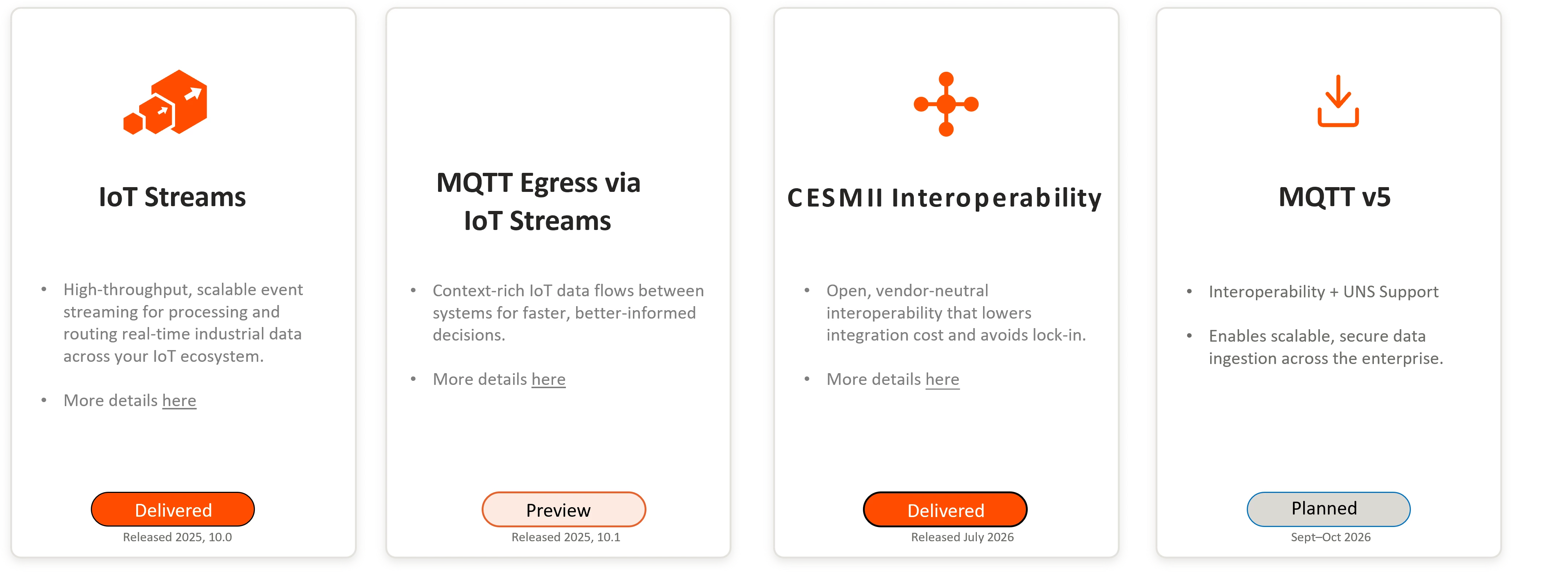
ThingWorx is committed to Interoperability
The common thread is simple:
Industrial data shouldn't have to stay trapped inside the system that generated it.
It should be possible to ingest it, contextualize it, process it, and make it available to the applications and systems that need it—including analytics and AI applications.
And that is exactly where Unified Namespace becomes interesting.
So, what does Unified Namespace actually mean?
The term Unified Namespace can sound more complicated than it really is.
At its core, the idea is straightforward:
Systems communicate based on what the data means—not simply where the data came from.
Instead of thinking:
“I need to connect to the MES system to get this value.”
you can think:
“I need the production data for this line.”
The business context becomes part of the way the data is organized.
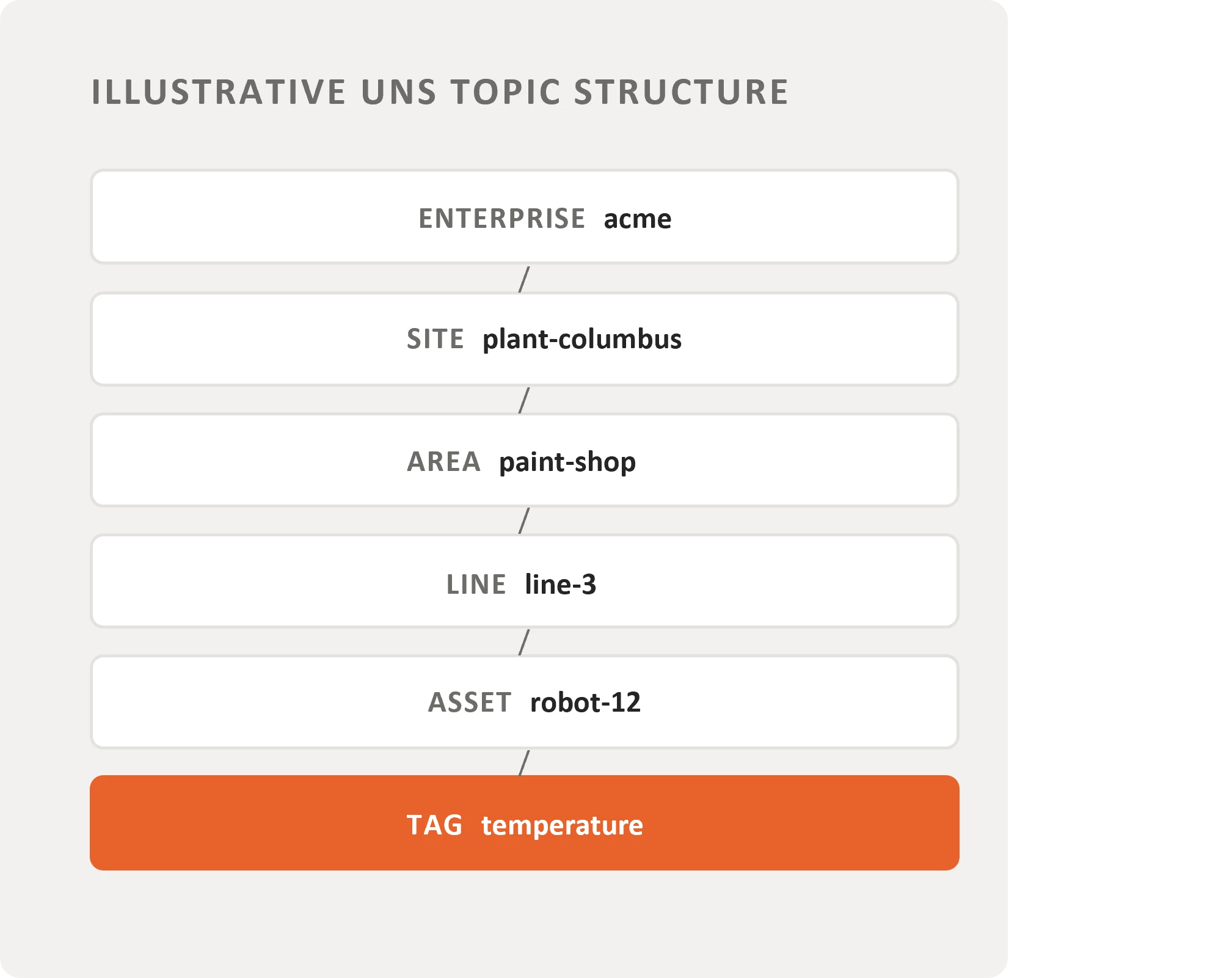
For example, a UNS topic might follow a structure such as:
enterprise/acme/site/plant-columbus/area/paint-shop/line/line-3/asset/robot-12/tag/temperature
The exact topic hierarchy can vary by implementation, but the important idea is that the topic itself carries meaning.
The data isn't just:
72.5
It is:
temperature→robot-12→line-3→paint-shop→plant-columbus→acme
That context makes the data significantly more useful to the applications consuming it. The ThingWorx 10.2 enablement material describes UNS specifically as topic-centric business semantics, where applications publish and consume data based on business meaning.
The shift: from values to context
This is where the MQTT v5 work becomes particularly important.
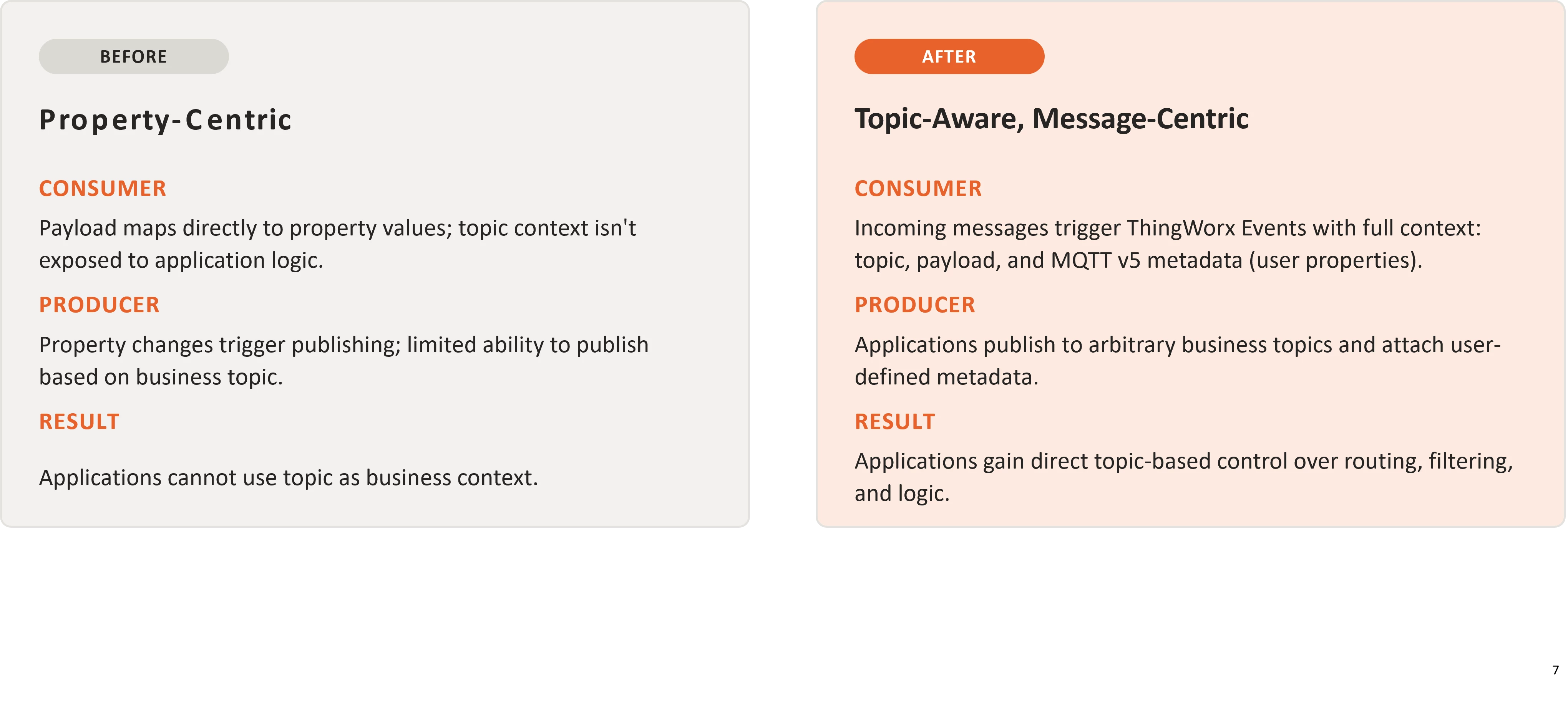
Historically, MQTT integration in ThingWorx has been largely property-centric.
A message arrives, its payload gets mapped to a property, and the application works primarily with that property value.
That works well when all an application needs is the value.
But what if the topic itself contains important business context?
In a UNS architecture, the topic can tell an application what the message represents.
With the MQTT v5 capabilities, ThingWorx moves toward making that context accessible to application logic.
On the consumer side, incoming MQTT messages can trigger ThingWorx events with:
-
the topic
-
the payload
-
MQTT v5 metadata, including user properties
On the producer side, applications can publish to arbitrary business topics and attach their own metadata.
This creates a fundamental shift:
Before
MQTT delivered a value.
Now
MQTT can deliver information together with its context.
And that distinction matters.
Because once an application understands the topic, it can use that information for routing, filtering, and application logic, rather than treating the topic as something external to the application.
ThingWorx becomes a native platform for UNS-style application developement
What does this mean for a ThingWorx application?
Imagine a factory publishing data through a UNS.
Instead of creating separate integrations for every application that needs production information, applications can subscribe based on the business context they care about.
For example, an application could be interested in:
-
all temperature data from a particular area
-
all events from a production line
-
all information associated with a particular asset
-
specific operational events identified through topic structure
The application doesn't necessarily need to know which underlying system generated the information.
It can work with the business meaning of the data.
This is one of the key ideas behind UNS:
Instead of asking, “Which system should I connect to?” the application can ask, “What business data am I interested in?”
That makes the architecture much more flexible as the number of systems, assets, and consumers grows.
MQTT v5: Modernizing the connectivity layer
The UNS story is only as strong as the connectivity underneath it. The new extension moves to an MQTT v5-based architecture, while maintaining compatibility with existing MQTT v3.1.1 use cases. But the modernization goes beyond protocol version support.
Please check the attached video for in-depth understanding of the extension.
Modern MQTT architecture
The extension is now based on HiveMQ and a non-blocking architecture, designed to handle MQTT traffic more efficiently and scale with increasing workloads.
Stronger security
Certificate-based authentication is supported through keystore and truststore-based certificate management, helping establish secure and trusted communication between MQTT clients and brokers.
Event-driven responsiveness
Incoming MQTT messages can trigger events directly, reducing the dependency on polling and allowing applications to react more quickly to incoming data.
High-availability readiness
The extension is designed to operate in HA environments, enabling more resilient enterprise deployments compared with the previous singleton-oriented model.
Greater flexibility
Topics can be created dynamically at runtime, helping applications adapt to changing integration requirements.
Together, these changes make MQTT in ThingWorx more than a connectivity mechanism. They provide a stronger foundation for working with modern, topic-oriented industrial architectures.
Vineet Khokhar
Principal Product Manager, IoT Security and ThingWorx
Stay tuned for more updates and as always in case of issues feel free to reach out to <support.ptc.com>