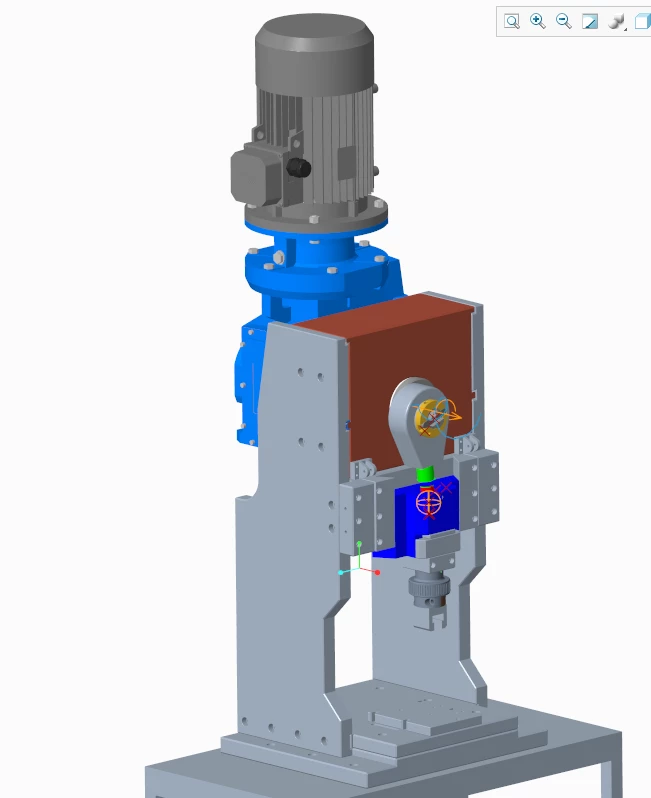
If you are still working on this I have a suggestion that will show how very high the force will be that the fixture and shafts will need to withstand.
Model the impact shaft as a stiff spring with the impacting end held.
Increase the stiffness/force of the spring until the motor reaches very close to stall torque very close to bottom dead center on the eccentric joint.
In order to do this you will need a realistic model of friction because otherwise the force is infinite to stop the motor since at bottom dead center there is no component of force about it axis other than friction.
Use a measure for the spring force generated. This is the maximum force possible which is now also seen to be dependent on friction and the stiffness of the impact shaft. Since it is dependent on stiffness, that is one of the reasons FEA would be desired, but this method should produce the maximum possible quasi-static force whereas the real flex of the whole setup would reduce this from the maximum. The inertial effects would increase this from the maximum but for really slow movement inertia can be neglected. I assume it is acting as a press, not hammer, however your title mentioned impact which sounds more like a hammer action.
Also, you want two pin joints at the top, the gearbox and the eccentric joint. You also want maybe a slider to limit the head to up down motion and the ball joint could be a cylinder to remove over-constrained degrees of freedom. (otherwise one of the pin joints could be changed from pin to cylinder)
My guess is you will see 100s of kN for force, which likely produces a lot of flex in your setup.