


Dale_Rosema
23-Emerald III
23-Emerald III
February 6, 2014
Question

Piercing a tube to create a boss.

  • February 6, 2014
  • 2 replies
  • 6799 views

There is a family of tubes that are cut to a raw length. Then they are run through a press to add a stamped hole and a piercing that gets tapped. Currently the family is built around the second step in that the the main diameter of the tube is extruded and the the piercing and hole are added (negating the fact that they come from a pre-cut tube length).

I was going to brake these appart so that the BOM called a tube in an assembly and then I was going to add the piercing. I forgot one thing. You cannot add an extrude in an assembly (only a cut/extrude). Any thoughts or suggestions on how to procede?

Thanks, Dale
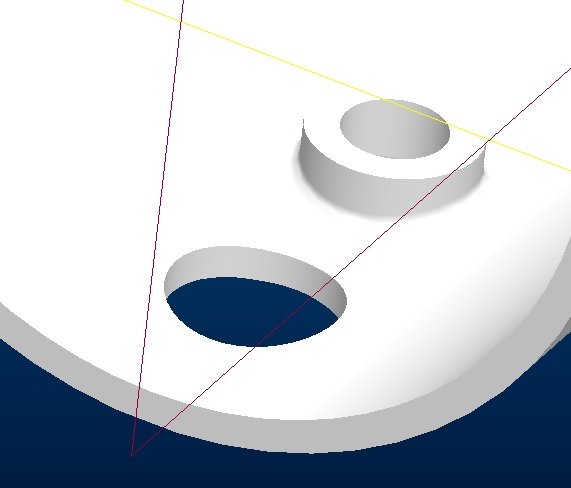
Pierce_boss.jpg


This thread is inactive and closed by the PTC Community Management Team. If you would like to provide a reply and re-open this thread, please notify the moderator and reference the thread. You may also use "Start a topic" button to ask a new question. Please be sure to include what version of the PTC product you are using so another community member knowledgeable about your version may be able to assist.

2 replies

17-Peridot
February 7, 2014

Why is it that the Pink Floyd's song The Wall comes to mind every time someone wants to do something only to get whacked with a ruler across the knuckles by the "teacher".

It is so odd that PTC doesn't recognize the need to "re-strike"... a form operation that happens at a next level assembly. This is so common in the industry!

I have seen a tutorial on a progressive die tutorial from PTC. They make extensive use of merged features from one level to the next. I cannot wrap my head around the logic, but there it is.

Let us know what you come up with.

Dale_Rosema
23-Emerald III
23-Emerald III
February 7, 2014

As for now, I will live to fight another day. Now I know why they didn't do that. We'll have a dumb BOM at that level for now and just keep it that way.

I let you know if I come across something else and can go from there.

Dale_Rosema
23-Emerald III
23-Emerald III
February 11, 2014

Ryan Kelley

Do you or any of your collegues have a suggestion about a way to add materail in an assembly (move material in this case)? If I form a tube by punching it with a press and get the boss on the inside while referencing it from a blank tube in an assembly.

Thanks, Dale

1-Visitor
February 11, 2014

Dale,

Currently adding material (or any feature) to parts in assembly context only is not supported.

Assembly-specifc context variations are available either as:

- Remove material - by assemly cut

- Change dimentions and parameters - by flexbile components/features

For the challange you are describing - there are two options you may consider:

1. If you wish to use *same* object for the different steps of the process (before/after adding the features) in different drawings - you can use part simprep and suppress the features as needed per drawing.

2. If you wish to have different object per step in the process - you can use Family-Table or Inhgeritance features.

We will consider in future releases to support part-level features addition in assembly context (similar to flexible components).

Hope that helps.

17-Peridot
February 11, 2014

Dale, since often we want to make a raw material part and leave it alone (read only file) it is problematic having to change the common raw material file for every iteration in next level fabrication. An incidental file corruption can create havoc across a broad real product offering from any company.

I use to have this issue with O-rings fitting glands... they can be round, rectangular, odd, or squished. Similar issue as "wire". Often wires would have to be shaped to the particular application. There is no way I would want the master part file to be edited at every turn. These files have been there for decades and really should d-never- be altered.

The solution we came up with is that the file name (which is the part number) would be the original file name with a dash and the name of the file where it is used. It was a great convention if you don't have strict PDM structure rules. You would also assembly a blanked original part. to account for the item in the BOM. Any part number that did not comply with the part number format would be removed from the BOM.

For example, I have an o-ring p/n N23456 and an assembly C65413. If I need a specific shape of the o-ring, I create a part N23456-C65413. You can easily find the o-ring by the base number, and the where used by the second number. For those occasions where there are similar assemblies, the o-ring can be used with this same second number (where used in PDM will find it anywhere). The idea is that you won't change it willy nilly anyway. You would also assembly a blanked N23456 into C65413 to account for the part in BOM creation (PDM or Repeat Region Table).

In the case of the wire, the parts are all empty. This is the case of bulk material where you simply do not need any geometry in the part file. It becomes a placeholder.

In your case, tubing is a simple enough flexible component as long as it is not formed, bents, or otherwise changed in the manner you are proposing. Again, since the raw material is 99.9% stable in properties, there are limited reason you would want to assembly the raw material and then it at a new level for processing.

Similar scenario is sheetmetal. We re-invent the raw material at every instance. We do not stock a 4x8 sheet where a 4x4 or 2x4 sheet will suffice the same. We all form up a part based on a raw material and we account for it by either weight or unit length (rarely in the "Each"). But we have to account for that raw material in many cases. The above solution deals with this. We account for the raw material (the o-ring by p/n) and we create a geometric representation with a "placeholder" filename.

There has to be countless implementations of similar issues across the install base for all platforms. Things were a lot simpler "on the board".

Dale_Rosema
23-Emerald III
23-Emerald III
February 11, 2014

The tubing that we buy are precut lengths and not just random 20's. So we order size specific parts that may (or may not) have secondary operations done to them depending upon what type of parts need to be made. And sometime they are not bought as blanks, but may have other things laser cut into them.

From a part-numbering standpoint, we do something similar for "specials" which are standard products modified to different lengths than the stadards that we offer. We just add the special length to the end of the part. These are typically cut from the next largest standard tube that we offer and for some special cases, we have a few random 20' for that extra long part.

The reason for wanting to assemble this into the secondary operations is that when I do have a special, I can modify the blank tube's length and it will propagate up the tree when I do a regen on the top level assembly. Currently with this and a couple of other operations, I have to modify 3-4 different parts to get the one length change that I want instead of doing one length change. This also reduces the potential for error when having to modify more then the one part.

Thanks for all of your input and discussions. It always helps to have fresh eyes to looks at what you are doing and see something that you may not be seeing it how to accomplish a task.