

Torque and centrifugal loads
Hi,
I want to simulate an air plug which makes the distribution in a motor.
This plug is in the cylinder head and two bearings at each end hold it in place.
Thanks to a chain on a sprocket at one end, the part rotates at 4000 rpm. So I add a centrifugal load on the whole part.
The chain does not rotate everytimes at the same speed and due to the inertia of the part, the chain creates a torque at one end of the part.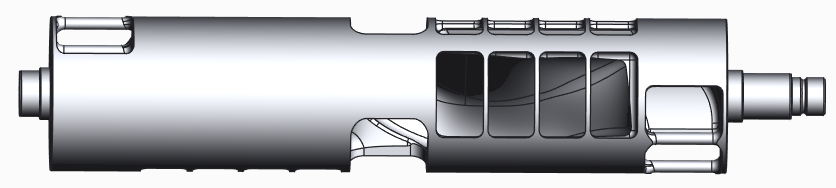
I put two pin constraints and two planar constraints at each end to simulate the bearing and I add the torque on the right end (460 Nm).
But I need to block the last degree of freedom (the rotation on the central axle of the part) otherwise I can not do a simulation...
I don't know what to block because in the reality the part is not blocked...
Can you please help me ?
Thanks,
Jordan
This thread is inactive and closed by the PTC Community Management Team. If you would like to provide a reply and re-open this thread, please notify the moderator and reference the thread. You may also use "Start a topic" button to ask a new question. Please be sure to include what version of the PTC product you are using so another community member knowledgeable about your version may be able to assist.