13-Aquamarine
May 14, 2016
Question

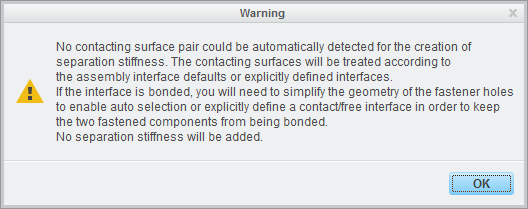
Fasteners fail

  • May 14, 2016
  • 2 replies
  • 8173 views

Creo3.0 M030

My surfaces are flat, holes are co-axial, only 2 components, the most benign model imaginable and  (grrr) ITAR.

Original geometry from Solidworks.

No lead in chamfers (first thing I dealt with).

Any thoughts?

(I have resorted to the old fashioned shrunken beam method)

Thanks

2 replies

1-Visitor
May 14, 2016

Do the holes that the threads are screwing into have a counter bore? Those are also not allowed.

Do the holes break through creating a non square edge for selecting the fastener ending reference? In that's the case you'll need to first create a surface region to square off the bottom of the hole.

Also make sure there are no c'bores, rounds, or chamfers in the entire length of the fastern.

Hope this helps,

Don Anderson

346gnu13-AquamarineAuthor
13-Aquamarine
May 14, 2016

Don,

No rest for you either eh?

This is a typical hole, fastener edge references highlighted.

Fastener head has smaller diameter than its counter bore.

I've done 1000's like this and have never encountered an issue with this typical geometry before.

There's just something 'funny' and I can't find it.

I will try removing the point, square the end off.

Thanks

Charles

346gnu13-AquamarineAuthor
13-Aquamarine
May 14, 2016

The following doesn't help :

Making the threaded hole square ended

Making the holes in both parts exactly the same diameter

Messing about with accuracy

1-Visitor
May 15, 2016

I'll wager that it is a failure to correctly evaluate surface normals in the import geometry and that the solid modeling kernal has a tweak to hide the defect from the user but the analysis software doesn't. Like, all the normals are pointing inward.

It's also possible that there is a difference in hole construction. PTC's cylindrical surfaces have 6 unique edges and are split into two surface patches, but maybe the SW model doesn't.

I'm leaning more to the former as contacting surfaces should have opposing surface normals that point out. Not having that condition would certainly lead to an inability to find a contact.

346gnu13-AquamarineAuthor
13-Aquamarine
May 16, 2016

looking the wrong way along the hole axis would fit the experience.

Though the following seems inconsistent with the hypothesis:

  • The problem persists if I 'model over the top'
  • The problem doesn't occur for a pattern of holes at a larger pcd.in the same parts
  • All other parts have behaved as expected
15-Moonstone
May 16, 2016

Hello Charles

Attached is a document which may be of interest to you.

Kind regards.

Denis.