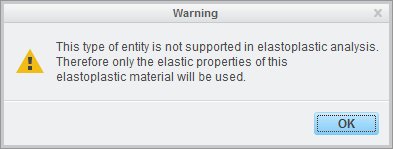
Correct, you can't use beams in models with plasticity. You will need to model the bolts using solids, which may be prohibitive. Or use Ansys...
I have requested having the possibility to include beams (+links) in large deformation models/plasticity models, but had no sucess yet. I would think it is relatively easy to implement this. As long as the beams themselves stay in the linear region and do not bend like fishing rods, they should be able to undergo "rigid"-body rotation and be included in large deformation/plasticity models. In statically indeterminate load cases with contact, deformations may be "small" but you still need large deformation analysis for correct results. Being able to include beams in such models would be great. It is often you have designs that rely on friction and contact, where pre-loaded bolts are present, and where you need to include large deformations to get correct results, even if deformations appear small. I hope PTC's staff reads this...
We don't often carry out plastic analysis. 99% of problems are linear enough. Use is mostly when a component cannot be redesigned to reduce stresses and therefore we need to know if it will actually rupture.
These components tend to be buried in an assembly and the loads to which they are subjected are complex and any attempt to carry out a single component analysis will give results that are simply wrong.
... This is where we could use sub-modelling to great effect and would be immediately much much more useful than being able to use 128gb RAM, buying light speed SHDD's and CPU's that require their own substation ...
The plastic material properties are limited to specific volume regions of a component. The rest of the model has linear material properties. Making the complete component plastic would be onerous.
I found that it isn't possible to work around using solids and preloads either. Preloads not supported for models with plasticity.
One discovers this after applying a preload to a model with plastic materials applied (or vice-versa). The moment of discovery is when the attempt is made to set up a static analysis.
A warning should be presented during the model build and not lie in wait to ambush the work.
I did check the help files. The help files ...
The overview should have a list of limitations as a MAJOR heading in the overview and therefore UN-miss-able.
Nothing in the help is immediately obvious or maybe I use it the wrong way.
Then the work around using solids with contact/interference. Just keeps failing insufficiently constrained. (tangential dofs were constrained). Using contact/interference eliminates anything to do with temperatures.
I had already filed a brief support call re volumetric preloads not recognising a prismatic volume if extruded up to surface rather than as a blind protrusion but this insufficiently constrained frustration will take many hours to build and reproduce in a model I am allowed to submit and will have to wait for some down time.
So I have tested a simple component with a volume region and a temperature load in the volume region (to shrink and gets rid of contact interferences) I am still able to define an analysis with plasticity and ran it.
The question is whether I am confident to invest more time here or to actually move the study to ansys as suggested earlier where I have certainty of outcome. (the reasons for remaining in Creo are at the request of the client; I will bend this soft rule if I have to in order to get the answers out of the door)
Just to demonstrate, I make a quick test with a model that requires large deformation analysis, in a pre-loaded structure, but where deformations may seem small. A bolt maintains a pre-load on a wedge that holds a component. An external load is applied to the part held by the bolt/wedge arrangement. I want to include the effect of shear/bending of the bolt; this is why it is necessary to use large deformation analysis - the problem is statically indeterminate.
The load is applied in two steps, first a pre-load to tighten the bolt, then the external load is applied. This is accomplished by using different time functions in the analysis form.
In a contact analysis like this, even though deformations are seemingly small, they are significant in comparison to the stiffness of the structure. This is a typical example where I would like to be able to include beam elements in a large deformation analysis, to model the bolt. In this simple example, it worked fine with a single solid bolt, but if there are many of them, and/or the model is otherwise complex, some component has material nonlinearity etc, I don't want to model bolts like this. I want to be able to include beam elements.
This model contains 3970 elements, took about 15 mins on my laptop (64 bit, 16 GB RAM, 2x2.7 GHz) It was made in Creo 3.0.
unfortunately, like you recognized, there are still many limitations in combining different nonlinear functionality in Simulate. You may find some useful information for your problem in my recently created blog “Rolos Simulate Sources”. Simply download the following presentations from there:
In this presentation about bolted connections, you’ll find an example about a centrically loaded fastener that undergoes significant plastic deformation (slides 41-51). I had to spend significant time to get that finally successful running, also because for the limitations described further above (no preloads, no non-isotropic materials in combination with elasto-plasticity, …). This was a real-world project, so no simple demo example. Unfortunately, all of these limitations still exist, and elasto-plasticity needs to be improved (I still have at least one open SPR for it).
All these limitations make Simulate pretty uncomfortable and sometimes impossible to use, as soon as a problem becomes a bit more complex. There is a lot of work to do for PTC R&D to improve this situation. This means implementation of significant enhancements and robustness increases for a lot of nonlinear engine functionalities. From my experience with the code won the last two years, R&D already has to struggle hard just to fix many existing bugs (I opened around 100 Simulate SPR after I left PTC, half of it is still open), and you can see that there is not even one engine enhancement or even robustness increase planned in Creo 4.0. That’s why I wrote this long feedback chapter for PTC in the finite friction presentation. This all needs highest management attention from PTC side and significant invest is necessary to compensate the huge loss of brainpower with laying off the San Jose engine group in 2013.
To be honest – I don’t know why this work has been branded as PTC internal only, I even did not recognize this when I worked for PTC, and I do not know who was responsible for this classification at PTC.
The presentations I wrote for PTC Global Services were always intended as public information for PTC users. They were supported by the old Simulate engine group in SJ: I got R&D info very helpful for understanding how to better apply the code. In this case, you usually find an acknowledgement at the end of the presentation (typically, Rich King, Tad Doxsee and Christos Katsis gave this support). We have always posted all these presentations in the archive of www.saxsim.de, where you still find them today. Even though I was working for Global Services in Germany, I sometimes started to write these presentations in English so that all users could benefit from them, not only the German ones. The old engine group itself used these presentations for their purposes, too: E.g. you find my presentation about Hyperelasticity from 2010 posted by Christos Katsis here in the PTCusercommunity.
When I prepared my latest presentation about finite friction during the last weeks, I started to search the internet for experiences other customers have with Creo Simulate, since I became pretty displeased the last two years about the quality state of the code after the engine group was laid off. There, I found the PTCusercommunity again which came a bit out of my mind. I recognized that users complained that these GSO presentations are not available. So I decided to create my own blog now (Rolos Simulate Sources) to make this info easier available to all at one certain place.
I hope this will limit now the effort necessary for doing reverse engineering… 😉
Best,
Roland
Translate
Windchill Satisfaction Survey
Help shape the future of Windchill. Take our 5-minute survey and share your feedback.