Werner_E
Werner_EAnswer
25-Diamond I

No answer - that's a pity!
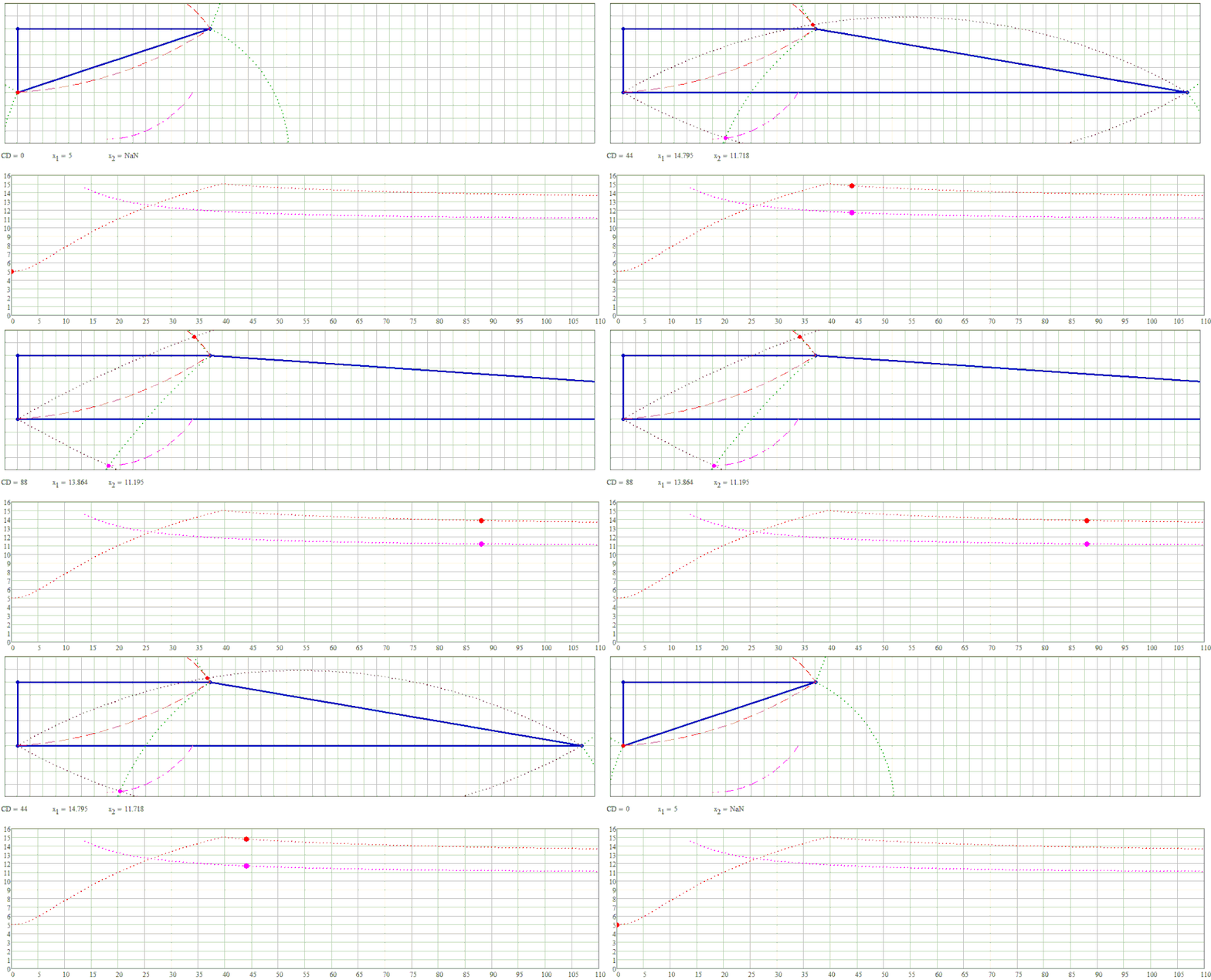
But no matter - anyway, to conclude for what ever it may be worth, here is a small animation made a few days ago, which shows the position of the possible solutions for P and the graphs of the distance functions at variable distance CD.

have fun!
ani2.gif

70 replies

Werner_E
25-Diamond I

OK, here is the approach which came into my mind at first.

Its basically the way a school pupil would be assumed to approach the problem. BP can be expressed in two ways using the triangles ABP and BCP using an auxiliary angle like beta in my pic. From the resulting two equations I eliminated BP and using the basic angle sum and difference identities I arrived at an expression for beta. Mathcads symbolics wasn't of much help here and it was quicker done by hand 😉

Using beta we can calculate AP and then the position/coordinates of P (using a' and b') and finally the distance x=PD.

The approach is straightforward, we get a nice (but not fully simplified) exact result and the approach can also be done fully symbolically (see one of my previous posts with all the symbolic expressions -> x1)

B1.png

Translate
Werner_E
25-Diamond I

And now my second approach.

It follows the way one would draw a sketch of the situation using peripheral angle arcs. Not sure whats it really called in English - maybe a native speaker could help.

Its quite easy to determine the center and radii of the two circles and using the symbolic solve, the points of intersection are found. Of course one of those points is B, so we filter for y>0 (and surprisingly Mathcads symbolics really takes this condition into consideration) to find P and finally calculate x=DP.

Again we can also get an exact result (not fully simplified and equivalent to, but more complex as the expression we got with method 1).

B2.png


Translate
Werner_E
25-Diamond I

Finally my last approach and the worksheet.

After thinking about method 2 where we intersect two circles and already know one of the points of intersection, it was clear, that all that must be done is to mirror this known point B at the connection line of the two circle centers.

This sure could be done in quite some different ways and I settled at using a transformation(mirroring) matrix.

This approach delivers the most simple exact representation of the result as could already be seen in the sheet with the symbolic functions I posted a while ago. -> x3

x3b was an attempt to manually simplify the expression further, but while the symbolic expression looks a bit smaller, the exact result with the values provided could not be simplified by Mathcad in a satisfactory way.

Here is the picture of method 3 along with a plot showing the circles and also the mirroring of point B to get P.

B3.png

MC15 worksheet attached.


Translate
23-Emerald V

I've seen more math problems like this...

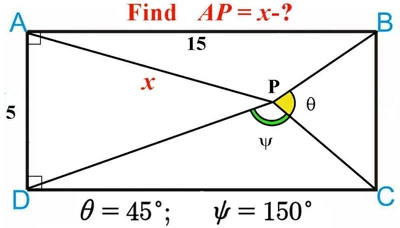
angles DAB and CDA are 90deg, so we know that AB and CD run in parallel, but the length of CD is not given, and neither is the length of CB. There's no telling if CB runs in parallel of AD.

I doubt if the problem can be solved with just knowing the sum of angles psi and theta. If not, I'm afraid the problem cannot be solved.


Luc

Translate
24-Ruby IV

Sorry - more correct picture

rec.png

Translate
-MFra-
21-Topaz II

Update. All that remains is to do the animation:

VO1.jpgVO2.jpgVO3.jpg

Translate
24-Ruby IV

I am tormented by doubts. It seems to me that in this zone there is either no solution or more than one solution!

Rec-Feel.png

Translate
Werner_E
25-Diamond I

@ValeryOchkov wrote:

I am tormented by doubts. It seems to me that in this zone there is either no solution or more than one solution!


The reason you get no or multiple results is because your solve block equations seem not to be well conditioned. Guess you need additional or other constraints to make the solve block work OK within the full valid range for CD. You sure know about this problem from your various experiments with different catenaries

.

As long as we demand that P has to be inside the quadrilateral there is exactly one solution (which is also shown by my animation).

You should try to calculate the coordinates of the point P from the solution lengths your methods give you and check, if the point is inside and if two initial angles (you have to calculate them with the coordinates of P) are still correct.

You should see that the second "solutions" you get are not really solutions as they violate either the rule that the point is inside or the angles are wrong.

It should be clear that, if CD changes, P is moving on a circle from D (for CD=0) to B (for CD approx. 39.434) as it has always to be seen at an angle of 165° from the segment BD. There is no solution for P inside the quadrilateral for CD > 39.434.


Create an animation using your calculation methods where CD changes from 0 up to 40 and show the quadrilateral, P and the calculated(!) angles psi and theta.


And .... if you really think that there may be no or two solution for, lets say, CD=9, then take a piece of paper, ruler pencil and compass and manually try to construct a solution. The two circles you have to intersect in doing so will intersect in C and P and I am pretty sure that there will be no third point of intersection and that P will be inside the quadrilateral - so you will end up with a unique solution.

I suggested doing the construction manually with pen and paper because to me that would be just more satisfying than doing it with a CAD or a program like GeoGebra, which you can do, too, of course.


Translate
-MFra-
21-Topaz II

A different approach to the problem, but with the same previous results:

VO4.jpgVO5.jpg

Translate
-MFra-
21-Topaz II

Study of the problem. Possibility of freedom of movement of point P (x0, y0).

I should say something about the possibility that the point P can move at least around the rectangle. From this analysis it seems possible. It requires further study.

VO6.jpg

Translate
Werner_E
25-Diamond I

Looks interesting - could you please elaborate on what the various plots in our sheet show?

As far as I see your functions are dependent on variable length CD and variable length BC.

In the (extended) question so far AB and CD were still parallel and so BC could be calculated based on CD.

Does your sheet extend the problem further to even more general quadrilaterals?

As far as I understood the pending question so far is a about the position of P and the distance AP when CD is changing (with DC parallel to AB).

Which problem do you study in your sheet?


Translate
-MFra-
21-Topaz II

It is the study of the trend of the two segments, a and f, varying the dimensions of the rectangle sides simultaneously (the two surfaces) and of one side at a time (graphs).

Translate