Best answer by Werner_E

Valery Ochkov wrote:

Thanks, Werner!

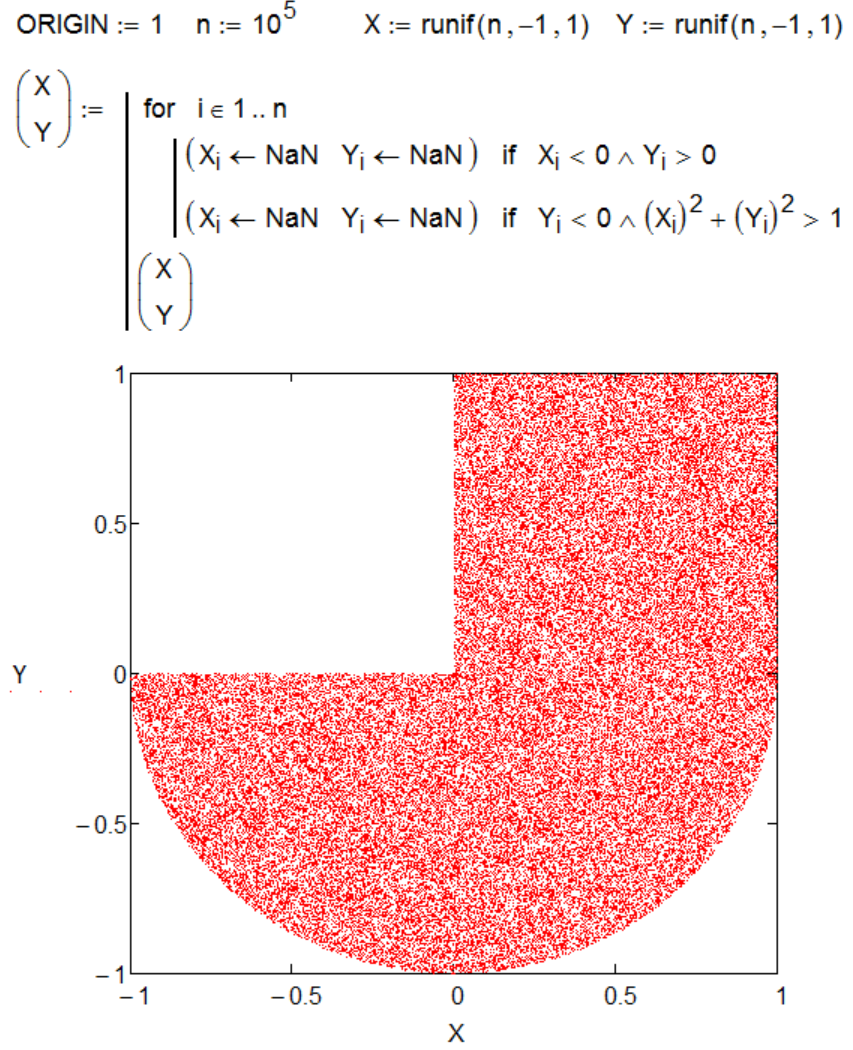
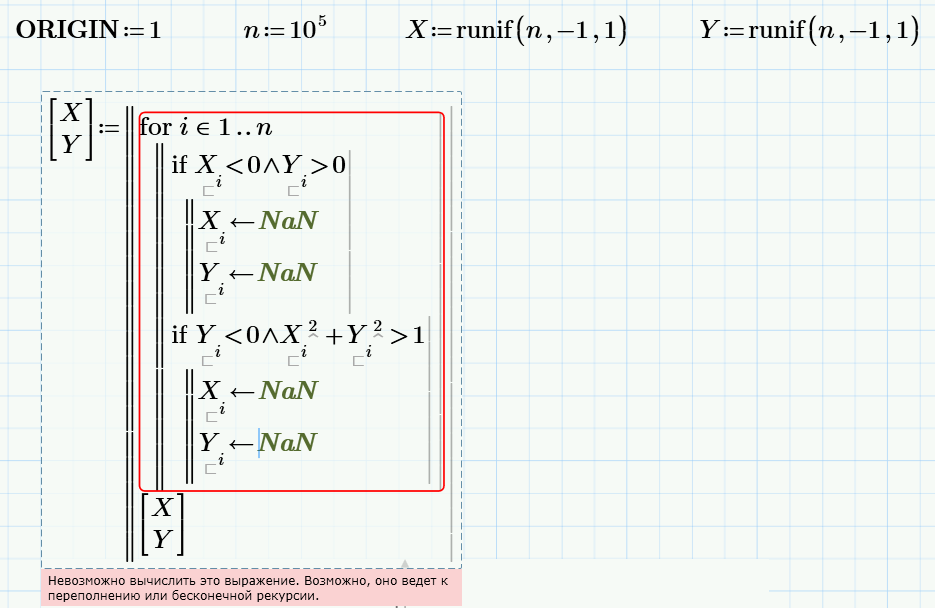
But without Fred's function we have a bug in Prime! In Mathcad 16 all is OK at n=10^5

Yes, its a bug. I could reproduce it.

Not sure what the reason for it could be.

First thought was that it might be a confusion between local X and global X, but using X <-- X in the program first did not change anything.

2 replies

23-Emerald I
November 17, 2016

Work around:

23-Emerald IV
November 17, 2016

Yep, I find the same Fred, but in Mathcad 11!

I suppose that Mathcad 15 is the exception here and

Once more, they've managed to bring some functionality of Mathcad 11 into Prime. That .... is.... an.... improvement....?

Here's the fun stuf (I stripped the program somewhat):

Notice that you loose array elements. With every run I get between 90 and 99 elements for each of the two elements of Z.

And notice how all the other, non-NaN elements are 0. (I can't check what Prime does here, I'm limited to Express = no programming).

But when I make Z a function of X and Y, I consistently get two arrays of 100 elements back, and the in-between numbers are (mostly) non-zero:

Luc

23-Emerald IV
November 17, 2016

When n=10, I (also) loose about 1 to 10 elements, so am sometimes left with zero elements in the two parts of Z, but sometimes:

I get them all.

So do I loose 0 to 10 elements consistently...

What if n=1000:

OK, it's possible to loose more than 10 elements, but it's rare. The worst I've seen in about 50 runs is 15 elements lost.

Luc

24-Ruby IV
November 17, 2016

Is it a center of mass (gravity)?

The converted sheet from Mathcad 15 to Prime 3.1 gives an error. See two sheets in attach.

23-8-Ship.png

24-Ruby IV
November 18, 2016

One verify:

23-9-Ship.png