Best answer by RogerMansfield

In my PlanetPTC post of February 3, I did not mean to shift the discussion away from Edwin Hubble and toward John Mather. It is just that the age and temperature of the universe are intimately related.

If Edwin Hubble can be said to have determined the age of the universe by means of his galactic recessional velocity vs. distance graph, then John Mather and his COBE colleagues took the temperature of the universe.

Because what John Mather and the COBE team showed is that the universe, as it exists today, behaves exactly like a black body radiating at 2.725 degrees Kelvin.

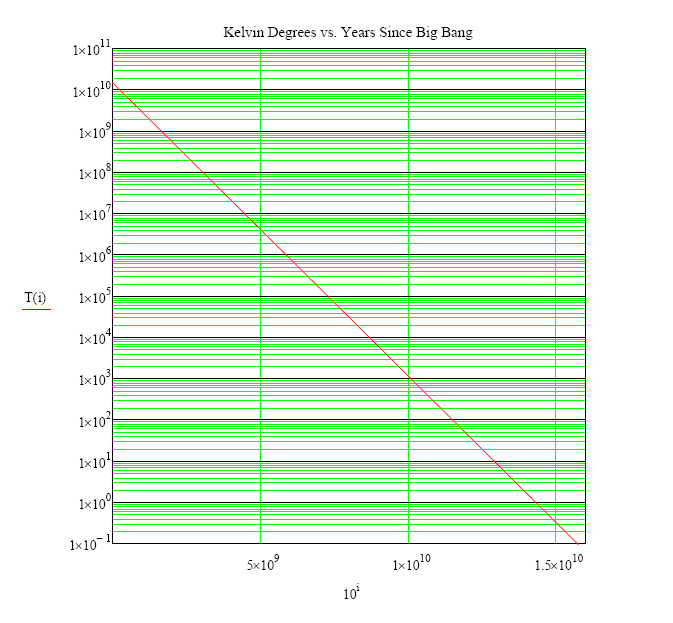
Given that it took the universe 13.7 billion years to cool down to its present temperature of 2.725 degrees Kelvin, as measured by the COBE team, how long will it take for the universe to cool down by one more degree, to 1.725 degrees Kelvin?

Using Hubble's and Mather's results, we can answer this question, at least to a first approximation. And we do not have to use any high-powered math or physics to come up with a reasonable answer.

So how long do you think it will take for the universe to cool down by one more Kelvin degree? Choose one:

A. A year.
B. A hundred years.
C. A thousand years.
D. A million years.
E. Much longer.

Or can you calculate an answer? (Hint: see the graph below.)

To see what I have calculated, download the attached Mathcad 15 worksheet or its rendering in Adobe PDF format.

Temp_vs._Time.jpg

2 replies

1-Visitor
February 2, 2011

Yes, they are both helpful and educational. The graph of recessional velocity vs. distance, nicely done in Mathscinotes, was first presented to the astronomical community by Edwin Hubble in 1929.

Simon Singh reproduces Hubble's graphs and comments as follows [1, pp. 257-258]:

"So, according to Hubble and Humason's observations, all the matter in the universe was concentrated into a relatively small region roughly 1.8 billion years ago and has been expanding outward ever since. The picture completely contradicted the established view of an eternal unchanging universe. It reinforced the notion put forward by Lemaitre and Friedmann that the universe began with a Big Bang."

Cosmological theory predicts that if the universe originated in a Big Bang, then there should now (in modern times) be a remanent cosmic microwave background (CMB*) radiation, detectable in all directions of space, consistent with the radiation emitted by a black body at 2.7 degrees Kelvin. This is what John C. Mather reported in 1990 [2, pp. 234-235].

The currently accepted value for the age of the universe is about 13.7 billion years since Big Bang. But Mathscinotes calculates 13.5 billion years and Hubble obtained 1.8 billion years. Why the differences, when all three sources are using the same plot of recessional velocity (Doppler redshift) vs. distance?

The answer is simply explained via Mathcad. When one fits a straight line to the curve using Mathcad's "line" function, the addition of more data, or refinement of the existing data, will usually shift the slope and y-intercept of the line a bit. Hubble had very little data to work with in 1929, but now in 2011 we have much more data to work with.

*I did a Mathcad worksheet on Dr. Mather's CMB results a few years ago. It is attached as a Mathcad 11 file and as a pdf file. It was the twelfth worksheet in the "Mathcad Worksheets by Astroger" suite, about which you can find more at http://mathcadwork.astroger.com.

[1] Singh, Simon. Big Bang: The Origin of the Universe (Fourth Estate, HarperCollins/Publishers, 2004).

[2] Mather, John C. and Boslough, John. The Very First Light (BasicBooks, HarperCollins/Publishers, 1996). -- I had the good fortune of several conversations with Dr. Mather at the University of Denver (DU) in 2005, just months before he won the Nobel Prize. My friend Dr. Bob Stencel, William Herschel Womble Professor of Astronomy & Physics at DU, hosted Dr. Mather's visit to the DU campus.

1-Visitor
February 8, 2011

In my PlanetPTC post of February 3, I did not mean to shift the discussion away from Edwin Hubble and toward John Mather. It is just that the age and temperature of the universe are intimately related.

If Edwin Hubble can be said to have determined the age of the universe by means of his galactic recessional velocity vs. distance graph, then John Mather and his COBE colleagues took the temperature of the universe.

Because what John Mather and the COBE team showed is that the universe, as it exists today, behaves exactly like a black body radiating at 2.725 degrees Kelvin.

Given that it took the universe 13.7 billion years to cool down to its present temperature of 2.725 degrees Kelvin, as measured by the COBE team, how long will it take for the universe to cool down by one more degree, to 1.725 degrees Kelvin?

Using Hubble's and Mather's results, we can answer this question, at least to a first approximation. And we do not have to use any high-powered math or physics to come up with a reasonable answer.

So how long do you think it will take for the universe to cool down by one more Kelvin degree? Choose one:

A. A year.
B. A hundred years.
C. A thousand years.
D. A million years.
E. Much longer.

Or can you calculate an answer? (Hint: see the graph below.)

To see what I have calculated, download the attached Mathcad 15 worksheet or its rendering in Adobe PDF format.

Temp_vs._Time.jpg

12-Amethyst
February 8, 2011

If the universe has taught us anything, it's that everything takes much longer. I'm going with E. Much longer