
6-Contributor
November 16, 2023
Solved

Data Preparation for Bicubic2D Function in MATHCAD Prime 9.0
  • November 16, 2023
  • 2 replies
  • 5920 views

3D_Point.JPG

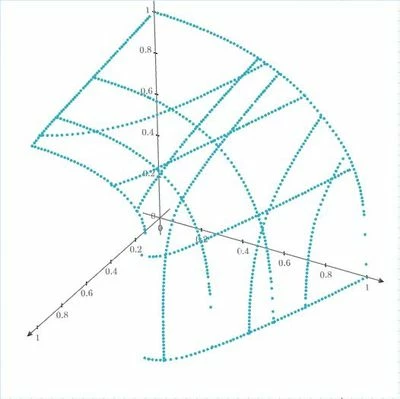
Good evening all. I have digitized some data points (see the 3D picture), in order to use interpolations in 3D.

The data are arranged in a matrix with N rows and 3-columns, each representing a coordinate. I need to create a data matrix for the functions "Bicubic2D" and "Create Mesh". The idea is to sort the data by the Z values and for each of them retrieving the matching X and Y values. Unfortunately duplicate Z-values are found, but belonging to different set of X and Y values. I would need some hints if someone encountered such a challenge before. Thanks in advance for the help.

Regards,

Gianfranco

Best answer by gianfry

I finally solved with this last hint the problem of mapping the points over a square domain. I just projected all the points on the reference plane Z=0. Then I removed the points that were too close to each other (as result of the intersecting curves) and reduced the set of initial points. After that I considered a net of X and Y values uniformly spaced and retrieved the ones close to a net point. After that the mapping was correct and win equal number of points in both X and Y direction. Then I checked the values interpolated vs the curves I digitized and the result was very good. I wish one day MATHCAD will have the interpolation function working also with different numbers of values in X and Y.

Thanks to everyone for the help. Problem solved!

2 replies

ttokoro
21-Topaz I
21-Topaz I
November 17, 2023

If you have a function such as , you can plot the any z line of the function.ttokoro_0-1700185058680.png

image.png

However, if you have only some f(x,y,z) lines data. you must interpolate the 3D surface and then plot the equi-z line.

Attach your data by Prime sheet, then some one help you to make it. 

t.t.
ttokoro
21-Topaz I
21-Topaz I
November 17, 2023

image.pngimage.png

t.t.
6-Contributor
November 21, 2023

This is exactly what I would like to achieve. However data preparation is quite cumbersome without pre-processing the raw data.

I tried to sort the matrix I created to visualize the points by the 3rd column (Z values) and try to retrieve the X and Y values corresponding to those ones. With lookup and/or match functions i got stuck because duplicated values/occurrences won't select all the values needed to build the matrix M needed to perform the interpolation.

Thanks for your the example.


25-Diamond I
November 17, 2023

I agree with ttkoro that you should post a worksheet including your data so we have something to play with 😉


I don't think that duplicate z-values should e a problem.

But to be able to use bicubic2D you need to provide z-values for every combination of x- and y-values present in your data set and I guess that thats not the case. So the problem may be fill those gaps.


Must it be a solution using bicubic2D?

Maybe you know something about the type of the surface function your data points are lying on and you can use a regression/fit rather than an interpolation?


6-Contributor
November 21, 2023

Hello Werner,

thanks for the hint. If I correctly understand I should fit all the curves I digitalized using a best fit technique and once I have them re-map the points at constant X and Y, retrieving the Z values, then build the M matrix with the Z values.

As I mentioned before I don't have the mathematical representation of the surface. The paper I am currently implementing in MATHCAD was produced long before computers became desktop tools as today. Therefore interpolation was the usual way to retrieve intermediate values. Unfortunately the surface was mapped on three plots such as (X vs Y at constant Z values), (Y vs Z at constant X values) and (X vs Z at constant Y values). Therefore, linear interpolation cannot be used because any curve represented in the three plot works as interpolator for the remaining ones.

I hope my English is clear.

Thanks for the initial hints.

25-Diamond I
November 21, 2023

As I mentioned before I don't have the mathematical representation of the surface.


Thats clear, but you probably know which process generated the data you have and chances are that therefore you know something about the type of function (3D, surface, not the individual curves) we have to expect and maybe also of how parameters it depends on. This sure would help to chose an appropriate type to try a least square fit (using a solve bock with "minerr"). As far as I am aware Prime does not offer a function to do that with 3D data (like "genfit" would do for 2D data).


From the data you posted it looks like you have more than just a bunch of points - looks like you have the data from a couple of slices with x=const, y=const and z=const.  Is it know which type of curves this should be - some info like "z=const" are parabolas, y=const are logarithmic curves, ....


I once wrote a function to do 3D interpolation (linear or cubic splines) but this function would need matrices for the data and so i guess we would have the same problems as destilling the matrix needed for bicubic2D.
Furthermore my function would only use your A and B data and would completely ignore the D data (z=const).
Not sure at the time how we could use the D data additionally to improve the interpolation quality.