1-Visitor
January 19, 2020
Solved

Derivative of regression line

  • January 19, 2020
  • 7 replies
  • 3409 views

I have used a regression line to find a curve fitting my datapoints.
Now I want to know the lowest point on my curve and I am trying to find that by finding the point where the derivative of the regression line is 0.


So I made a formula g(a) using the results from the regress function (by refering to entries in the regress solution matrix). I can use this function correctly to plot the curve and to calculate results for different values of a.

However when I want to get the derivative it gives me a formula including the regress function. Solving the derivative for 0 is impossible.


To check if I use the correct functions I also made a formula h(a). Basically the same as g(a), but now I have manually typed the results from the regress function in the formula, instead of linking to the regress solution matrix.

Now I can get the derivative and solve for equal to 0.

However this is not convenient if my datapoints change, because I have to manually update h(a) each time.


Is what I want possible and how to solve this? In other words, what am I doing wrong?


Attached a mathcad 15 file with an example.


Thanks in advance for your replies.
Best answer by LucMeekes

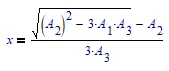
Incidentally, If all your polynomes are 3rd order and like the one given, the (positive) zero always occurs at

LucMeekes_1-1579434821667.png

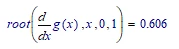
And instead of symbolically solving this, you could also use a numeric solver, which can happily work with the output of the interp function:

LucMeekes_2-1579434977532.png


Success!
Luc


7 replies

21-Topaz II
January 19, 2020

Hi

corn-m answer.jpg

23-Emerald IV
January 19, 2020

Try this

LucMeekes_0-1579434008712.png

then:

LucMeekes_1-1579434032454.png


Success!
Luc

19-Tanzanite
January 19, 2020

Mathcad has done the differentiation!

If you look at the error message it says the result is too big to display.  However, you can still use the result.


gradient.jpg


Alan

LucMeekes23-Emerald IVAnswer
23-Emerald IV
January 19, 2020

Incidentally, If all your polynomes are 3rd order and like the one given, the (positive) zero always occurs at

LucMeekes_1-1579434821667.png

And instead of symbolically solving this, you could also use a numeric solver, which can happily work with the output of the interp function:

LucMeekes_2-1579434977532.png


Success!
Luc


23-Emerald I
January 19, 2020

Rather than "regress" you might try "polyfit."  Polyfit returns a function so you don't have to extract the coefficients from a vector.

21-Topaz II
January 19, 2020

Hello !,

you simply have to reset the symbolic variables

corn-m answer 1.jpg

corne_m1-VisitorAuthor
1-Visitor
January 21, 2020

Thanks all for your replies.


My datasets are a result of a longwinding calculation, which I want to perform using tabulated input for multiple sets if input parameters. As I need to put all calculations into a program and repeat that program for all rows of the input tables, it is must useful if I can determine derivative=0 by simple formula. This is also easy because the output/result I want is the a value for all different inputs in a table to be able to calculate average a and so on.

As I am sure a is always between 0 and 1 (actually being 0 to 100%) I used the root function because it is the easiest solution for my problem.